Select Language:
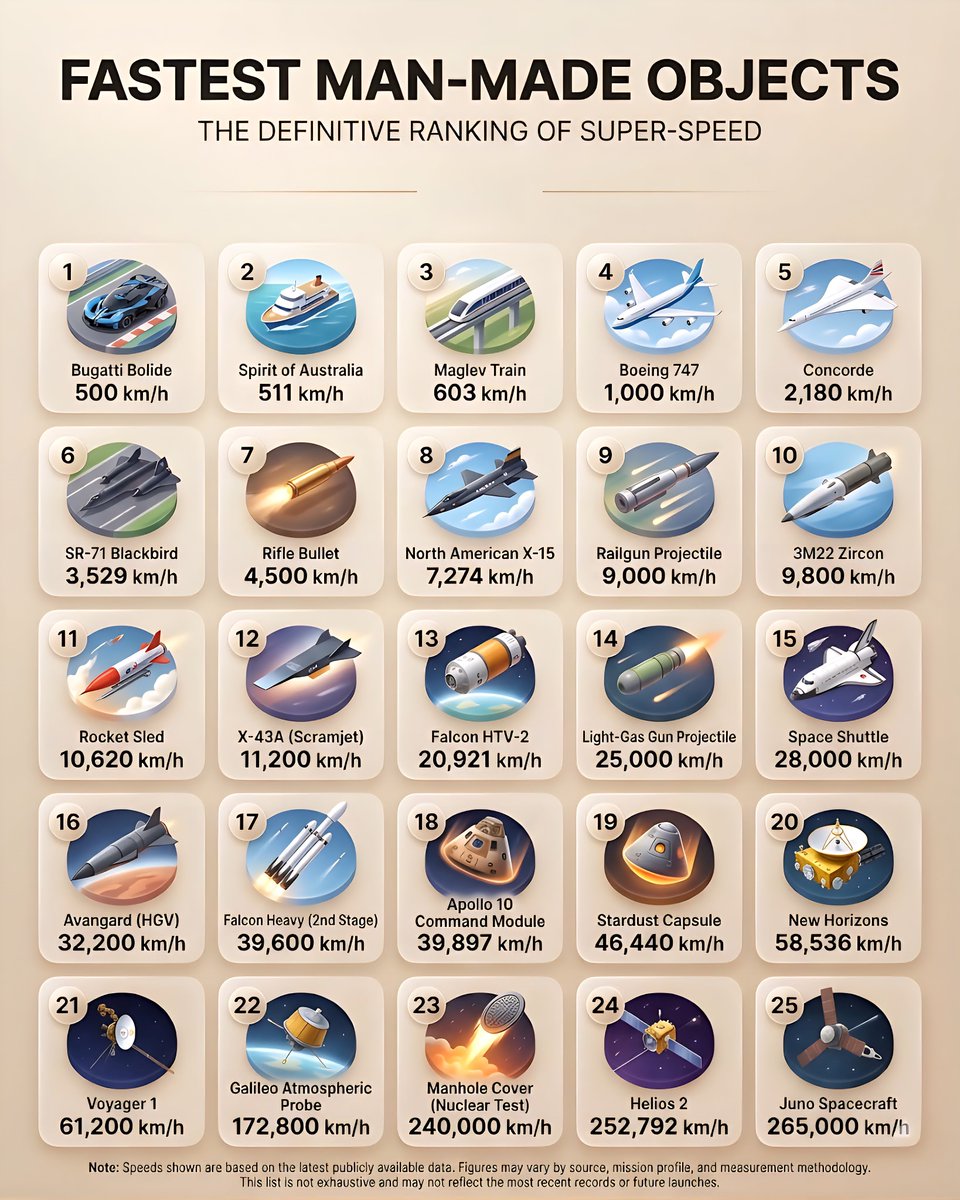
## Breaking Down the Fastest Man-Made Objects of 2025
### 1. Bugatti Bolide — 500 km/h
The Bugatti Bolide remains one of the fastest production cars, reaching speeds of up to 500 km/h. Designed for supreme performance and aerodynamics, this hypercar pushes the limits of automotive engineering and continues to set benchmarks on land.
### 2. Spirit of Australia — 511 km/h
This record-breaking speedboat, Spirit of Australia, continues to hold the record on water with a staggering top speed of just over 511 km/h. Its sleek, advanced design helps it slice through water with minimal resistance, showcasing human innovation in marine speed technology.
### 3. Maglev Train — 603 km/h
Magnetic levitation trains have revolutionized rail travel, with the modern-world Maglev train reaching speeds of approximately 603 km/h. Utilizing magnetic forces for propulsion, these trains promise rapid transit options connecting cities with unprecedented velocity.
### 4. Boeing 747 — 1,000 km/h
The iconic Boeing 747, a staple in commercial aviation for decades, can cruise at speeds close to 1,000 km/h. Although no longer the fastest airplane, its impressive speed remains a key component of global air travel.
### 5. Concorde — 2,180 km/h
The Concorde, the legendary supersonic passenger jet, maintained speeds of up to 2,180 km/h during its service. Its sleek fuselage and distinctive delta wings made transatlantic flights faster than any other commercial aircraft and a symbol of human engineering prowess.
### 6. SR-71 Blackbird — 3,529 km/h
The SR-71 Blackbird, a stealth reconnaissance aircraft, could reach speeds of approximately 3,529 km/h. Its unique design allowed it to perform high-altitude surveillance missions, remaining unmatched in speed during its operational years.
### 7. Rifle Bullet — 4,500 km/h
A typical high-velocity rifle bullet can hit speeds around 4,500 km/h. This impressive pace underscores advances in firearms technology and ballistics.
### 8. North American X-15 — 7,274 km/h
The X-15, a rocket-powered aircraft, set records with speeds nearing 7,274 km/h. Its flights contributed essential data for space exploration and supersonic travel development.
### 9. Railgun Projectile — 9,000 km/h
Railgun technology has evolved substantially, with projectiles capable of reaching speeds of about 9,000 km/h. This electromagnetic weapon system promises rapid defense capabilities.
### 10. 3M22 Zircon — 9,800 km/h
Russia’s Zircon missile is among the fastest ocean-launched missiles, averaging speeds around 9,800 km/h, making it a formidable threat on modern battlefields.
### 11. Rocket Sled — 10,620 km/h
Used mainly for testing human endurance and equipment, rocket sleds can attain speeds of over 10,620 km/h, simulating conditions for spacecraft launch and missile testing.
### 12. X-43A Scramjet — 11,200 km/h
NASA’s X-43A scramjet, capable of reaching speeds of 11,200 km/h, demonstrates the potential of hypersonic flight and could revolutionize future high-speed aircraft.
### 13. Falcon HTV-2 — 20,921 km/h
The Hypersonic Technology Vehicle-2 (HTV-2) by DARPA reached nearly 21,000 km/h during flight tests, pushing the boundaries of missile and aircraft speed mechanics.
### 14. Light-Gas Gun Projectile — 25,000 km/h
Laboratory experiments with light-gas guns have achieved projectile speeds around 25,000 km/h, pushing the frontiers of materials research and defense technology.
### 15. Space Shuttle — 28,000 km/h
During re-entry, the space shuttle travels at about 28,000 km/h. This speed is essential for flying back from orbit and returning safely to Earth.
### 16. Avangard Hypersonic Glide Vehicle — 32,200 km/h
Russia’s Avangard system is capable of traveling at speeds close to 32,200 km/h, making it one of the fastest strategic weapons developed.
### 17. Falcon Heavy (Second Stage) — 39,600 km/h
SpaceX’s Falcon Heavy’s second stage rockets can reach speeds nearly 39,600 km/h during orbital insertion, showcasing advancements in private spaceflight.
### 18. Apollo 10 Command Module — 39,897 km/h
The Apollo 10 spacecraft achieved speeds nearly 39,897 km/h during re-entry, exemplifying historic milestones in human space exploration.
### 19. Stardust Capsule — 46,440 km/h
NASA’s Stardust sample return capsule re-entered Earth’s atmosphere at around 46,440 km/h. It’s one of the fastest man-made objects to re-enter Earth.
### 20. New Horizons — 58,536 km/h
The New Horizons spacecraft, which explored Pluto, traveled at approximately 58,536 km/h, setting records for planetary exploration speed.
### 21. Voyager 1 — 61,200 km/h
Voyager 1, the farthest human-made object from Earth, continues traveling at an astonishing 61,200 km/h as it journeys beyond our solar system.
### 22. Galileo Atmospheric Probe — 172,800 km/h
The Galileo probe, descending into Jupiter’s atmosphere, reached speeds of around 172,800 km/h during its descent.
### 23. Helios 2 — 252,792 km/h
NASA’s Helios 2 spacecraft remains one of the fastest, traveling at over 252,792 km/h as it orbited the Sun in the 1970s.
### 24. Juno Spacecraft — 265,000 km/h
Juno, currently studying Jupiter, speeds through space at approximately 265,000 km/h, harnessing gravity assists to reach its destination.
### 25. Parker Solar Probe — 692,000 km/h
The Parker Solar Probe is the fastest man-made object, capable of reaching incredible speeds of about 692,000 km/h as it approaches the Sun to study solar phenomena.
—
The data showcased reflects the extraordinary progress in technology that continues to push human understanding of speed, propulsion, and space exploration. From high-velocity aircraft to interplanetary spacecraft, each achievement illustrates our relentless pursuit of breaking barriers and reaching new frontiers.
 ChatGPT
 Perplexity
 Gemini AI
 Grok AI