Select Language:
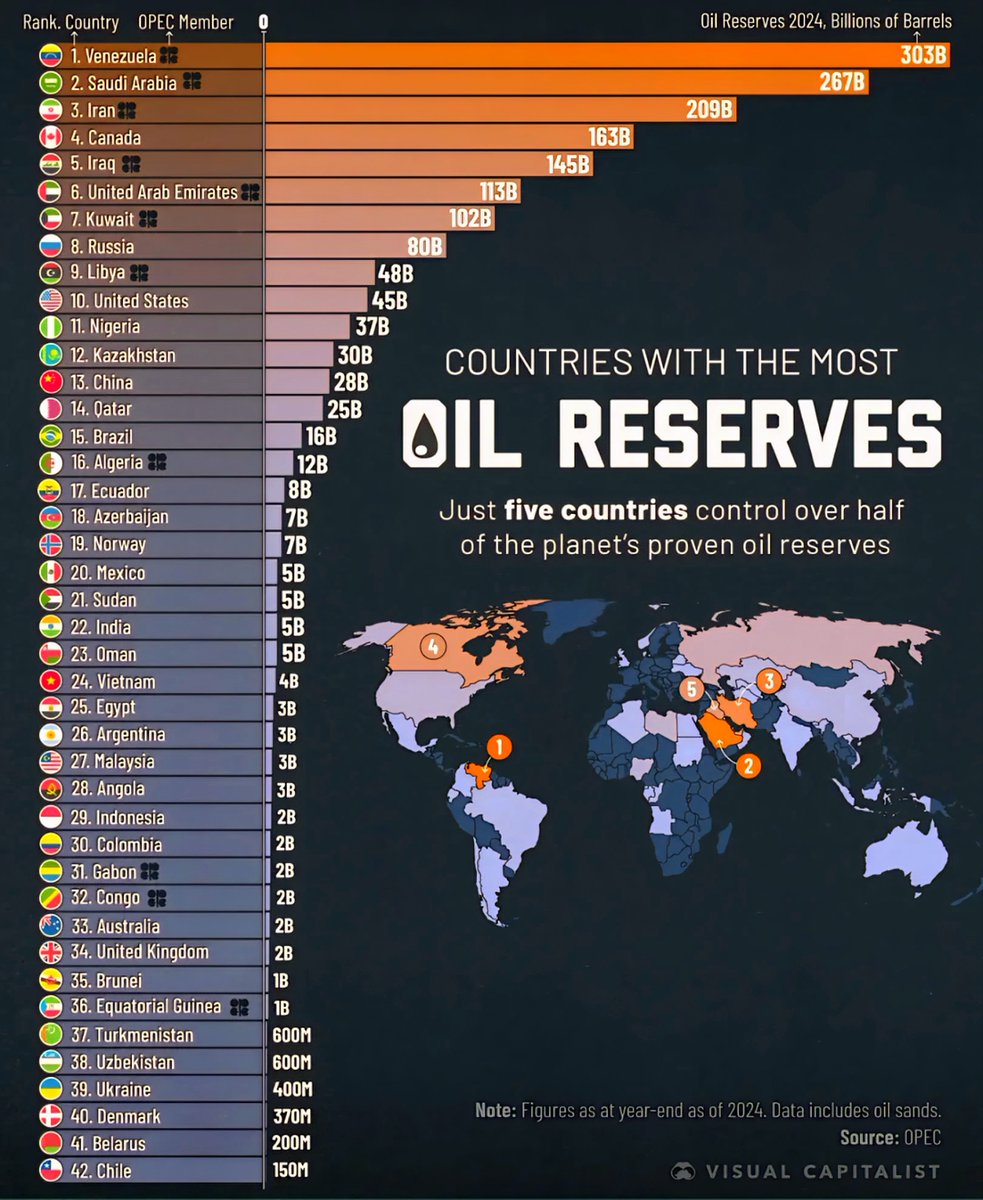
Top 10 Countries With the Largest Oil Reserves in 2025
Venezuela Leads the World with Over 300 Billion Barrels of Oil
Venezuela continues to hold the world’s most abundant oil reserves, boasting approximately 303 billion barrels as of the end of 2024. Despite economic and political challenges, its vast oil deposits remain a critical resource, positioning the country as a major player in global energy markets. These reserves include extensive oil sands, making Venezuela a key focus for international energy companies looking to tap into its underground wealth.
Saudi Arabia Maintains Its Position as the Global Oil Giant with 267 Billion Barrels
Saudi Arabia, renowned for its significant oil industry, has approximately 267 billion barrels in stored reserves. The kingdom’s support for OPEC policies and its strategic position in fluctuating oil markets help maintain its dominance. The nation continually invests in technology to prolong its access to these reserves, emphasizing its role as a reliable energy supplier on the world stage.
Iran Sits Third with Over 200 Billion Barrels
Iran’s substantial oil reserves — estimated at around 209 billion barrels — solidify its place among the top oil reserve holders. With ongoing geopolitical tensions and sanctions, Iran’s ability to exploit its reserves is occasionally hindered. Still, recent advancements in extraction technology suggest that Iran’s reserves will be crucial for future energy production.
Canada Ranks Fourth with 163 Billion Barrels
Canada’s formidable oil sands deposits make it a critical player in the global oil reserves landscape, with approximately 163 billion barrels. The country has invested heavily in sustainable extraction techniques, balancing environmental concerns with energy demands. Its vast reserves contribute significantly to North America’s energy independence.
Iraq Holds 145 Billion Barrels of Oil Reserves
Iraq’s strategic position and abundant reserves make it a vital part of the global oil supply chain. With about 145 billion barrels, Iraq has been expanding its infrastructure to increase extraction and export capabilities, aiming to bolster its economy and influence in global energy markets.
United Arab Emirates (UAE) Keeps its Reserves at 113 Billion Barrels
The UAE’s well-developed oil sector leverages its 113 billion barrels of reserves to maintain regional influence. Abu Dhabi’s investments in technology and diversification efforts further cement its commitment to remaining a major energy hub.
Kuwait’s 102 Billion Barrels Ensure Its Presence in Oil Dominance
Kuwait’s oil reserves rank among the largest worldwide at 102 billion barrels. The nation focuses on maximizing its reserves through technological advancements and effective resource management to sustain its economic stability and export capabilities.
Russia’s 80 Billion Barrels Continue to Power Its Economy
Despite geopolitical challenges, Russia holds approximately 80 billion barrels of oil reserves. Russia remains one of the top exporters globally, leveraging its vast reserves to navigate uncertain global markets and maintain energy security.
Libya’s 48 Billion Barrels Highlight Its Rich Reserves Amidst Turmoil
Libya’s 48 billion barrels reflect a nation rich in oil, despite political unrest that often hampers production. International investments are attempting to stabilize and expand its reserves, aiming to improve the country’s economic prospects.
United States Holds 45 Billion Barrels in Reserve
The U.S. remains a significant oil producer with 45 billion barrels. Domestic reserves and technological advancements fuel its energy independence, making it a major market influence globally.
Other Noteworthy Countries and Their Oil Reserves
- Nigeria (37 billion barrels) and Kazakhstan (30 billion) continue to grow as critical contributors in Africa and Central Asia, respectively.
- China, with 28 billion barrels, is investing heavily in energy diversification.
- Qatar’s reserve of 25 billion barrels underscores its regional influence.
- Brazil and Algeria, with 16 and 12 billion barrels respectively, show expanding reserves and strategic resource management.
- Smaller reserves are spread across nations like Ecuador, Azerbaijan, and Norway, each emphasizing production efficiency to maximize the value of their resources.
The Future of Oil Reserves in 2025
While traditional oil reserves continue to be a cornerstone of global energy markets, increasing focus on renewable energy initiatives and technological innovations may shift future reliance. Countries with significant reserves are investing in cleaner extraction techniques, while many are exploring alternative energy sources to reduce dependency on fossil fuels.
In Conclusion
As 2025 progresses, the global landscape of oil reserves remains dynamic. Venezuela, Saudi Arabia, and Iran lead the pack, but countries worldwide are adapting to new energy paradigms by strategically managing their reserves and investing in sustainable solutions. The future of oil relies not just on the size of reserves but also on technological innovation, geopolitical stability, and the global push toward cleaner energy.
 ChatGPT
 Perplexity
 Gemini AI
 Grok AI