Select Language:
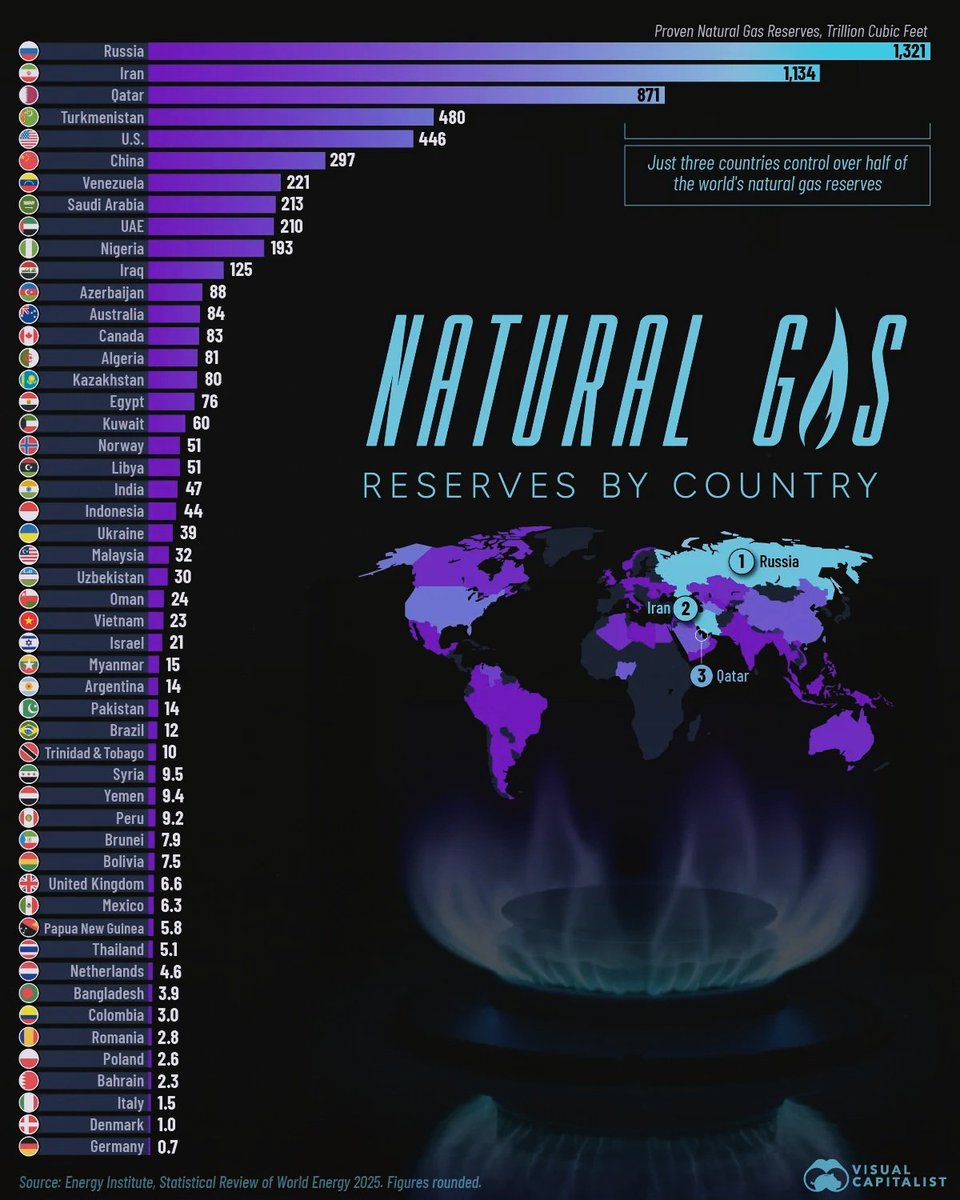
Countries with the Largest Natural Gas Reserves in 2025
Russia Dominates as the Top Natural Gas Supplier
Russia continues its reign as the world’s leading holder of natural gas reserves, boasting an estimated 1,321 trillion cubic feet (Tcf). This vast reserve positions Russia as a key energy hub with considerable influence over the global supply chain. The country’s extensive underground deposits, primarily in Siberia and the Arctic regions, sustain its role as a major natural gas exporter, especially to Europe and Asia.
Iran Secures Its Spot Among the Top Reserve Holders
Iran holds the second spot with approximately 1,134 Tcf. Its reserves are primarily concentrated in the South Pars field, which it shares with Qatar. Despite international sanctions, Iran’s natural gas reserves are immense, underpinning its strategic importance in the energy sector.
Qatar’s Massive Reserves Make It a Global Energy Power
Qatar comes in third with an estimated 871 Tcf. Its North Field, shared with Iran, is the world’s largest non-associated natural gas field. Qatar has leveraged these reserves effectively, transforming itself into a leading exporter of liquefied natural gas (LNG).
Turkmenistan Rises as a Critical Gas Producer
With roughly 480 Tcf, Turkmenistan ranks fourth. The country’s gas reserves are largely situated in the Galkynysh field, which has seen significant development efforts in recent years to boost exports toward Russia and China.
The United States Breaks Into the Top Six
The United States has around 446 Tcf of natural gas reserves, making it one of the most prominent producers globally. Thanks to technological advances in hydraulic fracturing and horizontal drilling, the U.S. significantly expanded its recoverable reserves, reducing dependence on imports and becoming a key LNG supplier.
China’s Growing Reserves and Strategic Ambitions
China holds approximately 297 Tcf, reflecting its expanding exploration efforts. Its recent investments in natural gas infrastructure aim to diversify its energy sources and reduce reliance on coal, positioning China as an emerging energy importer and consumer.
Venezuela’s Economic and Political Influence on Reserves
Venezuela has an estimated 221 Tcf. While its reserves rank it among South America’s top energy sources, political instability and economic challenges have hindered full exploitation and export capacity.
Saudi Arabia’s Strategic Reserves
Saudi Arabia contains about 213 Tcf of natural gas reserves. Traditionally known for its oil, the kingdom has increased efforts to develop its gas sector as part of its Vision 2030 to diversify energy sources.
United Arab Emirates and Nigeria: Key Middle East and African Reserves
The UAE holds roughly 210 Tcf, with recent developments in offshore fields. Nigeria’s reserves are estimated at 193 Tcf, making it Africa’s leading natural gas holder and a vital energy partner for Europe and Asia.
The Global Distribution of Reserves
Other notable countries include Iraq, Azerbaijan, Australia, and Canada, each with hundreds of billions of cubic feet of reserves. Iraq has about 125 Tcf, while Azerbaijan, Australia, and Canada hold 88, 84, and 83 Tcf respectively, reflecting significant untapped potential in the Middle East, Oceania, and North America.
Emerging Players and Developments
Countries like Egypt, Kuwait, Norway, and Libya also feature prominently, with reserves ranging from 51 to 76 Tcf. Many of these nations are investing heavily to develop and export their natural gas resources to meet rising global demand.
Small but Strategic Reserve Holders
Nations such as India, Indonesia, Ukraine, and Malaysia hold between 20 and 47 Tcf. Despite smaller reserves compared to giants like Russia and Iran, their strategic locations and infrastructural developments make them vital players in regional energy markets.
The Future of Natural Gas Reserves
As global energy demands continue to rise, nations with significant natural gas reserves will play a crucial role in world energy security. The shift toward cleaner energy sources also encourages investments in natural gas infrastructure, especially in countries like the U.S., Qatar, and Russia. Meanwhile, emerging economies in Africa and Asia are exploring their reserves to fuel economic growth and ensure energy independence.
Source: Energy Institute – Statistical Review of World Energy 2025 (Figures rounded) — Visualized by Capitalist.
Note: 1 Trillion Cubic Feet (Tcf) ≈ 22.65 billion kg (or 50 billion pounds) of natural gas.
 ChatGPT
 Perplexity
 Gemini AI
 Grok AI