Select Language:
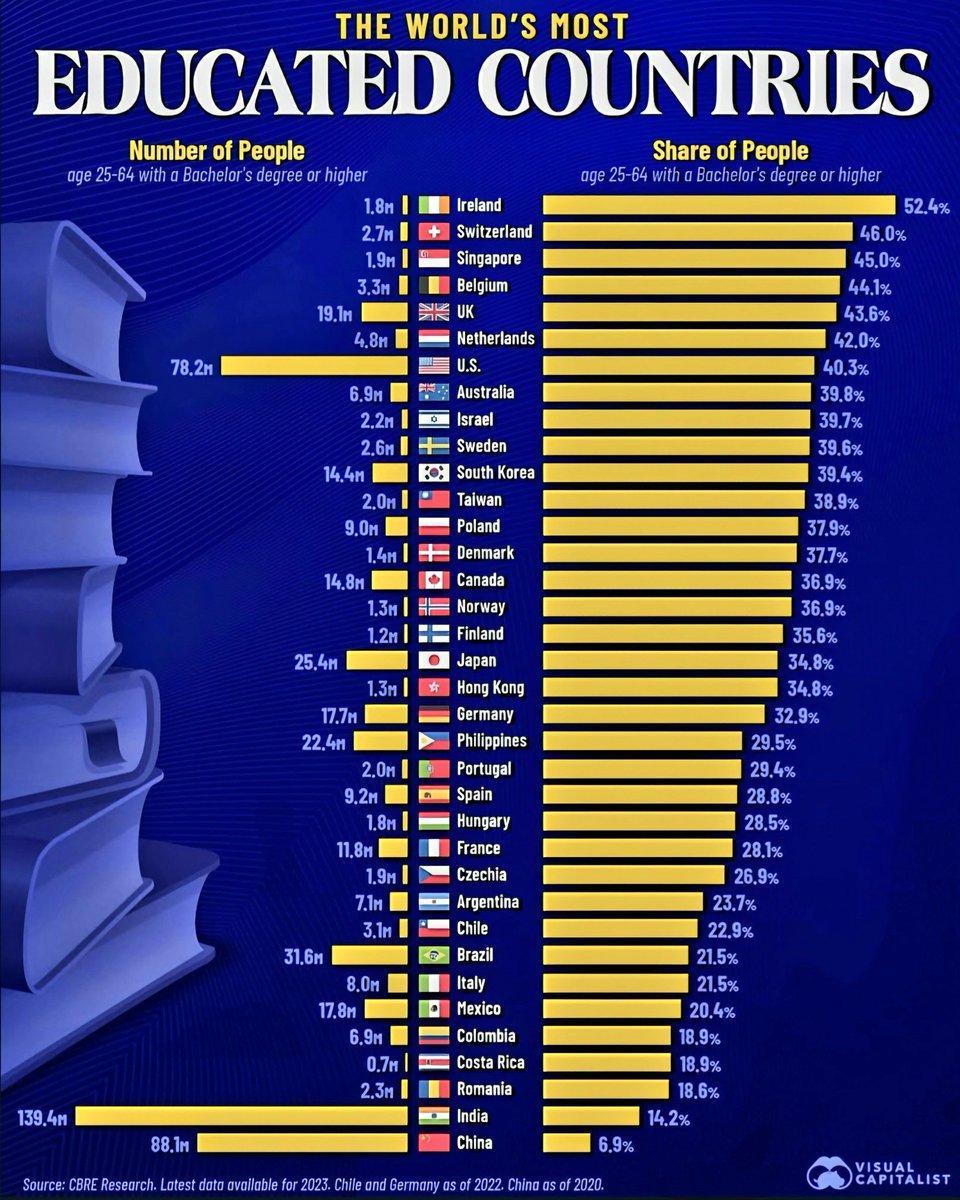
The 2025 Global Leaders in Education: Countries with the Highest College Graduation Rates
1. Ireland Dominates the List with Over Half Its Workforce Holding Degrees
Ireland continues to lead the world in higher education, boasting approximately 1.8 million adults aged 25-64 with a bachelor’s degree or higher—representing a remarkable 52.4%. This statistic underscores Ireland’s strong emphasis on tertiary education, which fosters a highly skilled workforce and boosts the nation’s global competitiveness.
2. Switzerland and Singapore Exhibit Exceptional Educational Attainment
Switzerland ranks second with 2.7 million residents (46%) holding college degrees, highlighting its world-renowned higher education system. Close behind, Singapore has around 1.9 million college-educated adults, making up 45% of its workforce. Both countries emphasize vocational training and continuous learning, contributing to their strong economies and innovation sectors.
3. European Countries Make Their Mark Among the Top Educated Populations
Belgium, with approximately 3.3 million degrees (44.1%), and the United Kingdom, with over 19 million (43.6%), illustrate Europe’s leadership in higher education. The Netherlands, Canada, and Sweden also rank impressively, with 42%, 36.9%, and nearly 40% of their adult populations holding advanced degrees, respectively. These nations prioritize accessible education, quality institutions, and lifelong learning initiatives.
4. The United States Keeps Its Position with a Large, Educated Workforce
The United States has about 78.2 million adults in the 25-64 age range with a bachelor’s degree or higher, accounting for 40.3%. While this remains lower percentage-wise than many smaller nations, the sheer size of the U.S. population makes it a global leader in total higher-educated individuals.
5. Australia and Israel Stand Out with High Education Rates
Australia boasts 6.9 million degree holders, representing nearly 40% of its adult working population, indicative of its strong tertiary institutions. Israel also has a significant 39.7%, driven by its innovative tech startups and research-heavy universities.
6. Asian Countries Show Rapid Educational Growth
South Korea has approximately 14.4 million college graduates, making up 39.4%, reflecting its focus on STEM and technology-focused education. Taiwan (38.9%) and Japan (34.8%) follow suit, emphasizing the region’s strategic investments in tech, science, and engineering fields.
7. Eastern and Central European Nations Continue Improving Education Access
Poland reaches nearly 38%, and Denmark is close behind at 37.7%, demonstrating the region’s growing emphasis on higher education. These countries are increasingly investing in university infrastructure and scholarship programs to enhance workforce skills.
8. Canada and Norway Demonstrate Strong Educational Foundations
With 36.9% of their adult populations holding college degrees, Canada and Norway underscore the value both nations place on higher learning, fostering innovation and social development.
9. Countries with Moderate Graduation Rates Show Potential for Growth
Spain, Portugal, and Hungary, with rates ranging from 28.5% to 29.4%, are making strides in expanding access to college education. These nations aim to climb higher on the global education ladder through reforms and increased funding.
10. Emerging Economies and Their Challenges
Countries like the Philippines (29.5%) and Mexico (20.4%) are witnessing steady increases in higher education participation, though they face infrastructure and funding challenges. Conversely, nations such as India and China, with large populations—139.4 million and 88.1 million respectively—have relatively low percentages (14.2% and 6.9%), reflecting ongoing efforts to expand higher ed access amidst demographic pressures.
In Summary:
As of 2025, countries like Ireland, Switzerland, and Singapore lead the way in educational attainment, setting examples for others striving to improve their higher education systems. While some nations still face hurdles in increasing university graduation rates, global efforts toward educational reform and investment signal positive momentum. Elevated levels of tertiary education not only bolster individual career prospects but also drive national economic growth, innovation, and societal advancement.
Source: CBRE Research, 2023 Data (latest available). Countries like Chile and Germany reported in 2022, China in 2020.
 ChatGPT
 Perplexity
 Gemini AI
 Grok AI