Select Language:
Top Countries with the Lowest Male Circumcision Rates in 2025
Armenia and Belize: Just 0.1% Prevalence
Despite cultural diversity, countries like Armenia and Belize have extremely low male circumcision rates, each hovering at just 0.1%. These nations typically do not have longstanding traditions or medical practices favoring circumcision, reflecting local cultural norms and religious practices that do not prioritize the procedure.
Bolivia and Costa Rica: Staying Close to the Bottom
With only 0.1% of males circumcised, Bolivia and Costa Rica continue to have minimal circumcision rates. These nations often emphasize natural biological diversity over medical intervention unless deemed necessary for health reasons, which remain rare for these populations.
Cuba and Czechia: Rare Occurrences
Both Cuba and Czechia report circumcision rates of 0.1%, indicating that circumcision remains uncommon, mostly limited to specific religious or medical cases rather than cultural norms.
Greenland and El Salvador: Minimal Figures
Greenland and El Salvador also register at 0.1%, highlighting a global trend where male circumcision isn’t ingrained culturally or medically in their societies.
Countries with Slightly Higher but Still Low Rates (0.2% – 1%)
Chile and Lithuania: Circumcision Rates of 0.2%
While still quite rare, Chile and Lithuania show marginally increased circumcision prevalence. These cases may relate to medical procedures or small religious communities practicing circumcision.
The Bahamas and Vietnam: 0.2%
The Bahamas and Vietnam also fall into this category, with circumcision often performed for health or ceremonial reasons rather than widespread cultural practice.
Belarus, Estonia, and Malta: Ranges from 0.3% to 0.3%
In Eastern Europe and the Mediterranean, circumcision remains negligible, with rates up to 0.3%. Medical necessity usually drives procedures in these regions rather than tradition.
The Middle Ground: Countries with 0.4% – 1% Rates
Latvia and Moldova: Marginally Higher
Latvia (0.4%) and Moldova (0.5%) show slightly increased rates mainly due to medical interventions, especially in urban areas or for specific medical indications.
Portugal, Uruguay, and Ireland: Slightly Br higher at 0.6%-0.9%
As we move toward Western Europe and South America, some medical practices and religious communities contribute to this slight rise.
Panama and Bhutan: 0.9% – 1%
In regions like Panama and Bhutan, circumcision is often performed for health reasons, with religious or cultural traditions playing minor roles.
Countries Approaching 2-5% Circumcision Prevalence
Italy, Argentina, and Norway: 2% – 3%
In Mediterranean Europe and parts of South America, circumcision has become more common, often influenced by cultural integration and medical recommendations.
Colombia, Nepal, and Mongolia: 4% – 4.4%
These nations show a moderate increase, reflecting changing health policies or local traditions evolving over time.
Greece: 4.7%
Greece has witnessed a small rise in circumcision rates driven partially by medical practices and diaspora communities.
Countries With 5% to 10% Rates: A Sign of Cultural and Medical Influence
Sweden and Denmark: 5%-6%
Nordic countries have tentative growth in circumcision rates, supported mainly by health reasons and immigrant communities.
Switzerland, the Netherlands, and Austria: 5.8%-6%
These nations report increased medical circumcisions, often for health and hygiene, with some religious communities practicing circumcision as part of their traditions.
Haiti and East Timor: 6%-7%
Both countries experience moderate circumcision prevalence primarily due to local health initiatives or customary practice.
Major World Regions with Elevated Circumcision Rates (10% – 30%)
Russia and Thailand: Approximately 11.8% – 12%
In Russia and Thailand, performing circumcisions is often linked to health campaigns or specific cultural groups.
Guyana and Zambia: Around 12.8% – 13.4%
In these regions, circumcision is sometimes promoted as part of health initiatives aimed at reducing disease transmission.
Rwanda and Bulgaria: 13% – 13.4%
Medical and cultural factors influence the relatively higher rates within certain communities.
India and the Dominican Republic: Close to 14%
Medical procedures, religious practices, and cultural traditions contribute to this level of prevalence.
Countries with 15% – 25% Circumcision Rates
Mexico and Suriname: 15%-16%
Widespread medical practices and cultural acceptance across diverse communities see these higher figures.
Mauritius and Montenegro: 16.6%-18.5%
Emerging trends among health-focused policies and religious norms.
United Kingdom and Malawi: 20.7% – 21.6%
In the UK, the process is often associated with religious customs, while in Malawi, health initiatives contribute to the prevalence.
Belgium and Cyprus: 22.6% – 22.7%
Religious communities and health considerations play roles here.
Countries with 25% or Higher Circumcision Prevalence
Namibia and Uganda: 25.5% – 26.7%
Epidemiological programs and cultural practices drive the trend in these African nations.
Hong Kong and Canada: 28% – 31.9%
Healthcare policies and multicultural influences account for the rising numbers.
New Zealand and North Macedonia: Around 33%
Medical, cultural, or religious reasons explain the moderate levels of circumcision.
High-Prevalence Countries (40% and Above)
Sudan and Bosnia & Herzegovina: 39.4%-41.6%
Religious and traditional practices dominate, especially in Muslim-majority Sudan.
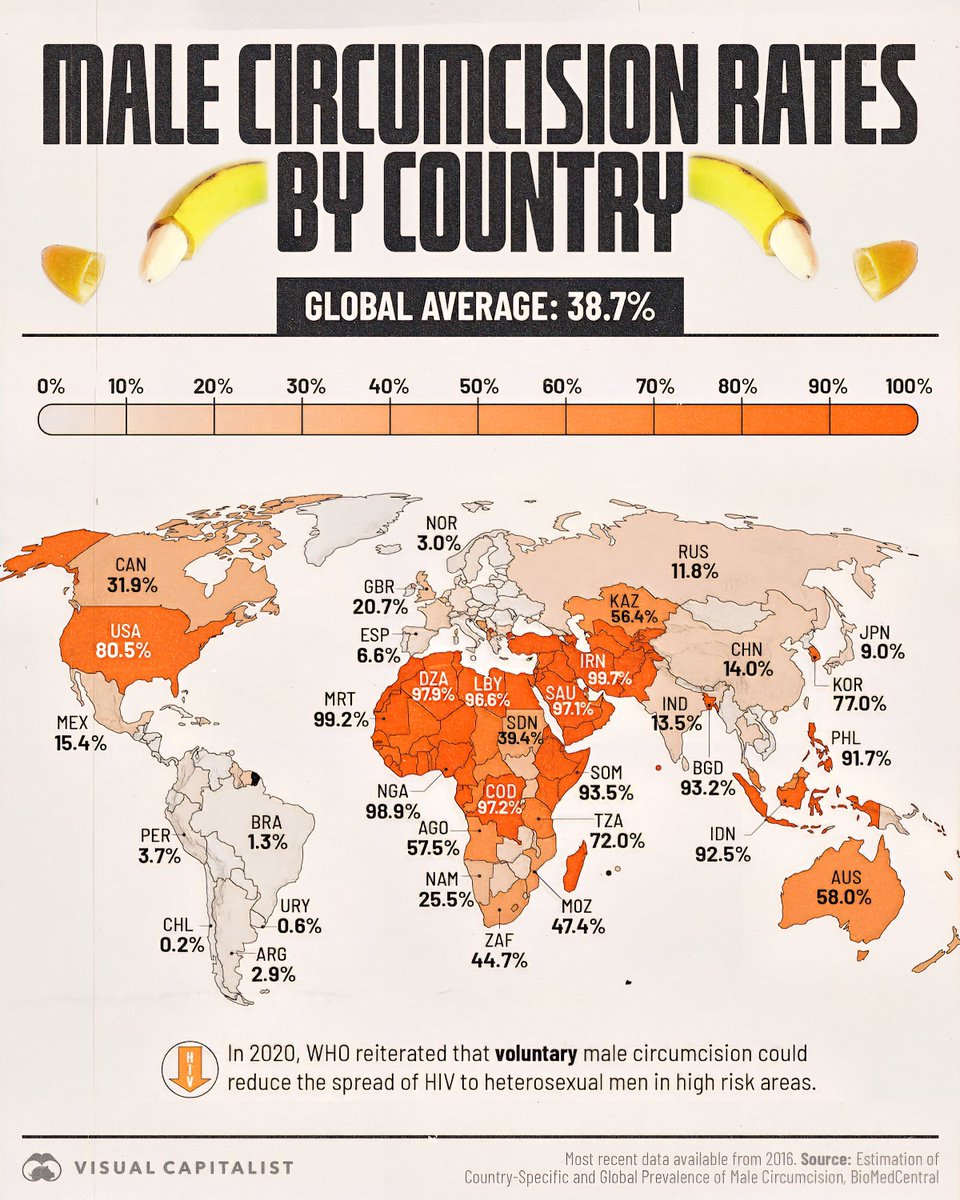
South Africa: 44.7%
Public health drives and cultural relevance sustain higher circumcision rates.
Albania and New Caledonia: Near 50%
Religious traditions and health policies support further adoption of circumcision.
Middle Eastern and African Countries: over 70%
Countries like Chad, the Republic of the Congo, and Saudi Arabia lead with extremely high circumcision rates — often exceeding 75% and approaching near-universal levels in some nations.
The Global Perspective in 2025
The world’s average male circumcision rate has risen to approximately 38.7%. Countries in the Middle East, Africa, and parts of Asia dominate the higher end of the spectrum, with cultural, religious, and health considerations shaping practices. Meanwhile, European and Latin American nations generally maintain low rates, reflecting different cultural norms and medical practices.
The trend indicates ongoing debates around health benefits, cultural identity, and tradition, with substantial regional variations. As global health policies continue evolving, circumcision rates are increasingly influenced by public health campaigns and medical research emphasizing disease prevention and hygiene.
 ChatGPT
 Perplexity
 Gemini AI
 Grok AI