Select Language:
The Countries Where Workers Put in the Longest Hours in 2025
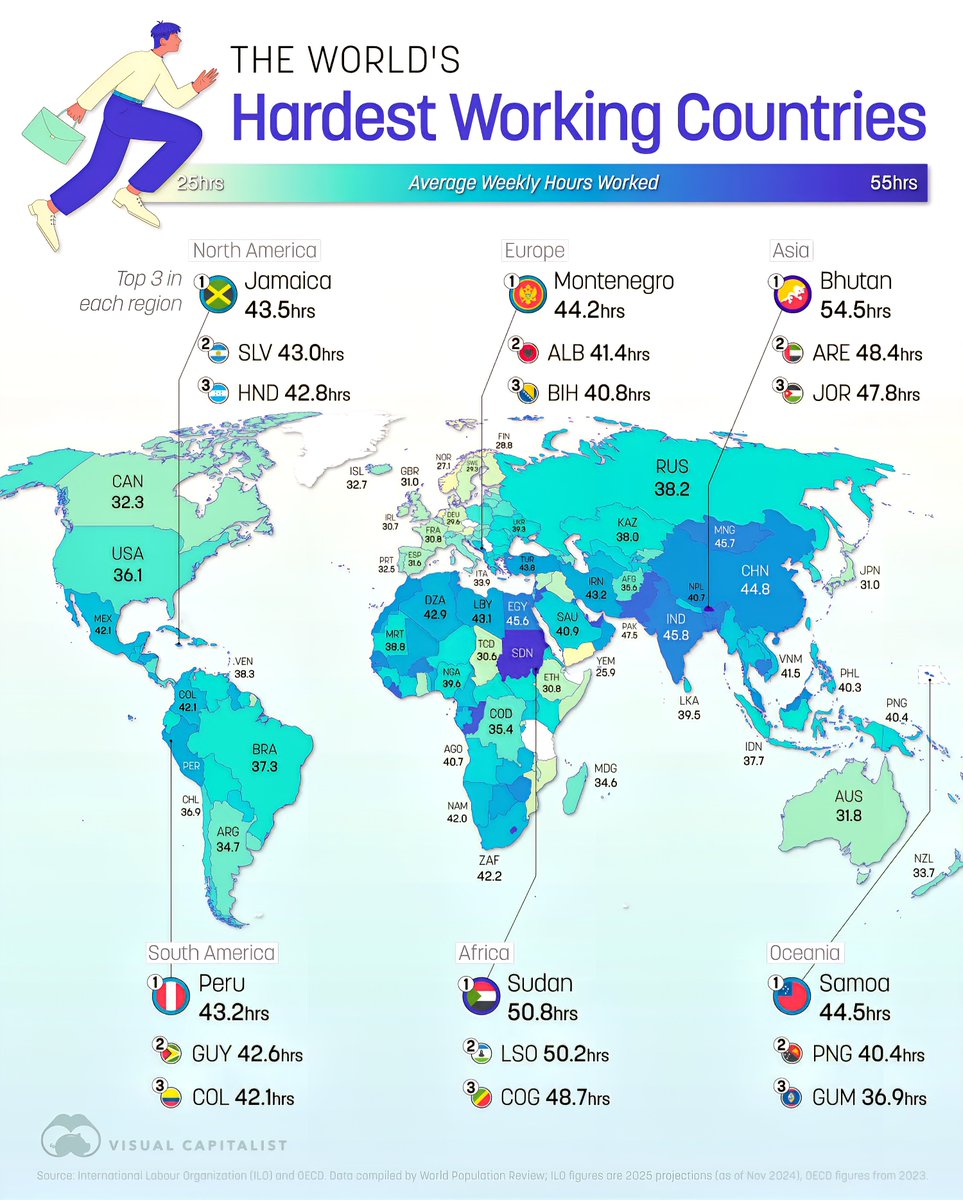
In 2025, a striking pattern emerges across the globe: certain nations are working significantly longer hours each week than others. From the small Himalayan kingdom of Bhutan to some bustling Middle Eastern economies, the number of hours worked weekly reveals much about economic conditions, cultural norms, and labor policies. Here’s a detailed look into the countries with the longest working hours, along with insights into what this means for workers and economies alike.
Bhutan Tops the List with Over 54 Hours a Week
At an average of 54.5 hours per week, Bhutan ranks as the hardest-working country globally. This is notably high considering global averages tend to hover around 36-40 hours. The extended workweek reflects the country’s early-stage economic development, where productivity levels are still catching up, and labor-intensive jobs remain predominant.
Implication: Such long hours can lead to increased fatigue and impact workers’ health, yet they also highlight the nation’s dedication to economic growth amid developing conditions.
Middle Eastern and African Nations Lead in Long Workweeks
Countries such as Sudan, Lesotho, and the Republic of Congo report weekly working hours ranging between 48 to 50 hours. For instance:
- Sudan: 50.8 hours
- Lesotho: 50.2 hours
- Republic of the Congo: 48.7 hours
These figures often mirror efforts to sustain economies with less automation, high unemployment, or the necessity to make ends meet in low-income settings. The UAE comes in at 48.4 hours due to a culture of extended workdays in many sectors.
Implication: While this indicates strong work commitment, it raises concerns about work-life balance and employee wellbeing in these regions.
Asian Countries with Intense Work Schedules
Several Asian countries also display lengthy work routines:
- Pakistan and Lebanon: 47.5 and 46.4 hours respectively
- Cambodia and Maldives: 45.9 hours each
- India and Mongolia: 45.8 and 45.7 hours
The high work hours are often influenced by economic necessity, competitive job markets, and cultural work norms that emphasize diligence.
Implication: Long hours might boost economic outputs temporarily but could diminish overall quality of life and productivity in the long term.
Countries with Moderate Work Hours
Moving towards countries with average or slightly above-average hours, nations like China, Singapore, and South Korea sit around 44 to 36 hours per week, reflecting a balance between work and personal life. For example:
- China: 44.8 hours
- Singapore and Kuwait: 44.6 hours
- South Korea: 36.8 hours
In these countries, labor laws and corporate culture increasingly promote reasonable working hours, aligning with health research suggesting optimal productivity and wellbeing at around 35-40 hours.
Implication: These countries are gradually shifting towards better work-life harmony, recognizing that long-term sustainability depends on worker health.
Countries with Shorter Working Weeks (Below 35 Hours)
Northern and Western European nations lead the way in minimizing weekly hours, often hovering near or below 30 hours:
- Iceland: 32.7 hours
- Portugal: 32.5 hours
- Netherlands and Canada: 32.3 and 32.4 hours
This is largely due to progressive labor policies, strong social safety nets, and a cultural emphasis on leisure and family time.
Implication: These nations exemplify a focus on quality of life, and their systems may serve as models for balancing productivity with wellbeing.
The Global Outlook on Long Hours
While longer working hours can sometimes foster economic growth, especially in lower-income nations, the potential downsides — burnout, health issues, and diminished life satisfaction — are increasingly recognized. Countries like Bhutan epitomize these high-work standards, but experts argue that sustainable economies should prioritize healthy working hours, improved labor conditions, and work-life balance.
As global labor trends evolve in 2025, many nations are reevaluating policies to strike this delicate balance, aiming for increased productivity without sacrificing workers’ health.
Summary of Key Takeaways
- The highest average weekly hours are found in Bhutan (54.5 hours) and African and Middle Eastern nations.
- Many Asian countries still report long workweeks, driven by economic factors.
- Europe and North America tend to have shorter, more balanced work hours, emphasizing quality of life.
- Progressive labor laws and cultural shifts in some nations are pushing for reduced working hours and better worker protections.
The picture of global labor in 2025 reveals a complex landscape—one where economic necessity often meets cultural norms, and where the debate over the ideal balance between work and life continues to evolve.
Note: Data sourced from the International Labour Organization (ILO) and 0ECD, compiled by World Population Review, with projections as of 2025.
 ChatGPT
 Perplexity
 Gemini AI
 Grok AI