Select Language:
1. Indonesia Dominates with the Highest Prayer Population
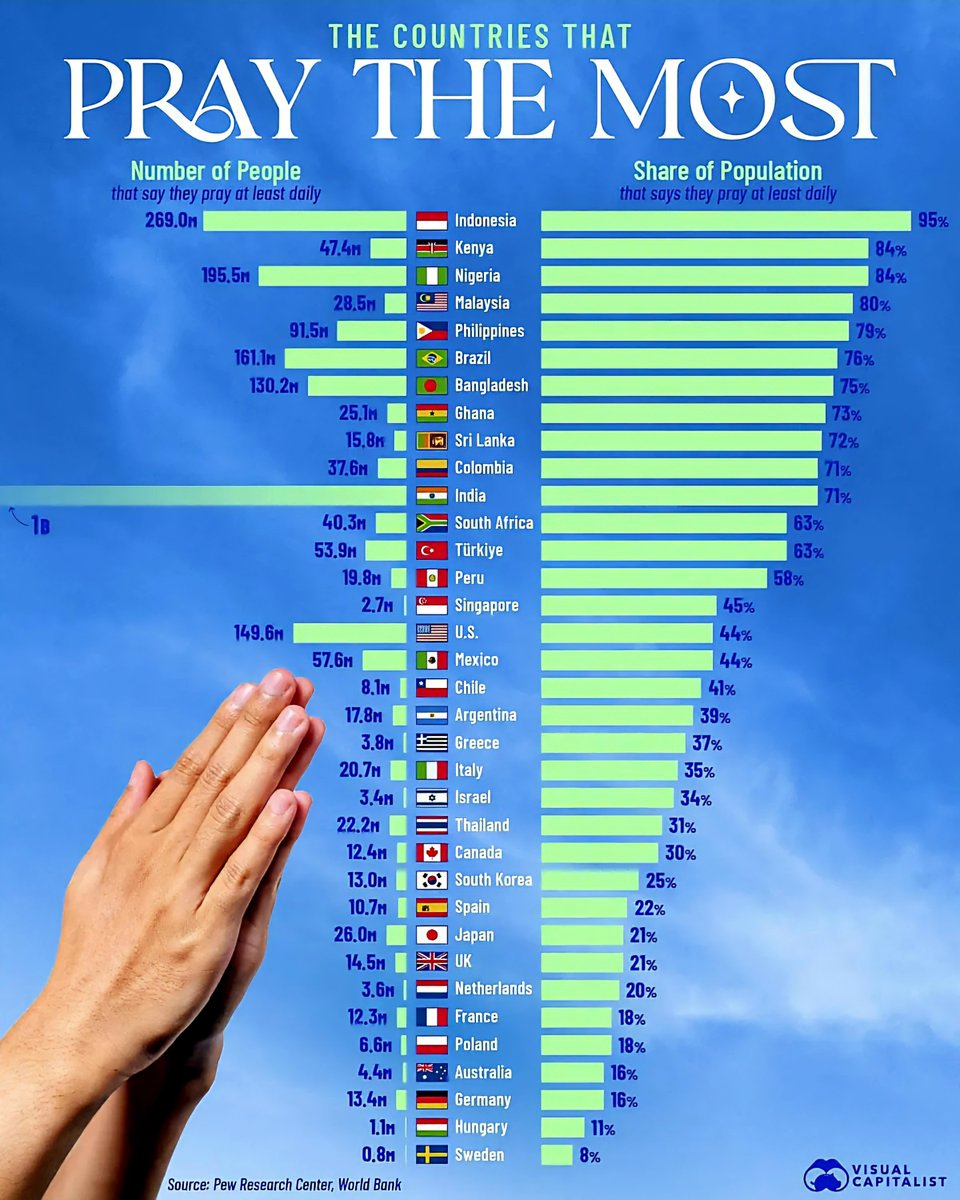
Indonesia leads globally with approximately 269 million people regularly engaging in prayer, making up about 95% of its population. As the world’s most populous Muslim-majority nation, prayer plays a central role in daily life and cultural identity for Indonesians. The widespread practice of prayer reflects deep-rooted religious traditions intertwined with the nation’s history and societal values. Despite modern influences, Indonesians maintain strong prayer routines, often praying multiple times a day, whether in mosques, at home, or in public spaces. The commitment to prayer is part of their fabric, affecting social gatherings, celebrations, and even political interactions.
2. Kenya and Nigeria: The African Prayer Giants
Kenya ranks second globally with 84% of its population praying regularly, totaling about 47.4 million people. Similarly, Nigeria, Africa’s most populous country, also reports a prayer population of around 195.5 million, representing 84% of its citizens. In Kenya, Christianity is the predominant faith, and prayer is integral to community and personal life. Nigeria, with its mix of Christianity and Islam, witnesses intense prayer practices across religious lines. These nations reveal a profound spiritual commitment, shaping social dynamics and national identity amid economic and political challenges.
3. Southeast Asia’s Religious Devotion: Malaysia and the Philippines
Malaysia’s 80% prayer participation involves 28.5 million individuals, reflecting its multi-religious landscape dominated by Islam, Buddhism, and Christianity. Prayer serves to foster community bonds and individual spirituality amidst diverse cultural influences. The Philippines shows a 79% engagement rate with 91.5 million praying citizens, primarily Catholics. In the Philippines, religious festivals and daily prayer routines are culturally significant, guiding moral values and social life. The deep-rooted faith acts as a source of resilience in the archipelago’s everyday life and national identity.
4. Brazil and Bangladesh: Large Populations, Strong Prayer Traditions
Brazil boasts around 161.1 million people praying regularly, representing 76% of its population. The country’s Catholic heritage reinforces daily prayer routines that influence societal norms, public celebrations, and family traditions. Bangladesh’s 130.2 million prayerful citizens account for 75% of its population. Primarily Muslim, many Bangladeshi believers incorporate prayer into their routines to navigate societal pressures and personal spirituality. Both nations display how faith sustains communal ties and individual resilience amid socio-economic struggles.
5. Smaller Countries with Notably High Prayer Engagements
Ghana (73%), Sri Lanka (72%), and Colombia (71%) showcase significant prayer adherence relative to their populations. Despite smaller total populations, these nations demonstrate the universal importance of prayer across different continents and cultures. Ghana’s prayer culture influences social cohesion and rural traditions. Sri Lanka’s Buddhist practices are reflected in daily rituals, while Colombia’s Christian faith sustains community ties and societal hope amidst challenges.
6. The Chinese and American Prayer Dynamics
While China’s official figures show approximately 15.8 million engaging in prayer (72%), actual practice might be higher due to cultural and political factors. The country’s complex religious landscape includes Buddhism, Taoism, Christianity, and folk traditions. In the United States, about 149.6 million people pray regularly, roughly 44% of the population. Prayer remains a cornerstone of American religious life, influencing public holidays, family routines, and personal well-being. The diversity of religious practices in the U.S. emphasizes individual spirituality within a broader multicultural context.
7. Trends in Global Prayer Practices
Overall, prayer remains a vital aspect of life for over 3.5 billion people worldwide, with the highest engagement in predominantly Muslim, Christian, or traditional faith communities. Countries like India, with approximately 1 billion prayerful individuals (71%), showcase the universal nature of spiritual practices regardless of economic development or cultural complexity. Countries such as South Africa and Turkey demonstrate moderate engagement, emphasizing the significant role of faith in shaping societal perspectives and daily routines.
8. Religious Engagement and Its Impact on Society
The high rates of prayer in these nations influence everything from social cohesion and political stability to individual mental health and resilience against adversity. Many countries report that prayer offers comfort during crises—whether political unrest, economic hardship, or natural disasters. The practice also fosters community bonding and reinforces cultural identity, serving as a bedrock of societal stability.
9. The Future of Prayer Worldwide
As global connectivity increases, the ways in which people engage with prayer evolve, blending traditional practices with modern technology. Online prayer groups, live-streamed religious services, and spiritual apps are expanding access to faith-based activities. Nonetheless, the core elements—hope, community, and personal reflection—remain consistent across borders.
10. Conclusion: The Power of Prayer Across Borders
From Indonesia’s vibrant prayer scenes to the United States’ diverse spiritual landscape, the enduring practice of prayer exemplifies humanity’s universal search for meaning, comfort, and connection. As we advance into 2025, the spiritual lives of billions continue to shape how societies grow, face challenges, and find hope for the future.
Source: Pew Research Center, World Bank, Visual Capitalist
 ChatGPT
 Perplexity
 Gemini AI
 Grok AI