Select Language:
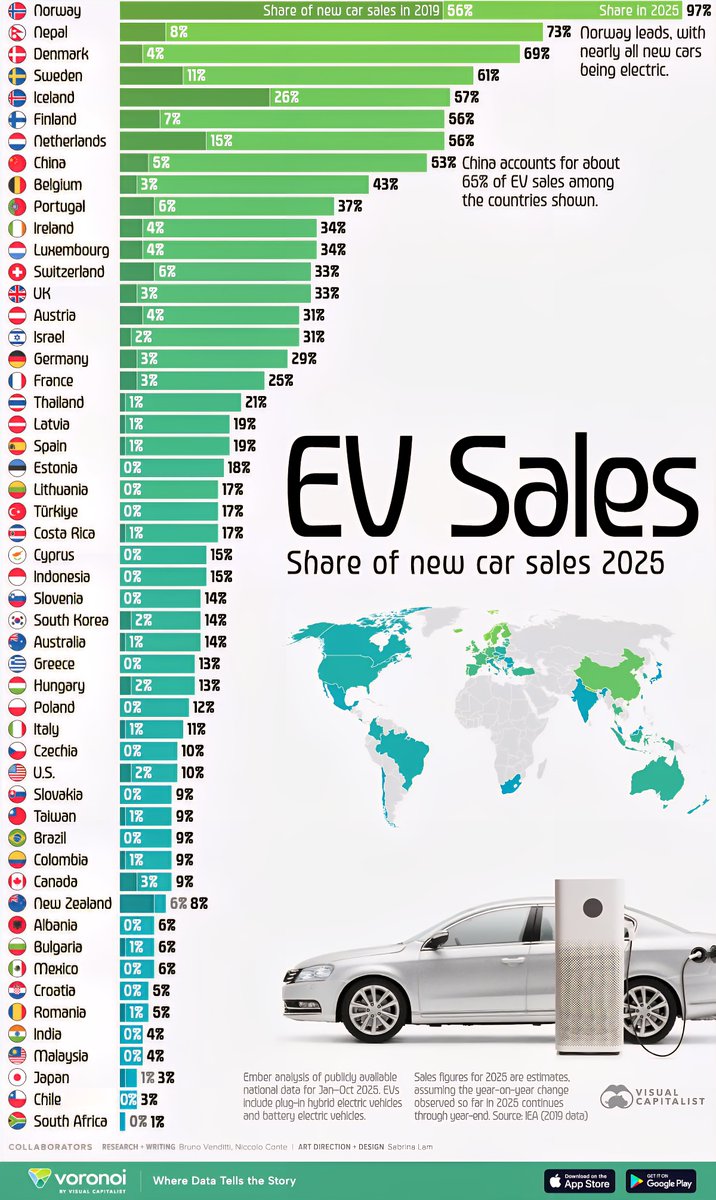
Top Countries Leading the Electric Vehicle Revolution in 2025
-
Norway Reigns With Electric Dominance
Norway continues to lead the world in electric vehicle adoption, with a remarkable 97% of new car sales being electric in 2025. The Scandinavian country’s aggressive policies, extensive charging infrastructure, and consumer incentives have cemented its status as the global EV leader. -
Nepal and Denmark Close Behind
Nepal has embraced electric mobility with 73% of new car sales being electric, further highlighting the country’s focus on sustainable transportation. Denmark follows at 69%, driven by strong government support, tax benefits, and eco-conscious consumer choices. -
Sweden, Iceland, and Finland Continue to Push Forward
Sweden’s EV sales account for 61%, with Iceland at 57%, and Finland at 56%. These Nordic nations are setting examples with their comprehensive renewable energy strategies and pioneering EV infrastructure investments. -
Netherlands = Leader in EV Adoption in Europe
With 56% of new vehicles being electric, the Netherlands is a European front-runner, propelled by progressive policies, urban planning that favors green transport, and widespread charging stations. -
China’s Growing EV Market
China has seen the electric share rise to 53%, reinforcing its position as the world’s largest EV market. Competitive pricing, government subsidies, and domestic manufacturing giants like BYD and Nio fuel this growth. -
European Countries Making Significant Strides
Belgium (43%), Portugal (37%), Ireland and Luxembourg both at 34%, and Switzerland at 33% showcase Europe’s rapid transition to electric vehicles, supported by strong policy frameworks and consumer interest. -
United Kingdom & Austria in the Mix
The UK’s EV market stands at 33%, with Austria slightly lower at 31%. Both countries continue to promote electric adoption through incentives and expanded charging networks. -
Germany’s Steady Climb
Germany’s EV share reached 29%, with its automotive industry heavily investing in electrification and new models, signaling a shift towards sustainable mobility. -
France Among European Leaders
France has a 25% share, driven by government rebates, stricter emissions standards, and increased consumer awareness about environmental impacts. -
Emerging Markets Show Promise
Thailand (21%) and Latvia, Spain, and Estonia (around 18-19%) are making notable progress in adopting EVs, indicating a broader global shift fostered by improved affordability and infrastructure. -
Turkey, Costa Rica, and Cyprus Gaining Ground
At 17-15%, these countries are beginning to catch up, with policies supportive of EV adoption and investments in charging infrastructure. -
Australia and South Korea Making Waves
Australia at 14% and South Korea at 14% are experiencing growth fueled by government incentives and technological advancements from local automakers like Hyundai and Kia. -
Smaller Markets and Developing Nations
Greece, Hungary, and Poland are at 13-12%, showcasing regional variations but a common global trend toward electrification. Italy (11%) and the Czech Republic (10%) are also progressing steadily. -
United States Continues Its Transition
The U.S. has reached a 10% share of new car sales being electric, reflecting a growing market driven by state incentives, technological innovation, and consumer interest. -
Other Regions Showing Signs of Growth
Countries like Slovakia, Taiwan, and Brazil (around 9% each) are starting their EV journeys, supported by global automaker investments and shifting policies. -
Emerging Economies Take Smaller Steps
Mexico, New Zealand, and Albania are still in early stages, with their EV share ranging from 6-8%. South Africa trails at just 1%, indicating room for growth in the developing world.
The Global Shift Toward Electric Vehicles Is Unmistakable in 2025
As nations worldwide adopt stricter emissions standards, invest in charging infrastructure, and offer incentives, the adoption of EVs is set to accelerate further. Countries leading the charge are not just changing their transportation landscape but are pioneering a sustainable future for transportation globally.
Source: Voronoi by Visual Capitalist
 ChatGPT
 Perplexity
 Gemini AI
 Grok AI