Select Language:
Top Countries with the Highest Rates of Babies Born Outside Marriage in 2025
Colombia Leads the World at an Unprecedented Rate
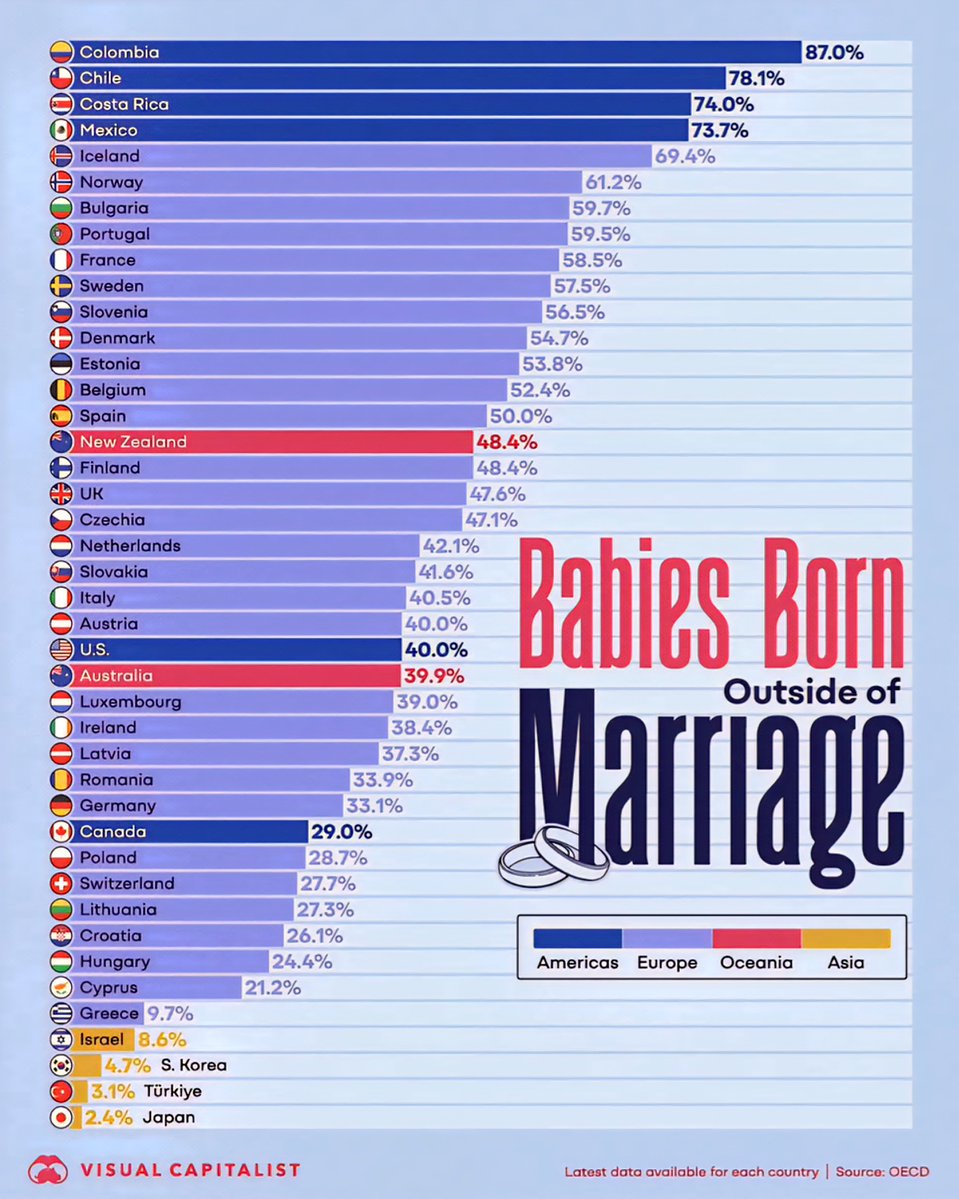
In 2025, Colombia continues to dominate global statistics with a remarkable 87.0% of babies born outside of marriage. The trend indicates shifting cultural norms where having children without formal marriage is increasingly accepted and normalized across Latin America. This figure highlights a significant social transformation, reflecting changing perspectives on family structures and the role of marriage.
Latin America’s Changing Family Dynamics
Chile and Costa Rica follow Colombia closely, with 78.1% and 74.0%, respectively. These numbers demonstrate a regional pattern where traditional marriage is no longer a prerequisite for parenthood. Mexico isn’t far behind, with 73.7% of children born to unmarried parents, indicating a broad regional shift in attitudes toward marriage and family.
Northern European Countries Set the Bar
Iceland, Norway, and Bulgaria report high rates of children born outside marriage, with 69.4%, 61.2%, and 59.7%, respectively. Scandinavian nations like Iceland and Norway have long championed progressive social policies, and their data from 2025 reinforce their status as leaders in family diversity and acceptance of non-traditional family arrangements.
Western Europe Shows a Steady Climb
Countries such as Portugal (59.5%), France (58.5%), and Sweden (57.5%) all have over half of their births occurring outside of marriage. This trend suggests a cultural shift towards individual choice and away from the traditional institution of marriage as a prerequisite for parenthood. Belgium, Spain, and Finland continue this narrative with more than 50% of births outside marriage.
Eastern and Central Europe’s Diverging Patterns
While nations like Slovenia (56.5%) and Denmark (54.7%) show high rates, others like Croatia (26.1%) and Hungary (24.4%) have much lower figures, indicating regional differences within Europe. These disparities are influenced by cultural, religious, and legal factors that shape societal attitudes toward marriage and childbirth.
North America and Oceania Maintain Moderate Levels
The United States and Canada each report around 40%, aligning with trends observed in other Western nations. Australia (39.9%) and New Zealand (48.4%) also reflect a society more accepting of non-marital births, although these numbers are lower compared to their European counterparts. Family planning, societal attitudes, and legal frameworks influence these figures.
East Asia and Middle Eastern Countries with Minimal Non-Marital Births
South Korea (4.7%) and Japan (2.4%) showcase significantly lower rates of children born outside marriage, rooted in societal values emphasizing traditional family structures and marriage. Turkey (3.1%) also maintains a conservative stance on non-marital parenthood, reflecting deeply ingrained cultural and religious norms.
Countries with Notable Cultural Reversals
Israel (8.6%) and Greece (9.7%) show relatively low but rising rates compared to past decades. These figures highlight ongoing societal changes, as younger generations become more open to non-traditional family arrangements, albeit still within culturally conservative frameworks.
Summary of Global Trends
The data reflects a long-term decline in the association between marriage and childbirth, particularly in Western and Latin American countries. Latin America, in particular, emerges as a leader in this trend, with some nations reporting nearly 90% of children born outside of marriage. Conversely, traditional societies in East Asia and the Middle East remain more conservative, with rates still under 5%.
Conclusion
The landscape of family and parenthood continues to evolve globally. With cultural norms shifting and legal frameworks adapting, the traditional view of marriage as the foundation of family is increasingly being complemented—or replaced—by diverse family arrangements that prioritize personal choice and social acceptance.
Note: All data is sourced from the OECD via Voronoi by Visual Capitalist, reflecting the latest available statistics for 2025.
 ChatGPT
 Perplexity
 Gemini AI
 Grok AI