Select Language:
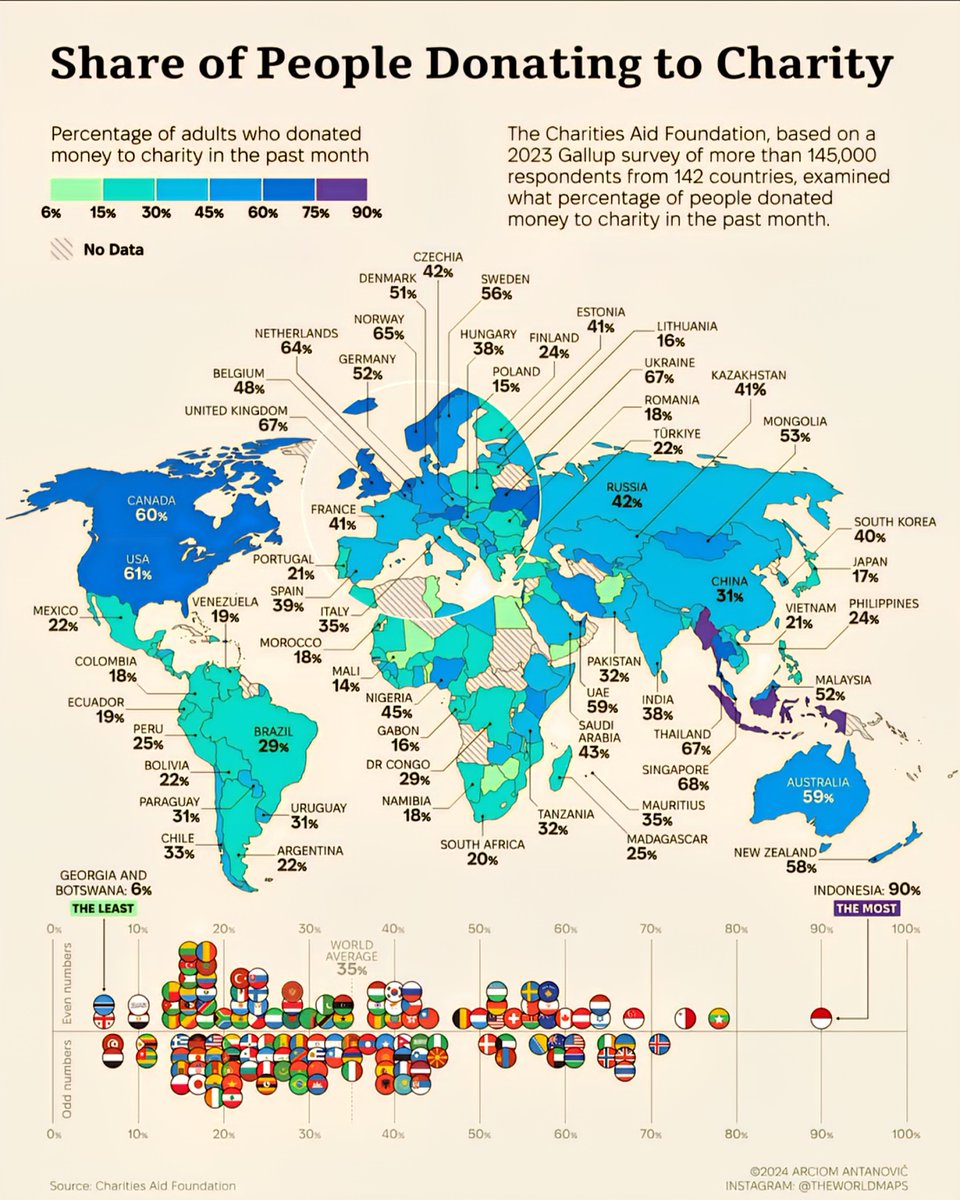
Top Countries with the Highest Charitable Donation Rates in 2025
-
Indonesia Leads with Remarkable Donations
Indonesia has maintained its status as the most generous country, with an astonishing 90% of its population contributing to charity in the past month. This cultural emphasis on community support and religious teachings seems to drive high participation levels. Local NGOs and international charitable organizations often praise Indonesia for its collective spirit and willingness to assist those in need.
ADVERTISEMENT -
Myanmar and Malta Close Behind
Myanmar ranks second, with 78% of its citizens donating regularly. Likewise, Malta boasts a notable 74%. These nations highlight the importance of community and religious values that foster a culture of giving, which persists despite economic challenges.
-
Iceland and Singapore Show Regional Diversity
In Europe, Iceland exhibits a 71% donation rate, emphasizing a strong social safety net and communal responsibility. Southeast Asia’s Singapore follows closely at 68%, underlining its status as a wealthy, socially conscious nation that encourages philanthropic efforts among its residents.
-
Eastern European Engagement
Ukraine, Thailand, and the United Kingdom each see about 67% of their populations giving to charity, reflecting diverse motivations—from humanitarian concerns to cultural traditions—that inspire widespread participation in philanthropy.
-
Ireland and Norway Illustrate European Generosity
With 65% of their populations donating, Ireland and Norway continue to uphold their reputation for high civic engagement, often driven by strong social welfare systems and community-focused values.
-
Israel and the Netherlands Culturally Invested in Philanthropy
Both nations record donation rates of 64%, highlighting the integration of charitable giving into daily life, often supported by religious and cultural institutions.
-
Austrian and Gambian Contributions
Austria contributes at a 62% rate, while Gambia clocks in at 61%, showcasing that generosity isn’t limited by regional income levels but also cultural practices and social norms.
-
United States and Canada Maintain High Participation
In North America, 61% of Americans and 60% of Canadians report donating monthly to charities, demonstrating the region’s ingrained philanthropic culture rooted in community service and civic responsibility.
-
Australia and the UAE: Wealth and Giving
Australia (59%) and the United Arab Emirates (also 59%) exemplify how affluence correlates with charitable behavior, supported by strong incentives and social expectations around philanthropy.
-
Developing Nations Show Growing Engagement
Countries like New Zealand (58%), Iran (58%), and Kosovo (58%) demonstrate increasing charitable trends, which may be fueled by rising awareness, community initiatives, or religious obligations.
Global Overview and Insights
The global survey by the Charities Aid Foundation, based on responses from over 145,000 individuals across 142 countries, illustrates that charitable giving is profoundly embedded in cultural, religious, and economic contexts worldwide. Countries with high donation rates often share common traits—strong community bonds, religious teachings emphasizing charity, and social systems that promote collective well-being.
In contrast, nations with lower donation rates, like Zimbabwe at 11% or Egypt at 10%, might face economic hardships, limited access to charitable organizations, or different cultural priorities that influence giving behaviors.
The data highlights significant regional variations as well as the impact of national values and societal norms. For instance, many Scandinavian countries trade high levels of trust and social cohesion for their charitable contributions, while in some developing regions, philanthropy may be more targeted or less formalized.
The Role of Societal Norms and Cultural Values
Cultural influences strongly dictate how and when individuals choose to donate. Religious teachings often emphasize altruism, which explains the high rates seen in countries like Indonesia, Myanmar, and the Middle East. Meanwhile, Western nations such as the UK, Ireland, and Norway reflect a blend of secular and religious motivators supporting widespread giving.
In rapidly developing economies, increasing awareness and globalization foster higher donation rates, making philanthropy an integral part of societal development.
The Power of Community and Collective Responsibility
The data reflects something deeper: a collective understanding that addressing societal issues requires shared effort. Countries with high donation rates often have robust civic institutions, active community organizations, and a cultural affinity for volunteerism, which collectively promote a giving mindset.
In summary, 2025’s global donation landscape demonstrates that while economic factors are crucial, cultural and societal influences play equally significant roles in fostering philanthropy worldwide.
Source: Charities Aid Foundation via Voronoi by Visual Capitalist
 ChatGPT
 Perplexity
 Gemini AI
 Grok AI