Select Language:
Top Countries with the Highest Education Levels in 2025
Ireland Leads with Over Half of Its Working Age Population Holding College Degrees
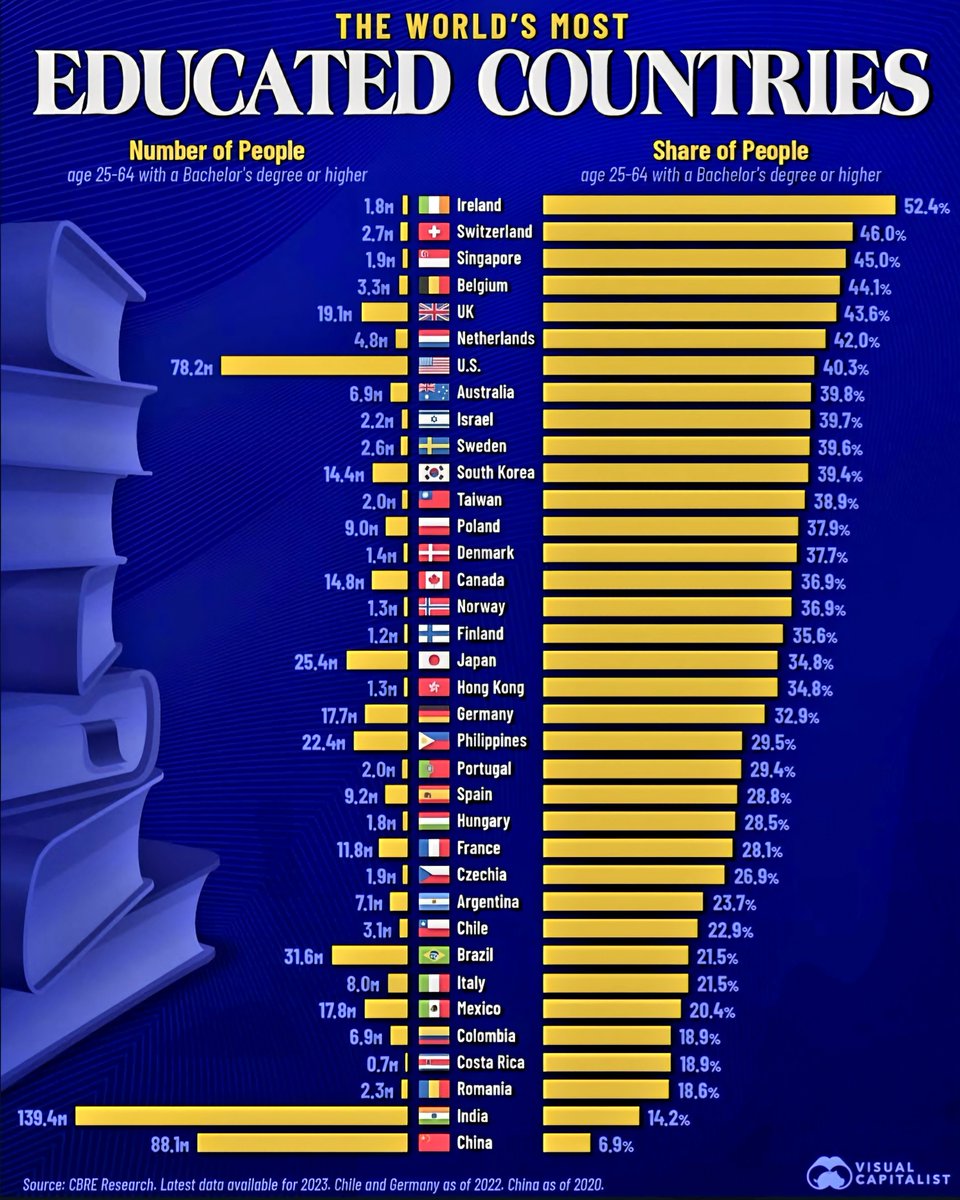
Ireland boasts the highest percentage of adults aged 25 to 64 with at least a bachelor’s degree, with 52.4% (approximately 1.8 million people) holding higher education qualifications. This marks Ireland as the most educated country in the world in 2025, reflecting its strong investments in tertiary education and a culture that emphasizes academic achievement. The country’s robust university system and active pursuit of international students contribute to this impressive statistic.
Switzerland and Singapore: Small Nations with High Education Attainment
Switzerland ranks second, with 46% of its working population (around 2.7 million people) possessing a college degree or higher. Known for its rigorous education system and emphasis on skilled trades, Switzerland continues to sustain its reputation for highly educated professionals.
Singapore follows closely, with 45% (roughly 1.9 million people) of its workforce holding tertiary degrees. The city-state’s strategic focus on STEM education and innovation keeps it atop global education charts despite its small geography.
European Nations Continue to Lead in Education
Belgium, the UK, and the Netherlands all have significant portions of their adult populations with university degrees. Belgium reports 44.1% (around 3.3 million), the UK 43.6% (nearly 19.1 million), and the Netherlands 42% (about 4.8 million). These countries benefit from longstanding higher education traditions and accessible university systems.
The U.S. and Australia: Large Populations with High Education Levels
The United States is home to approximately 78.2 million adults aged 25-64 with at least a bachelor’s degree, accounting for 40.3% of its workforce. Its extensive university network and diverse educational pathways contribute to this high figure.
Australia’s higher education rate stands at 39.8%, with around 6.9 million degree-holders, reflecting prioritization of tertiary education and international student recruitment.
Israel and Scandinavia Maintain High Education Rates
Israel has nearly 39.7% (around 2.2 million) of its working population with college degrees, emphasizing its focus on technology and innovation education.
Sweden, Norway, and Finland also rank highly; Sweden’s 39.6% (approximately 2.6 million), Norway’s 36.9% (~1.3 million), and Finland’s 35.6% (~1.2 million). These countries prioritize quality education, lifelong learning, and research.
South Korea and Taiwan: Asia’s Educational Powerhouses
South Korea continues its tradition of academic excellence with 39.4% (about 14.4 million) of its working-age population with degrees, driven by its competitive education system.
Taiwan closely follows with 38.9% (around 2 million), highlighting its focus on STEM and technological innovation.
Central and Eastern Europe: Growing Educational Attainment
Poland has approximately 37.9% (9 million) of its workforce educated at the tertiary level, with countries like Denmark and Canada following with nearly 38%. Canada’s current statistic is around 14.8 million degree holders, making it one of the most educated nations in North America.
Asia’s Expanding Educational Base
Japan, with 34.8% (about 25.4 million), and Hong Kong, with a similar percentage, continue investing heavily in education. Japan’s large population makes its global education rankings noteworthy despite a slightly lower percentage compared to smaller nations.
Germany and Latin America: Moderate Leaders in Education
Germany’s 32.9% (about 17.7 million) of the workforce has higher education degrees, maintaining its reputation for engineering and technical expertise.
In Latin America, Argentina and Brazil lead, with Argentina having 23.7% (~7.1 million) and Brazil with 21.5% (~31.6 million). These figures illustrate growing access to higher education in these regions, though they still lag behind global leaders.
Challenges and Opportunities in Education
While nations like India and China have enormous populations with increasing numbers of degree holders, their percentages of higher-educated adults remain comparatively low—14.2% (139.4 million) in India and 6.9% (88.1 million) in China. However, their sheer population size means they wield significant influence in global educational expansion.
A Closer Look at Less Educated Nations
Countries like Colombia and Costa Rica have 18.9% of their populations with college degrees, while Mexico’s percentage is just over 20%. These nations face ongoing efforts to expand access to higher education and improve educational quality.
In Summary:
The data from 2025 underscores a clear trend: smaller European nations excel in higher education attainment percentages, while large countries like the U.S., Brazil, and India boast immense absolute numbers of degree holders due to their population sizes. Continued investments in education worldwide highlight the growing importance of a skilled, educated workforce in a rapidly evolving global economy.
Sources: CBRE Research, 2025 Data as of 2023; figures updated for this year.
 ChatGPT
 Perplexity
 Gemini AI
 Grok AI