Select Language:
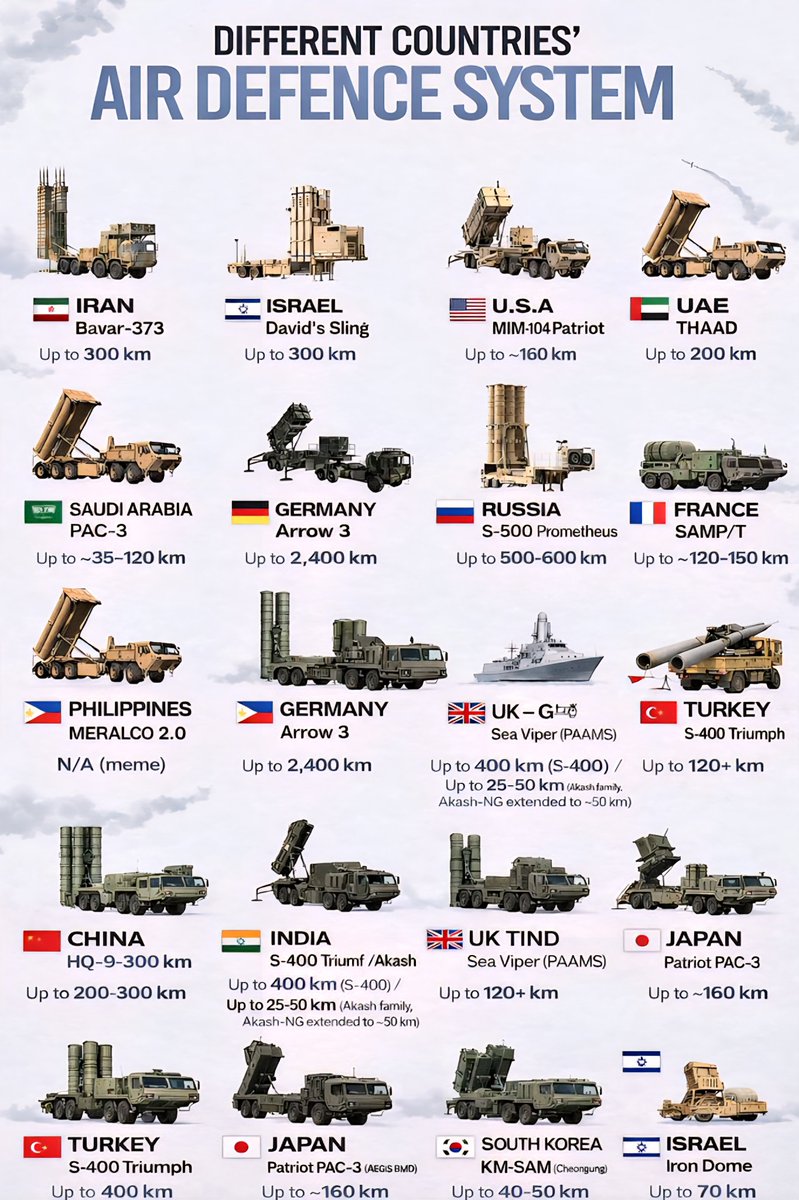
A Global Perspective on Advanced Air Defense Systems in 2025
-
Iran’s Bavar-373: Covering 300 km
Iran continues to bolster its air defense capabilities with the Bavar-373 system, an advanced missile defense platform capable of intercepting targets at distances up to 300 kilometers. This system enhances Iran’s strategic defensive posture, providing significant coverage against potential aerial threats in the region.
-
Israel’s David’s Sling: Regional Shield Up to 300 km
Israel’s David’s Sling system remains a key component of its multi-layered missile defense network, offering protection against medium- to long-range threats within approximately 300 kilometers. Its deployment underscores Israel’s focus on regional missile threat mitigation.
-
United States MIM-104 Patriot: The Long-Range Defender
The U.S. continues to rely on the MIM-104 Patriot system, which can engage targets approximately 160 kilometers away. With ongoing upgrades, the Patriot ensures robust national protection against a variety of aerial threats, including ballistic missiles and aircraft.
-
UAE’s THAAD: High-Altitude Defense at 200 km
The Terminal High Altitude Area Defense (THAAD) system used by the United Arab Emirates can intercept intermediate-range ballistic missiles within roughly 200 kilometers, providing a critical layer of defense for strategic installations.
-
Saudi Arabia’s PAC-3: Versatile Coverage
Saudi Arabia’s Patriot PAC-3 system offers flexible engagement ranges between 35 to 120 kilometers. Its deployment across the kingdom is vital in defending against emerging missile threats in the volatile Middle East.
-
Germany’s Arrow 3: The Long-Range Solution
Germany’s Arrow 3 missile system stands out with its impressive reach of up to 2,400 kilometers, designed primarily for intercepting ballistic missiles in space. This cutting-edge system marks Europe’s commitment to defending against sophisticated threats.
-
Russia’s S-500 Prometheus: A New Era in Defense
Russia’s S-500 Prometheus represents the latest in missile defense technology, capable of engaging targets at distances between 500 and 600 kilometers. Its multi-purpose capabilities include interception of ballistic and cruise missiles, aircraft, and even space-based threats.
-
France’s SAMP/T: Balancing Range and Precision
France’s SAMP/T system offers effective coverage at distances of approximately 120 to 150 kilometers. Its deployment solidifies France’s contribution to NATO’s integrated air defense network.
-
Philippines’ MERALCO 2.0: A Meme of Defense?
The Philippines’ MERALCO 2.0 isn’t an actual defense system but rather a humorous meme circulating online. It highlights unique regional humor amidst the serious landscape of missile defense.
-
China’s HQ-9: Extending Reach to 300 km
China’s HQ-9 missile system features an operational range of up to 300 kilometers, supporting the country’s effort to modernize its missile defense and strategic military presence across Asia.
-
India’s S-400 Triumf & Akash: Powerhouses at 400 km and 50 km
India’s S-400 Triumf missile system can engage targets at an extended range of 400 kilometers, bolstering its aerial defense network significantly. Additionally, the Akash family, including the newer Akash-NG, provides shorter-range coverage between 25 to 50 kilometers, ensuring versatile protection for Indian territories.
-
United Kingdom’s Sea Viper (PAAMS): Naval Defense at Over 120 km
The UK employs the Sea Viper missile system as part of its naval air defense, capable of intercepting threats over 120 kilometers away. Its integration into the Royal Navy’s fleet enhances maritime security.
-
Turkey’s S-400 Triumph: Extending 400 km
Turkey’s acquisition of the S-400 Triumph system exemplifies its strategic pursuit of advanced missile defense, with the capability to engage targets roughly 400 kilometers out, raising regional defense standards.
-
Japan’s Patriot PAC-3 (Aegis BMD): Defense Up to 160 km
Japan’s deployment of the Patriot PAC-3 system, integrated with Aegis Ballistic Missile Defense (BMD), provides effective coverage around 160 kilometers, bolstering regional missile deterrence.
-
South Korea’s KM-SAM (Cheongung): Close-Range Defense at 50 km
The South Korean KM-SAM, also known as Cheongung, is designed for shorter-range threats, with an effective interception distance of about 40-50 kilometers, crucial for staying ahead of North Korean missile advancements.
-
Israel’s Iron Dome: Short-Range Protector at 70 km
Renowned for its success, Israel’s Iron Dome is a short-range missile defense system capable of intercepting threats up to 70 kilometers, providing rapid response to incoming projectiles and rockets.
Note: The ranges listed are approximate public estimates. The actual capabilities can vary based on missile variants, deployment tactics, and technological upgrades.
With continuous advancements and international collaborations, the world’s missile defense landscape in 2025 showcases a blend of high-range systems and strategic regional defenses, emphasizing the importance of adaptive, layered security strategies.
 ChatGPT
 Perplexity
 Gemini AI
 Grok AI