Select Language:
Countries That Span Two Continents: A Detailed Look in 2025
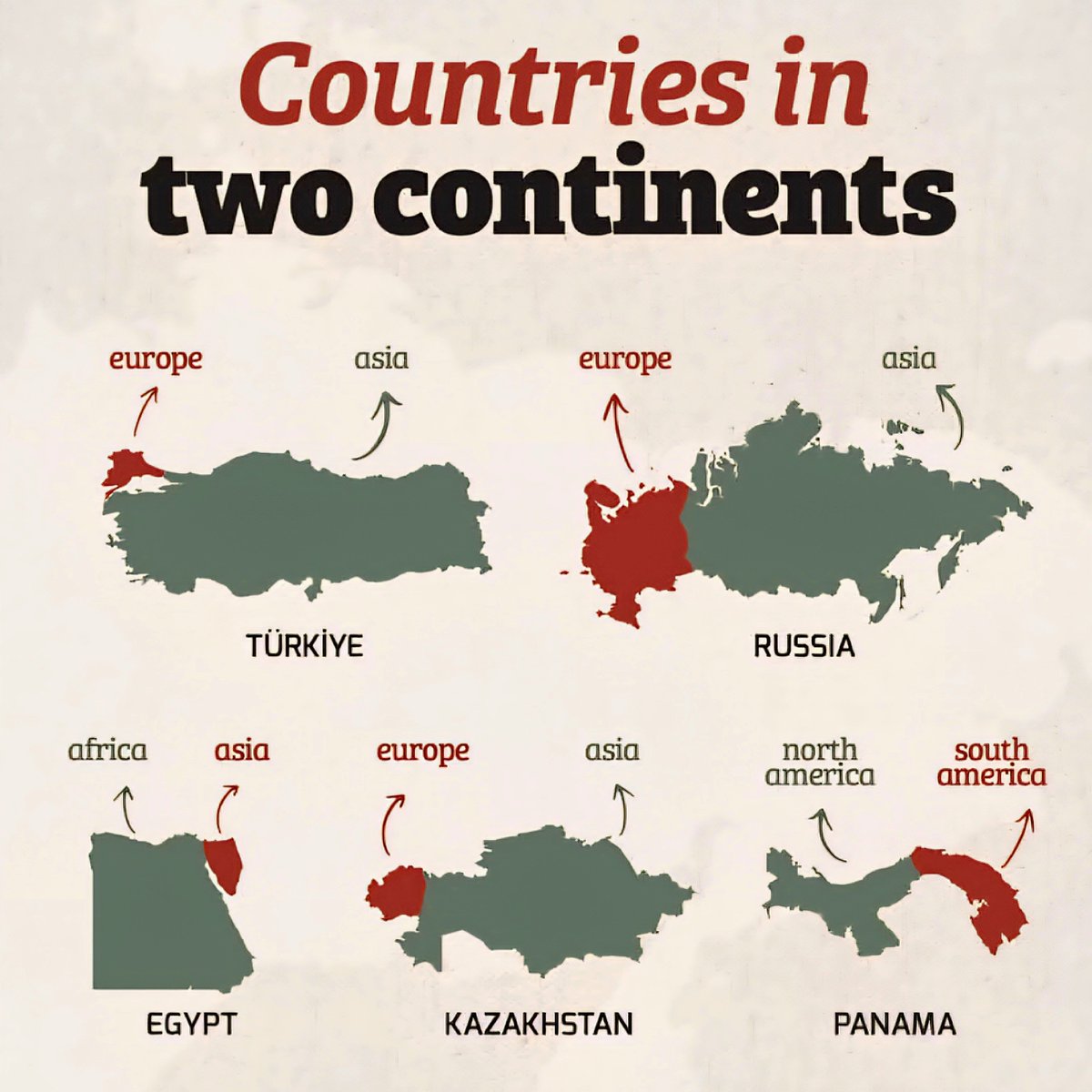
1. Turkey: The Bridge Between Europe and Asia
Turkey remains one of the most prominent countries that straddle two continents. The country’s landmass is divided by the Bosporus Strait, with roughly three percent located in southeastern Europe and the remaining 97 percent in western Asia. This geographical position has made Turkey a unique cultural melting pot and a strategic geopolitical hub.
Istanbul, Turkey’s largest city, straddles the boundary, blending European and Asian influences in its architecture, cuisine, and traditions. The country’s dual continent status plays a vital role in its economic and political relations, as it navigates between European and Asian alliances, notably within NATO and the Eurasian Economic Union.
2. Russia: The Transcontinental Powerhouse
Russia’s vast size makes it a transcontinental country spanning Europe and Asia. About 23 percent of Russia’s landmass is in the European part, which includes major cities like Moscow and Saint Petersburg. The remaining 77 percent extends into Asia, traversing diverse climates from tundra to taiga.
Moscow and Saint Petersburg serve as cultural and political centers for the European part of Russia, while cities like Novosibirsk and Vladivostok lie in the Asian expanse. Russia’s position as a bridge between Europe and Asia influences its policies, energy exports, and military strategies, making it a key global player in Eurasian affairs.
3. Egypt: The Gateway Between Africa and the Middle East
Egypt is uniquely positioned at the crossroads of Africa and the Middle East, with the Sinai Peninsula acting as the land bridge. The majority of the country’s population resides along the Nile River in Africa, but a small part of Egypt, the Sinai Peninsula, is situated in Asia.
While geographically closer to Africa, culturally and politically, Egypt functions as a Middle Eastern nation. Its strategic location in the Suez Canal region makes it vital for international trade routes and regional diplomacy.
4. Azerbaijan: The Caucasus Connector
Azerbaijan is situated in the South Caucasus region, with its territory divided between Eastern Europe and Western Asia. The country’s northern regions are considered part of Eastern Europe, while the southern parts align with Western Asia.
Baku, the capital city, is a vibrant metropolis with a blend of European sophistication and Middle Eastern tradition, reflecting Azerbaijan’s unique position. Its strategic location makes it a pivotal transit route for energy pipelines and trade between the two continents.
5. Kazakhstan: The Central Asian Crossroads
Kazakhstan covers a vast expanse in Central Asia, with land in both Eastern Europe and Western Asia. The country’s western regions are often classified as European, while the bulk of its territory lies in Asia.
Nur-Sultan, the capital, symbolizes its modern development and regional significance. Kazakhstan’s geographic duality influences its foreign policy, especially relations with Russia, China, and neighboring Central Asian countries, as it seeks to balance Eurasian integration and global diplomacy.
6. Georgia: The Mountain Pass Connecting Continents
Although smaller in size, Georgia’s strategic position links Eastern Europe and Western Asia. Located on the southeastern edge of Europe, Georgia’s territory includes the region of South Caucasus.
Tbilisi, its capital, is a cultural crossroads with a diverse history shaped by various empires and civilizations. Its location along key trade routes enhances its geopolitical significance, especially with ongoing projects like the Baku-Tbilisi-Ceyhan pipeline.
7. Greece: The Crossroads of Europe and Asia
Greece forms part of the Balkan Peninsula in southeastern Europe, but its transport links through the Aegean Sea connect it strongly to Asia. The country’s numerous islands and proximity to Turkey underline its position as a bridge between continents.
Athens remains an influential cultural hub, while the country’s strategic location impacts regional diplomacy, especially within the context of NATO and the European Union.
In 2025, these nations exemplify how geographic boundaries shape cultural identities, economic partnerships, and geopolitical strategies in a rapidly evolving global landscape. The dynamic interplay of continents creates a fascinating tapestry of history, development, and international cooperation that continues to influence global affairs.
Note: Geographical classifications can sometimes vary based on political and cultural perspectives, but these countries are widely recognized for spanning two continents.
 ChatGPT
 Perplexity
 Gemini AI
 Grok AI