
Select Language:
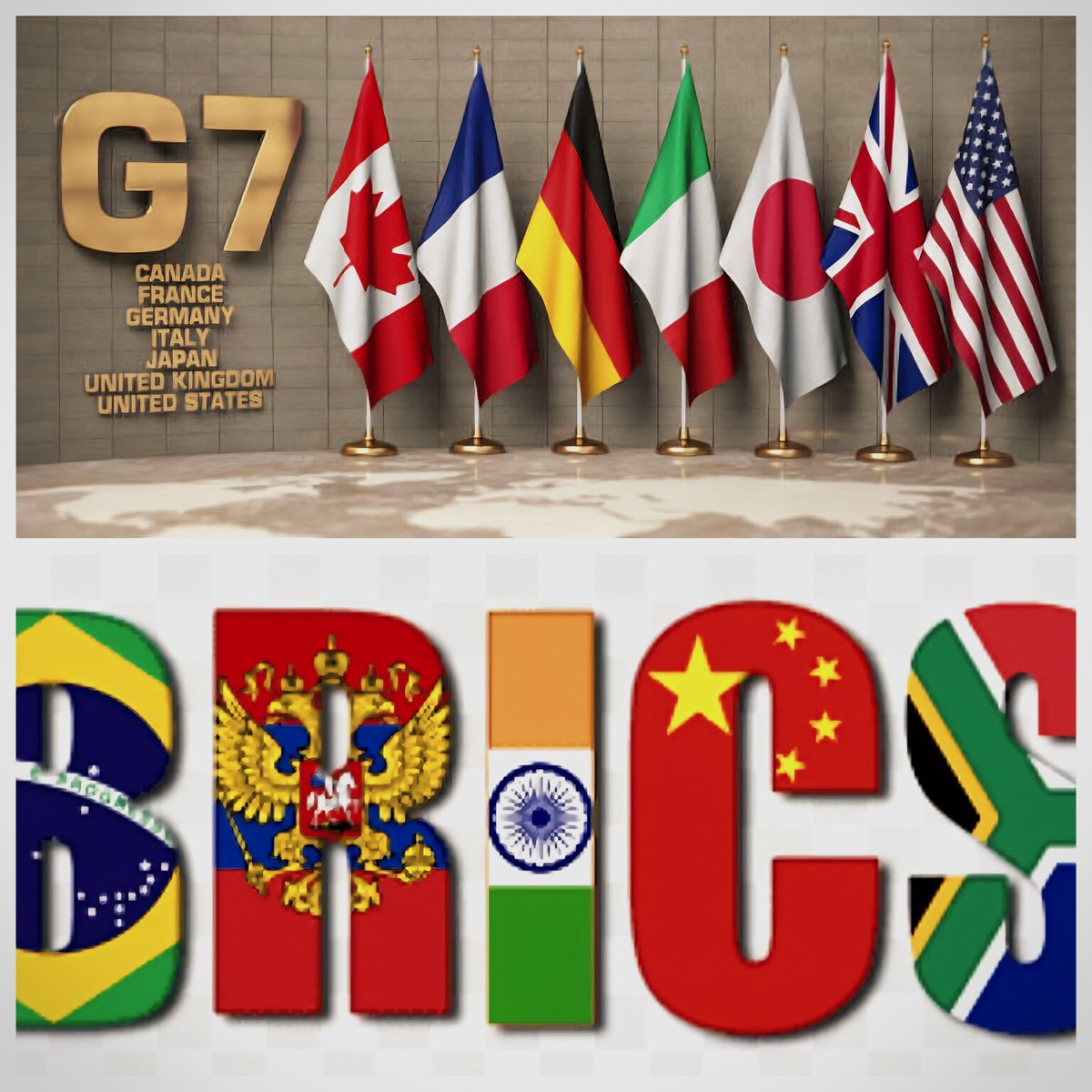
BRICS vs G7: Comparing The World’s Economic Powerhouses in 2025
1. BRICS Countries Boast a Combined Nominal GDP of Over $29 Trillion
The BRICS alliance, comprised of some of the world’s most dynamic emerging economies, has demonstrated impressive financial growth in 2025. Collectively, their nominal gross domestic product (GDP) stands at roughly $29.24 trillion, signaling a significant shift in global economic influence.
- Brazil leads Latin America with a GDP of approximately $2.13 trillion, maintaining its role as a regional economic leader.
- Russia holds steady at just over $2.08 trillion, leveraging its resource-rich economy.
- India continues its rapid expansion, with a GDP of about $4.19 trillion, making it the second-largest member after China.
- China remains the colossal economy in the group, with a staggering GDP of around $19.23 trillion — nearly two-thirds of the entire BRICS bloc.
- South Africa contributes $410.34 billion, representing Africa’s largest economy.
- Indonesia showcases promising growth, reaching approximately $1.43 trillion.
- Egypt adds $347.34 billion, solidifying its standing as North Africa’s economic hub.
- Iran reports a GDP of $341.01 billion, amidst ongoing regional challenges.
- UAE (United Arab Emirates), known for its diversified economy, totals $548.60 billion.
- Ethiopia emerges as Africa’s fast-growing economy with a GDP of $117.46 billion.
2. G7 Economy Dominance with Over $50 Trillion in Total GDP
The G7 nations remain the heavyweights of the global economy, with a combined nominal GDP exceeding $50 trillion. Their economic strength continues to influence international markets and geopolitics.
- United States dominates with a GDP of approximately $30.51 trillion, maintaining its position as the world’s largest economy.
- Canada follows with around $2.23 trillion, reinforcing its standing in North America.
- United Kingdom contributes $3.84 trillion, balancing its financial services and manufacturing sectors.
- France has a GDP of about $3.21 trillion, driven by a diverse economy.
- Germany maintains economic strength at $4.74 trillion, Europe’s largest economy.
- Italy boasts a GDP of $2.42 trillion, holding its position as one of Europe’s key markets.
- Japan remains a major economic power with a GDP of approximately $4.19 trillion.
3. The Rising Influence of BRICS: A New Competitive Landscape
While the G7 continues to maintain a significant lead in total GDP, the rapid growth of BRICS economies — especially India and China — indicates a potential shift in economic dominance in coming decades. China’s GDP, at nearly $19.23 trillion, remains a dominant force, but it’s the collective strength of the other member nations that signals a more multipolar economic landscape.
4. Geopolitical Implications of the Economic Data
- Emerging Market Growth: Countries like Indonesia, Ethiopia, and Egypt show promising economic trajectories, contributing to a more diversified global economic structure.
- Resource-Driven Economies: Russia and the UAE’s GDP figures underscore the continued importance of natural resources in national economic profiles.
- Economic Power Balance: As BRICS nations continue to grow, their collective influence could challenge traditional G7 dominance, especially as their economies diversify and expand.
5. Outlook for 2025 and Beyond
The GDP figures of 2025 underscore a pivotal moment in international economics. While the G7 nations still hold substantial economic clout, the rapid, sustained growth of BRICS countries underscores a potential reshuffle in global leadership roles. Policy shifts, technological advancements, and geopolitical developments could further alter this balance in the coming years.
Source: IMF, GDP as of 2025
 ChatGPT
 Perplexity
 Gemini AI
 Grok AI