Select Language:
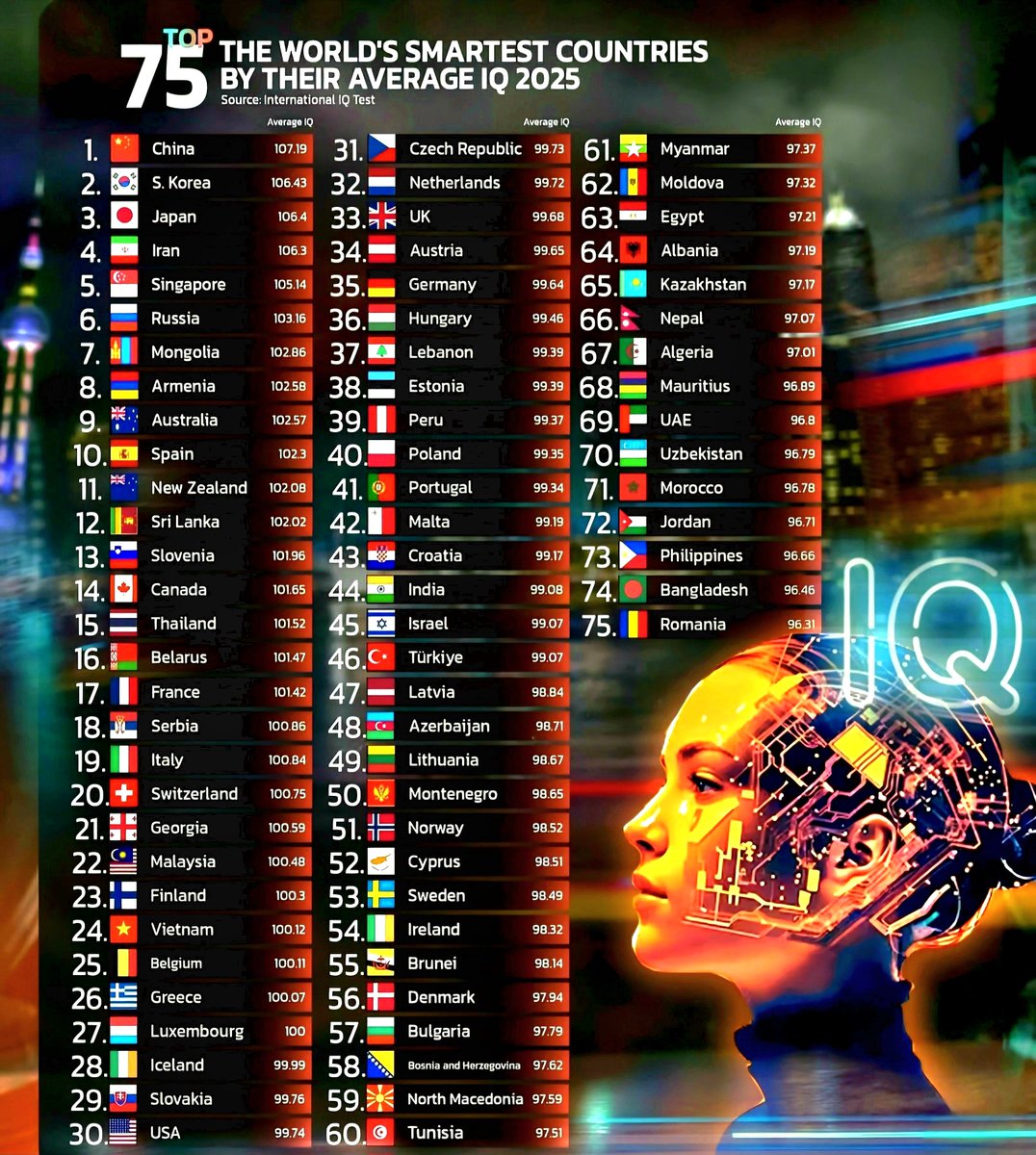
Top 75 Countries by Average IQ in 2025
1. Singapore: The Unrivaled Leader in Cognitive Performance
Singapore continues to dominate the global intelligence rankings in 2025. With a remarkable average IQ of 108, the city-state has maintained its position due to its top-tier education system and a culture that emphasizes academic excellence. The nation’s investment in early childhood education and innovative teaching methodologies ensures that its population remains at the forefront of cognitive capabilities worldwide.
2. Hong Kong: A Close Competitor in the Asian Powerhouse
Hong Kong ranks just below Singapore with an average IQ of 107. Its strong emphasis on rigorous academic standards and a highly competitive educational environment contribute significantly to its high IQ scores. The region’s focus on science, technology, and finance sectors continues to attract talents proficient in complex problem-solving and critical thinking.
3. South Korea: Technological Advancement and Educational Rigor
South Korea secures the third spot with an average IQ of 106. Known for its intense focus on education and innovation, South Korea produces highly skilled professionals in STEM fields. The government’s commitment to research and development fuels this intellectual growth, ensuring South Korea remains a global leader in technological advancements.
4. Japan: Integration of Tradition and Innovation
Japan retains its high standing with an average IQ of 105. The nation’s balanced approach to maintaining rich cultural traditions while investing heavily in science and education drives its cognitive excellence. Japan’s robust education system fosters analytical skills and creativity, vital for the country’s ongoing technological progress.
5. Switzerland: The Genius of the Alps
At number five, Switzerland boasts an average IQ of 104. Renowned for its high-quality education and multilingual population, Switzerland excels in fostering critical thinking and problem-solving abilities. Its innovative pharmaceutical, finance, and engineering sectors rely heavily on its intellectually talented workforce.
6. United States: A Diverse Intellectual Landscape
The U.S. ranks sixth with an average IQ of 103. While diversity presents a broad range of intellectual capacities, top-tier institutions, cutting-edge research, and technological innovations bolster America’s position. The nation’s extensive higher education network and vibrant research environment attract some of the brightest minds globally.
7. United Kingdom: Rich in Innovation and Academia
With an average IQ of 102, the UK remains a beacon of academic achievement. Its world-class universities and research institutions continue to contribute heavily to global science, arts, and technology development. The cultural emphasis on education sustains a high cognitive performance among its population.
8. Australia: A Knowledge-Driven Society
Australia scores an average IQ of 101, driven by its competitive education system and focus on scientific research. The country’s science community, coupled with investment in technological infrastructure, supports its position among the top IQ nations.
9. Canada: An Inclusive Approach to Education
Canada maintains an average IQ of 101. Its inclusive, multicultural society fosters diverse perspectives and innovative thinking. The country’s commitment to high-quality education and research facilities enhances cognitive skills nationwide.
10. Germany: Engineering and Innovation Powerhouse
Germany stands out with an average IQ of 100, known for its precision engineering, manufacturing, and scientific research. The country’s strong emphasis on vocational training and higher education supports a workforce capable of complex problem-solving and technological innovation.
In 2025, the rankings highlight a clear correlation between investment in education, technological innovation, and cognitive performance. While Asia continues to lead, Western nations such as the United States, UK, and Germany showcase the importance of diversity and specialized education systems in cultivating high intelligence levels. The global IQ landscape remains dynamic, influenced by social, economic, and technological forces shaping the intellectual capacities of nations worldwide.
 ChatGPT
 Perplexity
 Gemini AI
 Grok AI