Select Language:
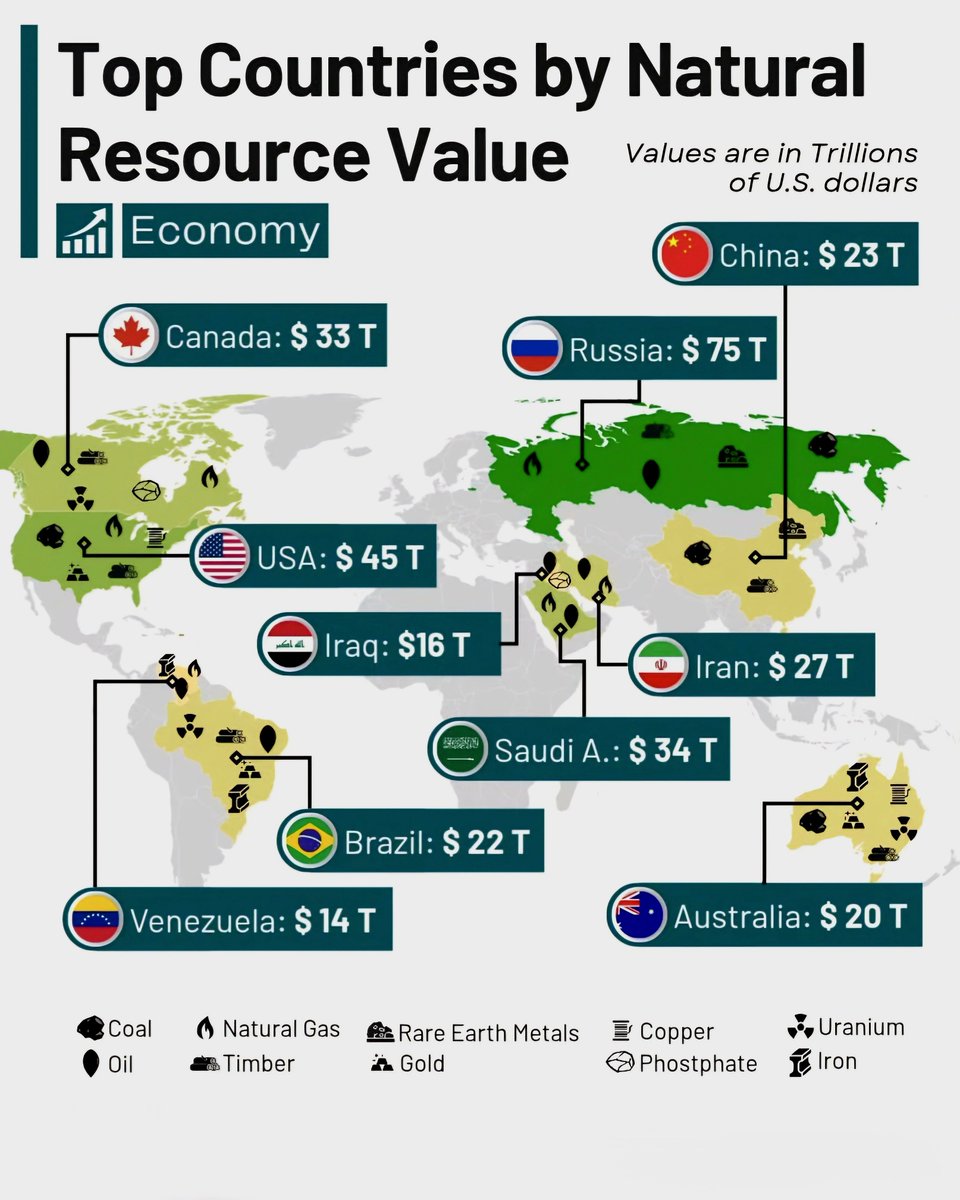
The 2025 Spectrum of Top Richest Countries by Natural Resources
Russia’s Dominance with an Estimated $75 Trillion in Resources
Leading the pack globally, Russia boasts an astonishing $75 trillion worth of natural resources. Its vast expanse supplies abundant reserves of oil, natural gas, minerals, and timber, cementing its reign as the world’s most resource-rich country. This wealth not only supports its economy but also makes Russia a geopolitical powerhouse, with resource exports shaping its international relations.
United States: The Resource Powerhouse at $45 Trillion
Close behind is the United States, holding an estimated $45 trillion in natural resources. From oil reserves in Texas and shale gas fields to precious metals in Nevada and agricultural wealth in the Midwest, America’s diverse landscape fosters extensive resource extraction. These assets underpin its status as an economic superpower.
Saudi Arabia and Canada: Oil Titans Banking on $34.4 Trillion and $33.2 Trillion
Saudi Arabia holds approximately $34.4 trillion in natural wealth, primarily driven by its enormous oil reserves, which sustain the country’s economy and political influence. Meanwhile, Canada’s resources, estimated at $33.2 trillion, are leveraged through vast oil sands, minerals, and forest products, fueling its industrial growth and exports.
Iran and the Democratic Republic of Congo: Diverse Resource Holdings
Iran’s resource value is roughly $27.3 trillion, largely from oil and natural gas. The Democratic Republic of Congo, with an estimated $24 trillion, is a treasure trove of minerals, including cobalt and coltan, vital for global tech industries. These nations exemplify the diversity in resource wealth across continents.
The Chinese and Brazilian Economies Driven by Natural Resources
China, with about $23 trillion in resources, benefits from its mineral deposits and energy reserves, fostering manufacturing and infrastructure development. Brazil’s $21.8 trillion worth encompasses rich forests, iron ore, and agricultural products, bolstering its status as a global exporter.
Australia and Iraq: Minerals and Oil Powerhouses
Australia’s resource treasure chest, valued at nearly $20 trillion, includes vast mineral deposits like lithium and iron ore, pivotal for modern technology and construction. Iraq’s approximately $15.9 trillion reserve base is predominantly oil, which remains central to its economy and regional stability.
Venezuela and Kazakhstan: Resource-Dependent Nations
Venezuela’s estimated $14.3 trillion in resources is chiefly oil, though economic challenges have impacted its industry. Kazakhstan’s $12 trillion reserves are mainly oil, gas, and minerals, positioning it as a key energy player in Central Asia.
Norway, UAE, and Nigeria: Balancing Oil Wealth
Norway ($11 trillion) exemplifies a nation that effectively manages resource wealth through sovereign funds. The UAE, with about $9 trillion, leverages its hydrocarbons alongside rapidly growing tourism and financial sectors. Nigeria, holding around $8 trillion, remains a top oil producer but faces development hurdles.
South America’s Rich Resources: Chile, Mexico, and Argentina
Chile’s $7.5 trillion reserves are largely copper-rich, underpinning its industrial sector. Mexico’s estimated $7 trillion includes oil and minerals, while Argentina’s $6.5 trillion reflects its diverse natural resources.
Indonesia and Peru: Emerging Resource Economies
Indonesia’s $6 trillion valuation is driven by coal, palm oil, and mineral resources. Peru, with about $5.5 trillion, benefits from copper and other minerals vital to global supply chains.
North African and Middle Eastern Countries
Libya’s $5 trillion reserves hinge on substantial oil deposits. Qatar and Algeria hold $4.5 trillion and $4.2 trillion respectively, with natural gas and oil dominating their resource landscape.
Major Asian Economies: India and Vietnam
India’s resource valuation is approximately $3.9 trillion, drawing from coal, iron ore, and other minerals. Vietnam, with around $3.1 trillion, is rich in coal, minerals, and agricultural land, fueling its manufacturing sector.
Growing Markets: Turkey, Philippines, Malaysia
Turkey (~$2.4 trillion), the Philippines (~$2.2 trillion), and Malaysia (~$2 trillion) harness a mix of mineral deposits, energy, and agricultural resources to advance their economies.
Smaller but Significant Reserves: Democratic Republic of the Congo and Georgia
While smaller in total value, countries like the Republic of the Congo (~$1.9 trillion) and Georgia (~$900 billion) hold vital mineral and resource deposits crucial for regional development.
Notable Mentions and Future Outlook
Countries such as France, Egypt, and Thailand maintain valuable resource stocks, supporting diverse industries. Israel (~$750 billion) is emerging as a hub for innovative resource exploration, especially in natural gas.
This snapshot of national resource values sheds light on global economic dependencies, geopolitical influence, and the potential for future growth based on resource management. As resource discoveries continue and technologies evolve, these rankings are poised to shift, shaping the world’s economic landscape well into 2025 and beyond.
Note: Figures are estimates based on data available as of 2025, compiled from reputable sources like the World Bank, IMF, U.S. EIA, BP, and other international agencies. Reserves are subject to change due to market dynamics, new discoveries, or revisions.
 ChatGPT
 Perplexity
 Gemini AI
 Grok AI