Select Language:
The World’s Wealthiest Countries in 2026: A Closer Look
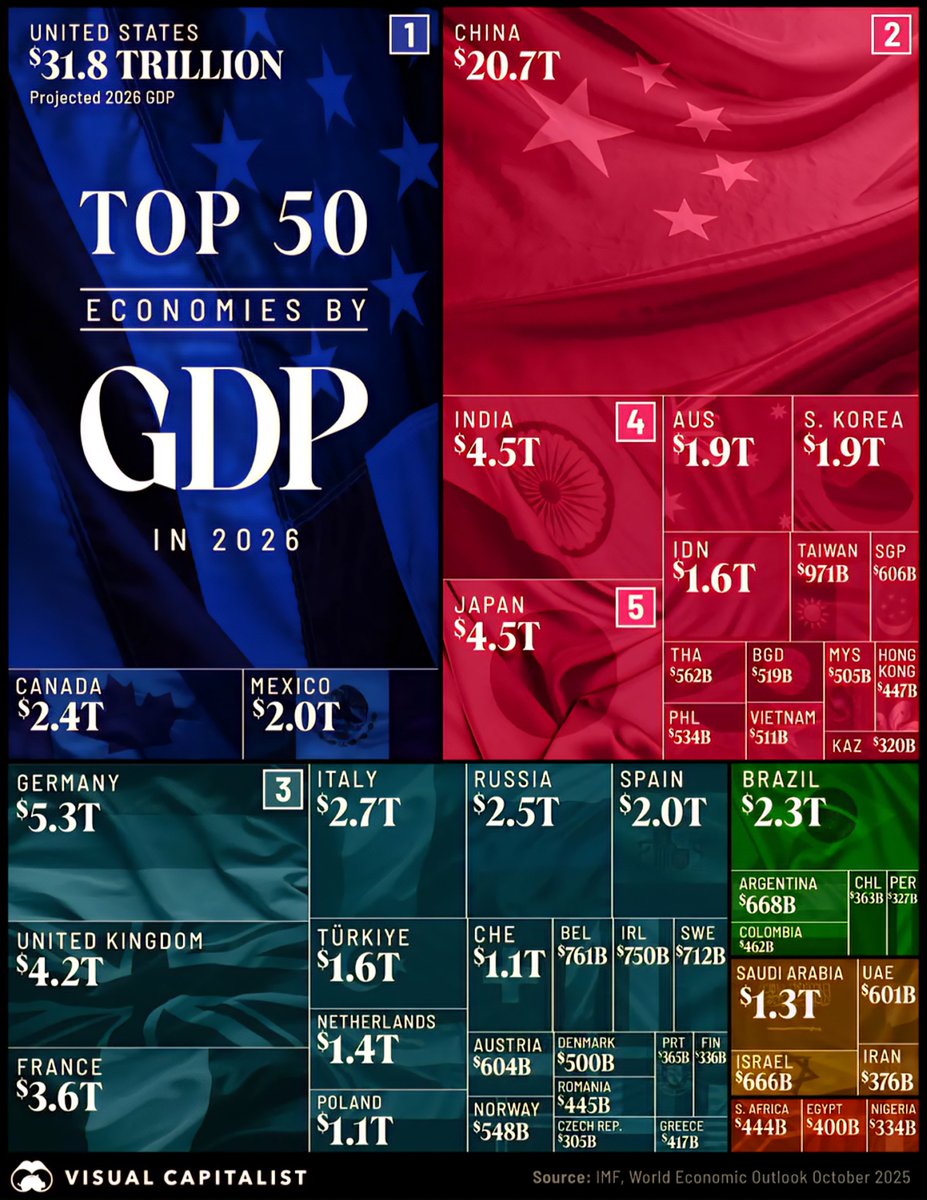
1. United States Claims the Top Spot with Over $31.8 Trillion in GDP
The United States continues to dominate as the world’s economic powerhouse, boasting a gross domestic product (GDP) of approximately $31.82 trillion in 2026. This substantial figure underscores America’s enduring influence in global markets, technological innovation, and financial services. The U.S. economy’s resilience is anchored by its diverse industries, from advanced technology and entertainment to manufacturing and agriculture.
2. China Trails Close Behind with Over $20.65 Trillion
China maintains its status as a key player on the global stage, with an estimated GDP of $20.65 trillion. Over the past decade, China’s rapid industrialization, robust export sector, and expanding consumer base have fueled its economic growth. The country’s Belt and Road Initiative continues to boost trade and infrastructure investments across Asia, Africa, and Europe, securing its position as the second-largest economy worldwide.
3. Germany’s Steady Leadership in Europe with $5.33 Trillion
As Europe’s economic leader, Germany’s GDP hits approximately $5.33 trillion. Known for its automotive industry, manufacturing prowess, and engineering excellence, Germany remains a vital cog in the European economy. Post-pandemic recovery strategies have strengthened its industrial sectors, making it a key trading partner within the European Union and beyond.
4. India’s Rapid Rise to Over $4.5 Trillion
India’s economy is experiencing a significant boom, reaching around $4.51 trillion in 2026. Advancements in technology, a burgeoning middle class, and substantial investments in infrastructure are propelling India forward. The nation’s vibrant startup culture and reforms targeting ease of doing business are attracting foreign investments, positioning it as emerging global economic leader.
5. Japan’s Resilience with a GDP of $4.46 Trillion
Despite demographic challenges, Japan maintains a stable GDP of roughly $4.46 trillion. Its core industries include automobiles, robotics, and electronics. Japan’s innovation-driven economy continues to adapt, emphasizing automation and high-tech manufacturing to sustain growth and competitiveness.
6. The United Kingdom’s Economic Stability at $4.23 Trillion
The UK’s economy remains formidable, with a GDP nearing $4.23 trillion. As a global financial center, London commands influence in banking, insurance, and professional services. Recent trade agreements and strategic investments have helped stabilize its economic landscape amid geopolitical shifts post-Brexit.
7. France’s Economic Soundness with $3.56 Trillion
France sustains its position among the top global economies with a GDP around $3.56 trillion. The country’s strengths lie in luxury goods, aerospace, and tourism industries. Ongoing governmental reforms aim to enhance productivity and innovation, ensuring France’s role in the European and global markets.
8. Italy’s Steady Economic Output at $2.7 Trillion
Italy’s economy holds steady with a GDP of approximately $2.7 trillion. Renowned for fashion, automotive, and culinary industries, Italy faces challenges like slow growth and aging demographics but remains a vital European economy due to its manufacturing and export sectors.
9. Russia’s Economic Challenges and Opportunities at $2.51 Trillion
Russia’s GDP is estimated at $2.51 trillion, reflecting both its vast natural resources and economic sanctions impact. The country’s future hinges on diversification efforts into technology and agriculture sectors, alongside its traditional energy exports.
10. Canada’s Resource-Rich Economy Reaches $2.42 Trillion
Canada’s economy, valued at about $2.42 trillion, is driven by natural resources, including oil, minerals, and forestry. Its stable banking system and trade relationships with the U.S. bolster its economic standing, fostering growth despite global uncertainties.
This list highlights the impressive and diverse economic landscapes across the globe, showcasing how innovation, resource management, and strategic policies shape nations’ financial futures in 2026.
Source: IMF, World Economic Outlook, October 2025 (Projections).
 ChatGPT
 Perplexity
 Gemini AI
 Grok AI