Select Language:
2025’s Top 50 Companies with the Biggest Cash Reserves
Berkshire Hathaway Surpasses All with $381.7 Billion in Cash
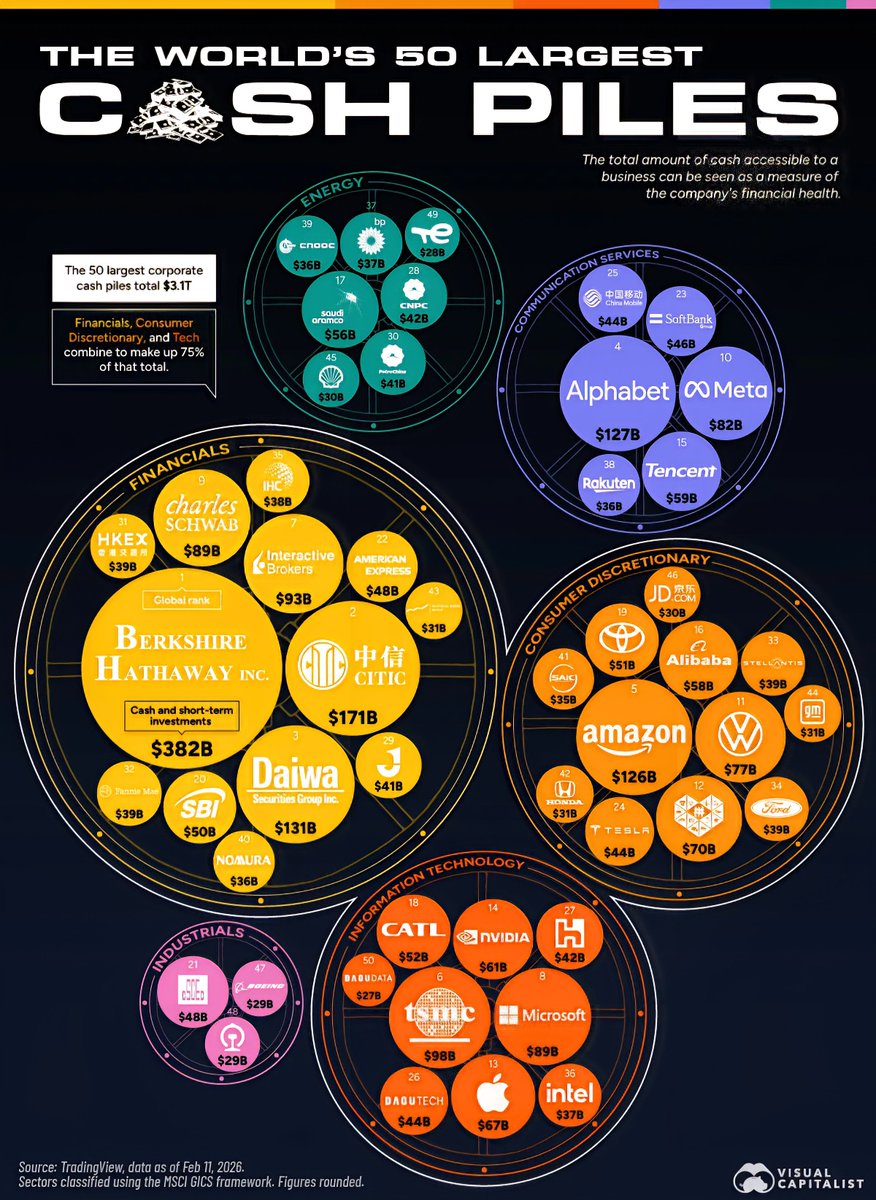
At the top of the list, Warren Buffett’s conglomerate, Berkshire Hathaway, maintains an astonishing $381.7 billion in cash reserves. Its massive liquidity provides flexibility for acquisitions, investments, and navigating economic uncertainties. Buffett’s long-standing strategy of holding large cash reserves has clearly paid off, especially amidst fluctuating markets in 2025.
Chinese Giants Leading the Cash Race: CITIC and PDD Holdings
CITIC Limited, a major Chinese state-owned investment firm, holds approximately $171.5 billion in cash, reinforcing China’s robust corporate cash position. Following closely are PDD Holdings with $69.5 billion and Tencent with $59.2 billion. These companies reflect China’s emphasis on capital strength to support growth in e-commerce, tech, and infrastructure sectors.
Tech Titans Are Cash-Rich: Alphabet, Amazon, and Microsoft
American technology leaders continue to dominate the cash reserves alongside manufacturing and retail:
- Alphabet (Google’s parent company): $126.8 billion
- Amazon: $126.3 billion
- Microsoft: $89.5 billion
Their substantial cash buffers are strategic for research, acquisitions, and navigating regulatory landscapes across countries.
Financial Sector’s Significant Cash Holdings
Financial services companies emphasize liquidity to support operations and expand influence, exemplified by:
- Charles Schwab: $88.9 billion
- Interactive Brokers Group: $93.4 billion
- American Express: $47.8 billion
These firms utilize cash to offer competitive services, fund innovations, and absorb market shocks effectively.
Automotive and Manufacturing: Still Cash-Heavy
Leading automakers and manufacturers have amassed significant cash reserves:
- Volkswagen: $76.9 billion
- Toyota Motor: $50.5 billion
- Honda Motor: $30.9 billion
Manufacturers’ substantial cash positions provide stability and enable investments in electric vehicle advancements and smart manufacturing solutions.
Energy and Resources Hold Massive Reserves
Energy giants maintain vast cash holdings to facilitate infrastructure projects and stability:
- Saudi Aramco: $56.0 billion
- CNOOC: $35.8 billion
- Shell: $30.3 billion
Such liquidity underscores their readiness to fund renewable energy projects and global energy demands.
Asian Tech and Telecom Powerhouses
Chinese corporations lead the pack in the tech and telecom sectors:
- Tencent: $59.2 billion
- Alibaba Group: $58.2 billion
- China Mobile: $43.8 billion
Taiwan Semiconductor Manufacturing (TSMC) with $97.8 billion and Hon Hai Precision Industry with $42.5 billion show Taiwan’s rising prominence in high-tech manufacturing.
Stable Governmental and Financial Institutions
Government-backed agencies and financial institutions also feature prominently:
- Fannie Mae: $39.4 billion
- Deutsche Boerse: $30.6 billion
- Boeing: $29.4 billion
Their cash levels enable them to support large-scale projects and manage economic shifts.
Major Retail and E-commerce Players
Retail and online marketplaces continue to amass cash to fund expansion and technological innovation:
- JD.com: $29.6 billion
- Rakuten Group: $36.0 billion
Their financial strength allows continued investment in logistics, AI, and user experience improvements.
Key Takeaways from 2025’s Cash Reserves Landscape
- Global Giants Prioritize Liquidity: Companies across sectors emphasize cash reserves for stability, strategic growth, and innovation.
- China’s Leading Role: Multiple Chinese firms rank high, signaling continued economic resilience and aggressive expansion strategies.
- Tech Companies Maintain Cash Piles: Dominance of cash-rich tech firms signals ongoing investment in AI, cloud computing, and other advanced technologies.
- Traditional Sectors Hold Steady: Automotive, energy, and industrial companies function with ample liquidity, ready for transformation investments.
Conclusion:
The cash positions of these industry leaders highlight a cautious yet proactive approach, preparing to seize new opportunities and weather uncertainties. As 2025 unfolds, observing how these companies deploy their substantial cash reserves will be pivotal in understanding the global economic trajectory.
Data source: TradingView, updated as of February 11, 2026, based on MSCI GICS classification.
 ChatGPT
 Perplexity
 Gemini AI
 Grok AI