Select Language:
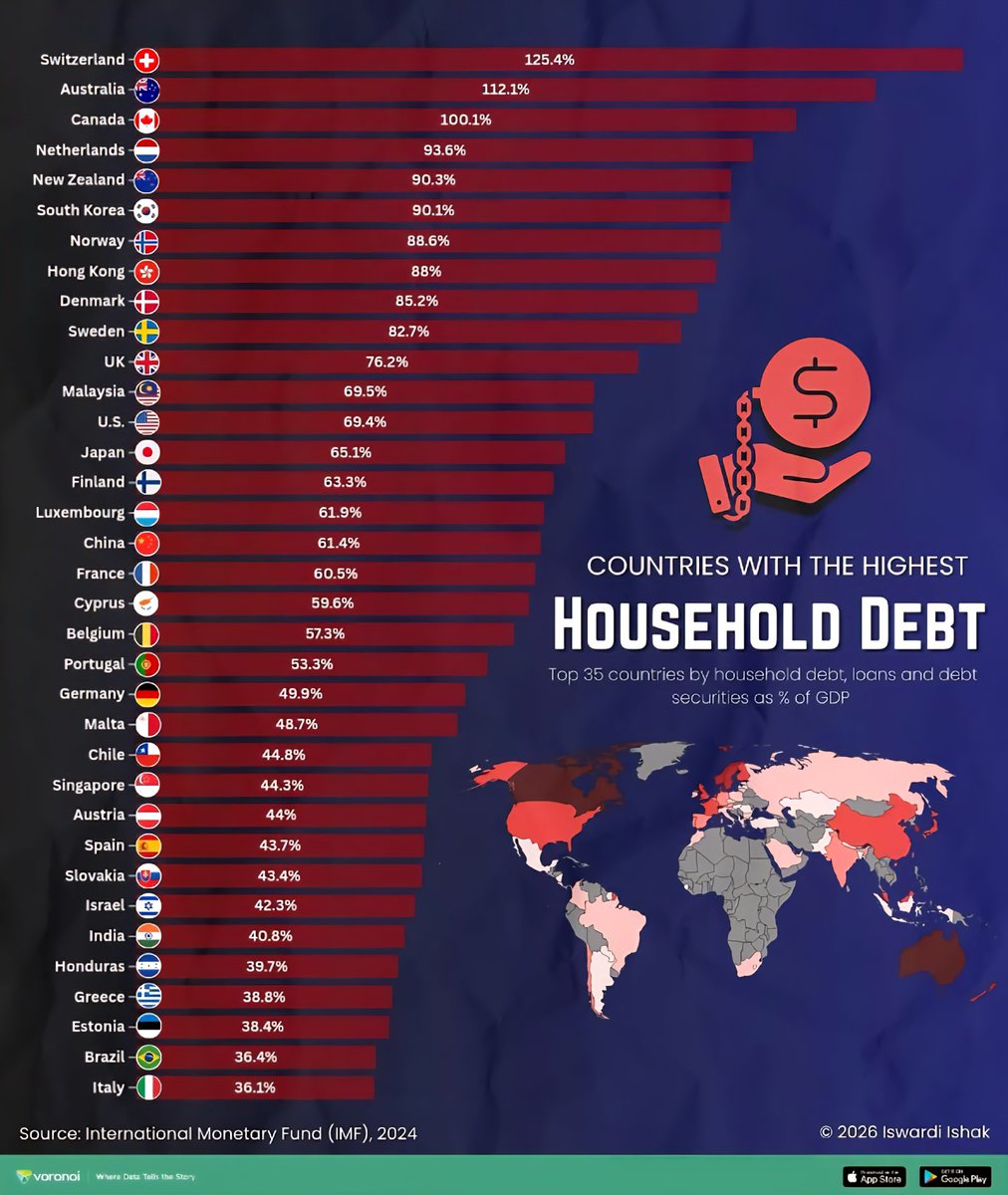
The World’s Leading Countries in Household Debt as a Share of GDP in 2025
-
Switzerland Tops the Chart with Over 125% Debt Ratio
Switzerland has overtaken all other nations to become the country with the highest household debt relative to its economic output. With debt levels reaching 125.4% of its GDP, Swiss households are carrying more than their entire annual economic activity in debt, reflecting a deepening trend of high borrowing in the affluent European nation. -
Australia and Canada: Close Contenders with Over 100% Ratios
Australia follows closely with a household debt-to-GDP ratio of 112.1%, driven by a persistently hot property market and low interest rates that encourage borrowing. Canada also maintains a high ratio at 100.1%, underscoring the heavy reliance Canadians have on debt for home purchases and consumption.ADVERTISEMENT -
European Countries Show Mixed Debt Profiles
The Netherlands (93.6%) and New Zealand (90.3%) are notable European nations with very high debt levels. Norway (88.6%) and Hong Kong (88%) also stand out, with their populations heavily leveraging debt — often linked to real estate investments. -
Northern Europe Continues to Demonstrate High Household Borrowing
Denmark (85.2%), Sweden (82.7%), and the United Kingdom (76.2%) are countries where household debt continues to be substantial, primarily fueled by long-standing real estate markets and consumer credit preferences. -
Asian Economies Exhibit Diverging Debt Trends
South Korea (90.1%) and Hong Kong are among the most indebted, owing to high property prices and aggressive borrowing cultures. China, with a household debt ratio of 61.4%, reflects the nation’s ongoing balancing act between economic growth and financial stability. -
The United States and Japan Maintain Moderate Ratios
The US, with household debt at 69.4%, demonstrates a balanced debt scenario compared to global leaders. Japan’s debt is slightly lower at 65.1%, a result of longstanding economic policies and demographic shifts influencing borrowing behaviors. -
Western European Countries Show Relatively Lower Debt Levels
France (60.5%), Germany (49.9%), and Spain (43.7%) demonstrate more conservative household borrowing, often associated with stable housing markets and cautious lending practices. -
Emerging Economies Steady but Less Leveraged
India (40.8%), Brazil (36.4%), and South Africa (33.7%) have notably lower household debt ratios, but rising middle-class borrowing signals future increases if economic growth persists. -
Smaller and Island Nations with Lower Debt Ratios
Countries like Portugal (53.3%), Malta (48.7%), and Vanuatu (30.6%) carry modest debt levels relative to their GDP, often due to smaller economies and different lending environments.
Overall Insights and Future Outlook
In 2025, the high household debt levels in many countries signal ongoing reliance on borrowing for housing, consumption, and investment. Switzerland’s dominance at over 125% of GDP underscores an unprecedented level of household leverage, posing potential economic risks if global interest rates rise or economic conditions deteriorate.
While nations like Germany and France maintain moderate debt levels, the trend of increasing borrowing persists, especially in real estate-driven economies. Asian economies continue to grapple with balancing growth and financial stability, with some signs of debt saturation emerging.
Policy responses to these trends could include tightening lending standards, increasing financial literacy programs, or adjusting interest rates to prevent debt levels from spiraling out of control. Global policymakers face the ongoing challenge of fostering economic growth without compromising financial stability due to excessive household debt.
The Changing Debt Landscape in 2025
Note: The data source is the IMF, 2024, as reported via Voronoi. These figures highlight the evolving debt consumption patterns across the globe and emphasize the importance of vigilant economic monitoring.
 ChatGPT
 Perplexity
 Gemini AI
 Grok AI