Select Language:
The World’s Military Might in 2026: A Closer Look
1. United States Dominates the Global Military Landscape
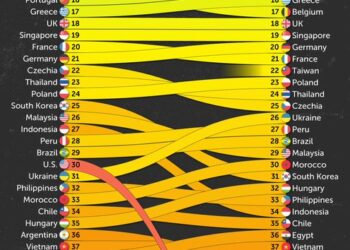
The United States remains the most powerful military force in the world, with a Powerlndex score of 0.0741. This ranking reflects its unmatched technological advancement, extensive nuclear capabilities, and global reach through numerous military bases worldwide. The U.S. continues to lead in defense spending, innovation, and strategic alliances, maintaining its position at the top of the list for 2026.
2. Russia and China: The Rising Military Giants
Russia, with a score of 0.0791, holds strong as a formidable force, especially notable for its nuclear arsenal and terrestrial military strength. China, on the other hand, has surged ahead with a score of 0.0919, marking significant investments in its navy, air force, and missile technology. Both countries pose significant regional and global challenges, shifting the balance of power in their favor.
3. Emerging Powerhouses in Asia
South Korea (0.1642), Japan (0.1876), and India (0.1346) showcase Asia’s growing military prowess. South Korea’s proximity to North Korea and its advanced technological infrastructure bolster its defenses, while Japan maintains a robust self-defense force. India’s expanding military budget and strategic alliances with Western nations highlight its rising military stature.
4. European Countries Stepping Up Their Defense Capabilities
France (0.1798), the UK (0.1881), and Germany (0.2463) emphasize their commitment to modernizing armed forces, investing heavily in cyber and missile defense. Italy (0.2211) and Spain (0.3247) also demonstrate considerable military strength, contributing to regional stability and NATO’s overall power.
5. Middle Eastern and North African Powerhouses
Turkey (0.1975), Iran (0.3199), and Egypt (0.3651) continue to play pivotal roles in regional security. Turkey’s strategic location and military modernization efforts, Iran’s asymmetrical warfare tactics, and Egypt’s sizable armed forces reflect the complex geopolitical landscape of the region.
6. The Pacific and Southeast Asian Forces
Australia (0.3208), Taiwan (0.3927), Vietnam (0.4066), and Thailand (0.4458) are notable for their strengthening defenses amid rising regional tensions. Australia’s strategic alliances and advanced defense systems reinforce its position, while Taiwan’s military focus remains on deterring potential aggression. Vietnam and Thailand have increased military spending to modernize their forces.
7. Strategic Power Plays in the Gulf and Scandinavia
Saudi Arabia (0.4473) and Sweden (0.4834) represent critical strategic players. Saudi Arabia’s defense modernization aims to secure its oil infrastructure and regional dominance. Sweden’s focus on military modernization enhances its defense posture amidst geopolitical shifts. Algeria (0.4849) also stands out as a North African military hub.
8. North America, Europe, and Beyond
Canada (0.5269) and Singapore (0.5272) exemplify high defense standards and technological competence. Canada emphasizes peacekeeping and Arctic security, while Singapore invests heavily in modern defense systems. Greece (0.5484) maintains a strategically vital position in the Mediterranean, with ongoing military upgrades.
9. The Shifting Power Dynamics in 2026
While traditional superpowers continue to dominate, several emerging nations have improved their military capabilities, reflecting a multipolar world. Countries like Poland (0.3891), Ukraine (0.3691), and Taiwan are key players in regional security strategies, especially amid ongoing geopolitical tensions.
10. The Future of Global Military Balance
The minor gaps between these nations highlight an evolving battlefield where technological innovation, strategic alliances, and defense investments are critical. Countries are increasingly investing in cyber warfare, artificial intelligence, and missile defense to secure their positions in the 2026 military hierarchy.
The ranking is based on comprehensive assessments involving over 60+ military, financial, and logistical factors, giving a holistic picture of each country’s military strength.
Source: GlobalFirePower 2025
Note: The global military landscape in 2026 indicates ongoing shifts, with emerging nations closing the gap on traditional powers through innovation, modernization, and strategic partnerships.
 ChatGPT
 Perplexity
 Gemini AI
 Grok AI