Select Language:
2025’s Top 30 Global Research Universities: Leading the World in Innovation and Discovery
-
Harvard University Continues Its Global Dominance
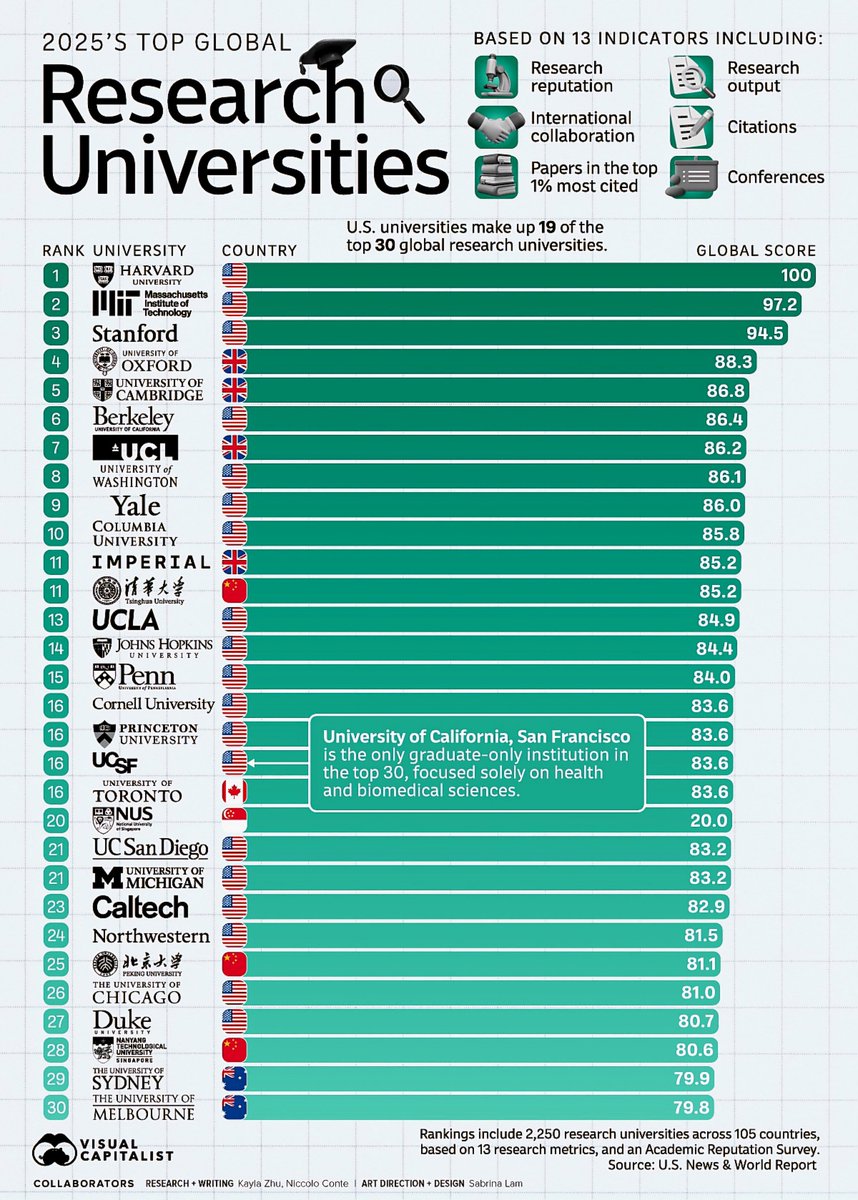
Harvard University remains at the top of the global research rankings in 2025. Known worldwide for its influence across multiple disciplines, Harvard’s extensive research funding and collaborative initiatives solidify its position as a leader in groundbreaking discoveries. Its faculty and student body are responsible for prolific scientific papers, innovations in medicine, and technological advances that shape industries globally. -
Massachusetts Institute of Technology (MIT) Sets the Standard for Tech Innovation
MIT, renowned for its cutting-edge engineering and technological research, holds firmly in the second spot. The university’s emphasis on applied sciences and entrepreneurship fuels advancements in artificial intelligence, robotics, and sustainable energy, making it a hub for startup incubators and patent filings.ADVERTISEMENT -
Stanford University Maintains Its Research Excellence
Sitting at third, Stanford continues to drive innovation, especially in Silicon Valley. Its partnerships with leading tech companies and focus on interdisciplinary research promote new discoveries in computer science, biotech, and environmental science. -
United Kingdom’s Universities Hold Strong Presence
Oxford and Cambridge, while historically rooted, still lead the UK’s global research efforts, ranking 4th and 5th respectively. Their vast networks of research institutes contribute extensively to medicine, sciences, and humanities, shaping policy and academic discourse worldwide. -
California-Based Universities Dominate the U.S. Research Scene
Many U.S. institutions continue to lead, with the University of California, Berkeley (6th), UCLA (13th), and Johns Hopkins University (14th). U.S. schools account for nearly two-thirds of the top 30, reflecting immense investment in research infrastructure and funding. -
The Evolution of Prominent U.S. Universities
Yale (9th), Columbia (10th), Penn (15th), Cornell (16th), and Princeton (17th) underscore the strength of private research universities. They have significantly contributed to medicine, law, public policy, and social sciences with pioneering research and outstanding faculty. -
Asian Universities Rise in Global Research Influence
Tsinghua University (12th), Peking University (25th), and Shanghai Jiao Tong University (28th) are notable Asian powerhouses. Their rapid expansion in research output, especially in engineering, science, and technology, reflects increasing investment and talent attraction in the region. -
Canadian and Australian Universities Equal Global Footprint
The University of Toronto (19th) leads Canada’s research efforts, while the University of Sydney (29th) and the University of Melbourne (30th) continue to excel in health sciences, environmental research, and the humanities. -
New Entrants and Notable Shifts
The 2025 rankings see emerging universities climbing the global ladder, emphasizing the importance of international collaboration, research funding, and innovation ecosystems. Notably, institutions like UCLA and the University of California San Diego (21st) are gaining ground with impressive research outputs. -
Research Metrics and Reputation
The rankings are based on 13 research metrics, including publications, citations, grants, and patents, complemented by an Academic Reputation Survey covering 2,250 universities across 105 countries. These measures reflect global perceptions of research impact, collaboration, and innovation.
Key Insights:
- The United States continues to dominate the global research landscape with 19 universities in the top 30, reaffirming its role as a powerhouse of innovation.
- European institutions like Oxford, Cambridge, and Imperial College London demonstrate continued excellence.
- Asian universities are rapidly expanding their research influence, especially in technology and engineering fields.
- The global research ecosystem is increasingly interconnected, with universities across continents contributing to scientific progress.
The landscape of global research in 2025 exemplifies a dynamic, collaborative, and highly competitive environment, with institutions continually striving to push the boundaries of knowledge and technological advancement.
Source: U.S. News & World Report 2025 Rankings
 ChatGPT
 Perplexity
 Gemini AI
 Grok AI