Select Language:
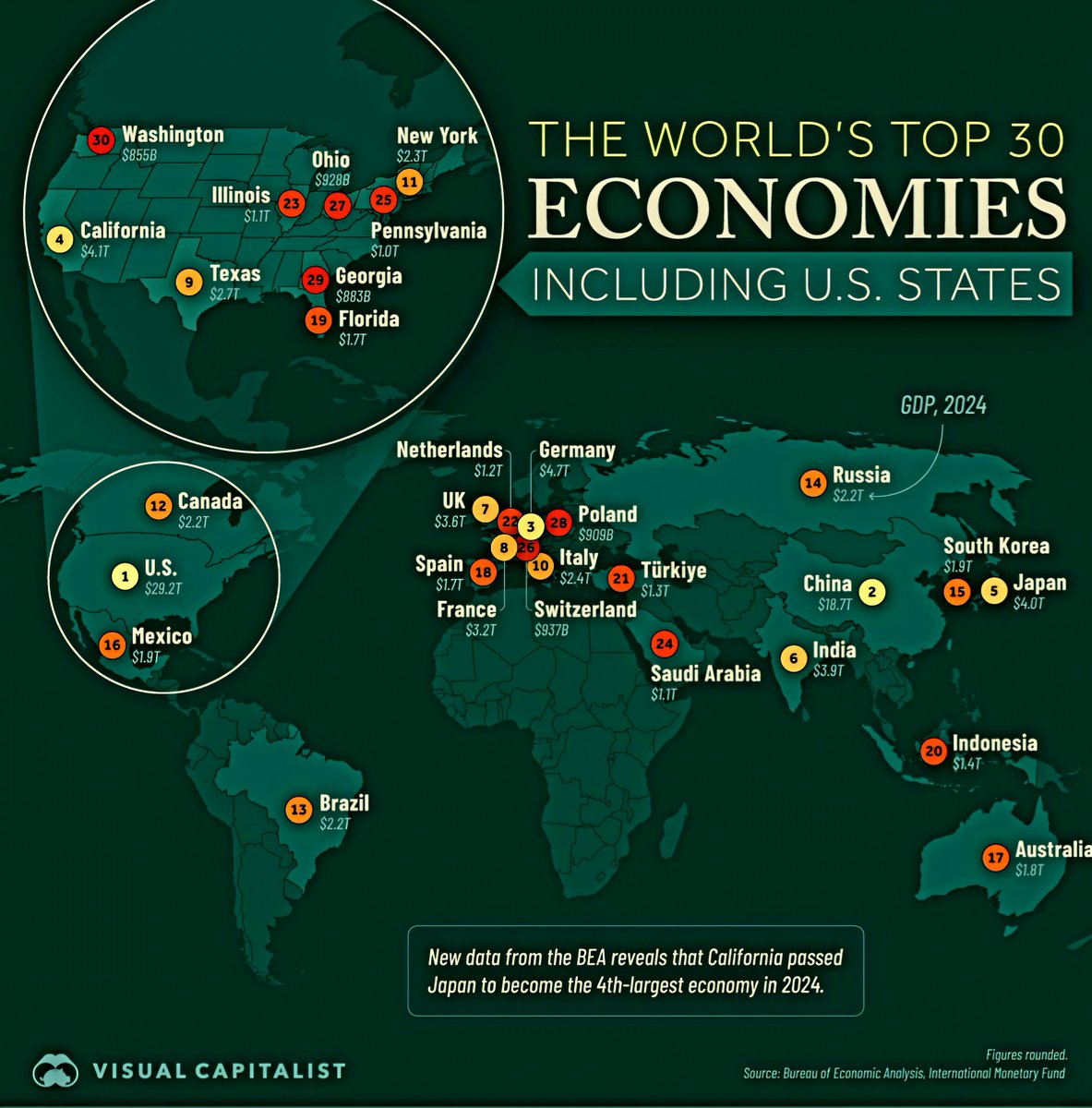
The Biggest Players in the Global Economy in 2025
1. The United States Maintains Its Leading Position
The U.S. continues to be the world’s largest economy with a staggering gross domestic product (GDP) of $29.2 trillion. This economic dominance underscores its broad-based strengths, from technology and finance to manufacturing and consumer services. Notably, within the U.S., California’s economy alone has surged past Japan, reaching an impressive $4.1 trillion, making it the fourth-largest economy globally by itself.
2. China Secures Second Place
China remains a powerhouse with an economy valued at $18.7 trillion. Its rapid growth over recent decades has solidified its position as a critical driver of global economic activity. The country continues to expand its influence through infrastructure projects, technology investments, and trade expansion.
3. Germany’s Economic Resilience
Germany holds onto its spot as Europe’s largest economy with a GDP of $4.7 trillion. Known for its engineering, manufacturing, and export strength, Germany remains a central hub within the European Union.
4. California Outpaces Japan
In a significant shift, California’s economy has eclipsed Japan’s, reaching $4.1 trillion in 2024. This growth highlights the increasing prominence of U.S. states in global economic standings, reflecting a trend toward decentralization of economic power.
5. Japan’s Stable Economy
Japan remains in the top five with a GDP of $4.0 trillion, supported by its advanced technology sector, automotive industry, and innovation in robotics.
6. India’s Rapid Growth
India now stands at $3.9 trillion, showcasing impressive development fueled by technology, services, and manufacturing sectors. Its expanding middle class and young workforce continue to boost economic expansion.
7. The United Kingdom’s Continual Presence
The UK’s economy is valued at $3.6 trillion, remaining a global financial center, especially in London, with strengths in finance, pharmaceuticals, and creative industries.
Key U.S. States in the Top 30
8. Texas Rises in the Ranks
Texas, with a $2.7 trillion economy, exemplifies the state’s diversified economy, with strengths in energy, technology, healthcare, and agriculture, making it the eighth-largest economy in the world among regions and countries.
9. New York’s Financial Hub Power
New York’s economy hits $2.3 trillion, driven by finance, real estate, media, and technology sectors, maintaining its position as a global financial capital.
10. Florida’s Economic Boom
Florida’s economy now stands at $1.7 trillion, driven by tourism, real estate, technology, and healthcare, reflecting its importance as an economic hub within the U.S.
11. Illinois and Pennsylvania: Heavyweights in the Midwest
Illinois and Pennsylvania boast economies of $1.2 trillion and $1.0 trillion respectively, with diverse bases in manufacturing, finance, healthcare, and education.
Other Notable Economies and Regions
- Canada ($2.2T): Rich in natural resources, Canada’s stable economy benefits from strong energy and mining sectors.
- Brazil ($2.2T): Latin America’s largest economy, Brazil’s growth is led by agriculture, mining, and services.
- Russia ($2.2T): The nation’s economy remains prominent due to energy exports and natural resources.
- South Korea ($1.9T): A technological and industrial powerhouse, especially in electronics and automotive.
- Mexico ($1.9T): With close ties to the U.S., Mexico benefits from manufacturing and export industries.
- Australia ($1.8T): Driven by minerals, agriculture, and services sectors.
- Spain ($1.7T): A major tourist destination with growing technology and manufacturing sectors.
The Rise of U.S. States as Economic Powerhouses
Recent data from the Bureau of Economic Analysis (BEA) shows that several U.S. states have become economic powerhouses comparable to small nations. California, Texas, Florida, Illinois, Pennsylvania, Ohio, Georgia, and Washington have all crossed the trillion-dollar mark, underscoring the decentralized nature of economic activity within the U.S.
The Significance of These Trends
This shift reflects broader global economic patterns, where regional economies within the U.S. are increasingly influencing the overall national and even global economic landscapes. The growing regional economic clout also indicates a diversifying and resilient economy that is less dependent on traditional centers.
All figures are rounded and sourced from the Bureau of Economic Analysis and the International Monetary Fund as of 2025.
 ChatGPT
 Perplexity
 Gemini AI
 Grok AI