Select Language:
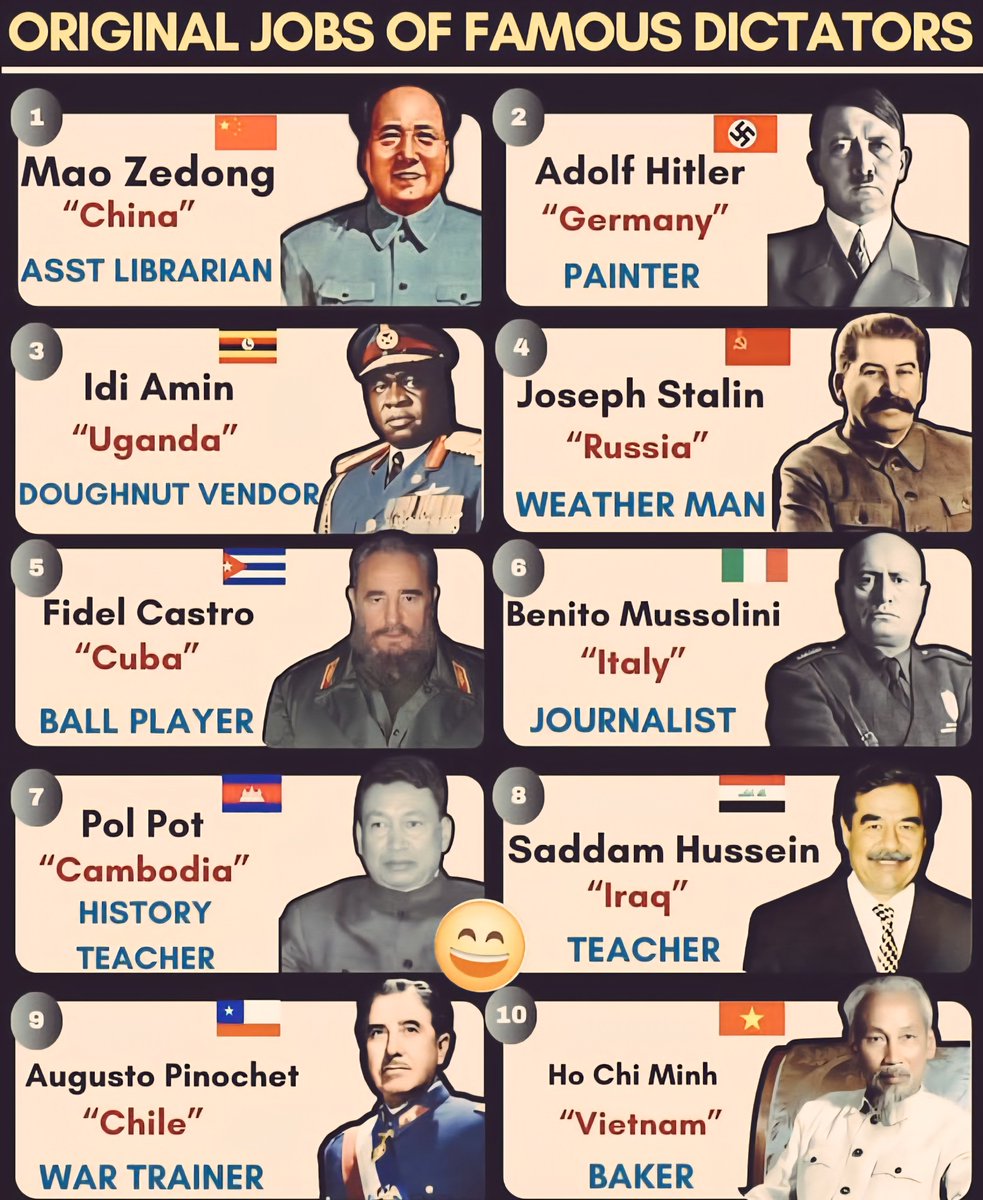
From Ordinary Jobs to Global Icons: The Surprising Past Careers of 25 Notorious Leaders
Discover the unexpected beginnings of some of history’s most influential and controversial dictators. Before they rose to power, many of these figures held humble occupations, highlighting that greatness sometimes starts with modest jobs. Here’s a detailed look into the initial careers that these prominent leaders once had.
1. Mao Zedong – Assistant Librarian
Before shaping China’s history, Mao Zedong worked as an assistant librarian. His early days spent organizing books laid a foundation for his later ideological pursuits and leadership in revolutionary movements.
2. Adolf Hitler – Painter
Famous for his role in history, Adolf Hitler initially pursued art. He studied painting but struggled to succeed, a journey that eventually led him down a darker path.
3. Benito Mussolini – Journalist
Before founding fascism, Mussolini was a dedicated journalist. His writing skills helped amplify his political ideas and set the stage for his future leadership of Italy.
4. Pol Pot – History Teacher
Pol Pot, the notorious dictator of Cambodia, started his career as a history teacher. His educational background would later influence his brutal revolutionary policies.
5. Ho Chi Minh – Baker / Pastry Chef
Before leading Vietnam’s independence movement, Ho Chi Minh was a baker. The skills learned crafting pastries and bread are a testament to his humble beginnings.
6. Fidel Castro – Talented Amateur Baseball Player
Fidel Castro was a talented amateur baseball player in his youth. His athletic pursuits showcased a different facet of his personality before politics took center stage.
7. Chiang Kai-shek – Military Cadet / Stockbroker
Chiang Kai-shek’s early career spanned both military training and finance. His roots in military cadet training laid the groundwork for his future as a leader of China.
8. Francisco Franco – Career Soldier
Franco’s military career started early, and he achieved recognition as a career soldier, which eventually propelled his rise to leadership in Spain.
9. Nicolae Ceaușescu – Shoemaker Apprentice
Ceaușescu began as a shoemaker apprentice, a trade that grounded him in manual labor before he embarked on a political journey to lead Romania.
10. Kim Il-sung – Guerrilla Fighter / Clerk
Kim Il-sung initially fought as a guerrilla combatant and worked as a clerk, combining militant resistance with administrative skills to forge North Korea’s leadership.
11. Deng Xiaoping – Factory Worker (France)
Deng Xiaoping’s early days included working in factories in France, experience that would later influence his economic reforms in China.
12. Ali Abdullah Saleh – Non-Commissioned Officer in the Army
The late Yemen leader, Saleh, started his career as an NCO in the military, demonstrating a military background that underpinned his political dominance.
13. Muammar Gaddafi – Army Officer
Gaddafi rose through the ranks as an army officer before establishing Libya’s Jamahiriya governance—his military training shaping his revolutionary approach.
14. Saddam Hussein – Law Student / Ba’ath Activist
Initially studying law, Saddam Hussein’s political activism within the Ba’ath Party marked his transition from student to dictator.
15. Hafez al-Assad – Air Force Pilot
Hafez al-Assad’s career in the air force guided his control of Syria’s military apparatus, culminating in his long-standing rule.
16. Joseph Stalin – Seminarian / Bank Robber
Before becoming the Soviet Union’s leader, Stalin studied theology as a seminarian, but his tumultuous path included acts like bank robbery, illustrating a complex history.
17. António de Oliveira Salazar – Economics Professor
Salazar’s stint as an economics professor provided a scholarly foundation that contributed to his authoritarian economic policies in Portugal.
18. Daniel Ortega – Student / Guerrilla
Daniel Ortega’s early life featured student activism and guerrilla warfare, both instrumental in his rise to power in Nicaragua.
19. Hugo Chávez – Army Officer / Minor League Baseball Player
Chávez was both an army officer and a minor league baseball pitcher, showcasing his diverse pursuits before leading Venezuela.
20. Mustafa Kemal Atatürk – Military Officer
The founder of modern Turkey, Atatürk, started as a military officer before transforming Turkey into a secular republic.
21. Sukarno – Civil Engineer
Sukarno built his leadership from the ground up, beginning his career as a civil engineer before leading Indonesia’s independence movement.
22. Gamal Abdel Nasser – Army Officer
Nasser’s military background laid the groundwork for his surge to power, leading Egypt through a revolutionary era.
23. Juan Perón – Ski Instructor / Army Officer
Perón balanced life as a ski instructor and army officer, combining skills from both worlds before his political ascendancy in Argentina.
24. Georgios Papadopoulos – Army Officer
The Greek military officer turned dictator underscores how military ranks often serve as stepping stones to political power.
25. Augusto Pinochet – Military Academy Instructor
Pinochet’s early role as an instructor at a military academy helped shape his disciplined approach to governance and military strategy.
While these leaders’ early professions varied widely—from artisans to athletes—what remains evident is how diverse backgrounds can lead to paths of historical significance. Their humble beginnings serve as a reminder that success and influence often come from unexpected origins.
 ChatGPT
 Perplexity
 Gemini AI
 Grok AI