Select Language:
Major Players in Global Oil Consumption: Who’s Leading the Charge in 2025?
United States Dominates with Nearly 20 Million Barrels Daily
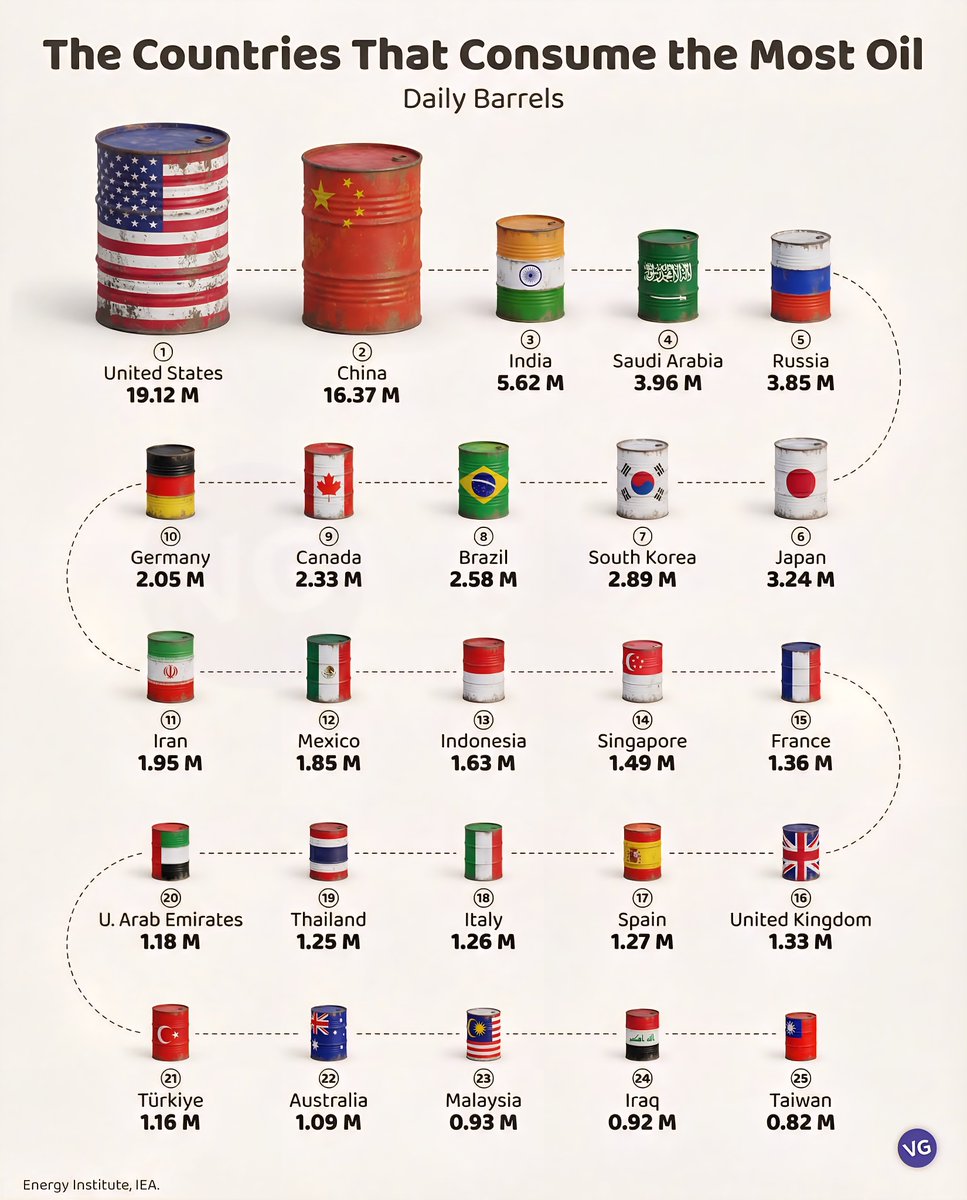
The U.S. continues to be by far the largest consumer of oil worldwide, with an impressive 19.12 million barrels consumed each day. This figure underscores the nation’s vast transportation networks, industrial output, and energy needs. Despite ongoing shifts toward renewable energy, America’s high demand for oil remains a critical component of its economy. The country’s dependency on oil influences both global markets and geopolitical relations, making it a key player in the international energy landscape.
China Holds Steady as the World’s Second Largest Oil Consumer
China ranks second, with a daily consumption of approximately 16.37 million barrels. As the world’s manufacturing hub and a rapidly urbanizing society, China’s need for energy continues to grow. Its strategic investments in alternative energy sources do not yet overshadow its reliance on imported oil, especially for transportation and heavy industries. China’s consumption pattern significantly impacts global oil prices and supply chains, especially as it seeks to balance economic growth with environmental commitments.
India Ramps Up Oil Usage Amid Economic Growth
India consumes around 5.62 million barrels daily, making it the third-largest consumer. With a booming population pushing the country’s energy demands upward, India’s oil consumption is poised to increase further. Government initiatives to expand infrastructure and boost industrial activity are likely to sustain this growth. As India faces pressure to reduce carbon emissions, it will be interesting to watch how its energy mix evolves in the coming years.
Saudi Arabia and Russia Remain Major Oil Consumers Within the Oil-Producing World
Saudi Arabia and Russia, two leading oil producers, also rank high in consumption, with 3.96 million and 3.85 million barrels per day, respectively. Their large domestic markets, combined with their roles in global oil production, make their consumption patterns vital indicators of global energy dynamics. Saudi Arabia, in particular, balances its status as a major producer with substantial internal energy needs fueled by its developing sectors and population growth.
Japan and South Korea Lead Energy Use in East Asia
Japan consumes approximately 3.24 million barrels daily, while South Korea’s intake is about 2.89 million barrels. Both countries rely heavily on imported oil to meet their energy needs, given their limited natural resources. Their commitment to technological innovation and renewable energy is notable, but oil remains critical for transportation, manufacturing, and power generation.
Brazil and Canada Showcase North American Consumption Trends
Brazil’s oil consumption stands at 2.58 million barrels, reflecting its expanding economy and transportation sector. Canada, with a demand of 2.33 million barrels daily, benefits from proximity to North American markets and substantial fossil fuel resources. Both nations are progressing towards diversified energy portfolios but remain heavily reliant on oil for now.
European Leaders and the Middle East’s Rising Consumption
Germany leads oil consumption among European nations with approximately 2.05 million barrels daily, followed by France, the UK, Spain, and Italy. These countries are actively pursuing renewable energy and efficiency measures, yet oil remains integral to their economies.
In the Middle East, Iran and the UAE consume 1.95 and 1.18 million barrels daily, respectively. Despite their large oil reserves, these nations are investing in technological advances and diversified energy sectors to prepare for the future.
Southeast Asia and Other Notable Consumers
Indonesia, Thailand, and Malaysia all show increasing energy consumption figures, with Indonesia leading at 1.63 million barrels. These emerging economies are experiencing rapid industrialization and urbanization, driving their oil needs higher. Taiwan and Turkey are also significant consumers, each fulfilling strategic roles in their regional energy markets.
The Future of Global Oil Consumption
As 2025 unfolds, the landscape of oil consumption remains vibrant and complex. While renewable energy sources gain traction, the sheer scale of demand from these leading nations underscores oil’s enduring significance. How these countries balance sustainability goals with energy requirements will shape the future of global markets.
Figures are rounded and based on recent data from the Energy Institute and the International Energy Agency (IEA) as of 2025. The evolving geopolitical and technological landscape continues to influence these consumption patterns.
 ChatGPT
 Perplexity
 Gemini AI
 Grok AI