Select Language:
The Evolution of Global Economies: A 2025 Perspective
1. The United States Maintains Its Leadership
In 2025, the United States continues to hold the title of the world’s largest economy, thanks to its diversified industries, technological innovation, and resilient consumer market. Despite shifts in global influence, the US economy’s unwavering adaptability has sustained its top position for over four decades, streamlining its leadership in sectors like technology, finance, and healthcare.
2. China Surges Ahead
China’s rapid economic growth over the past 45 years has catapulted it from an emerging market to a global powerhouse. By 2025, China’s GDP has surpassed expectations, with massive investments in renewable energy, infrastructure, and technology fueling its ascent. This growth reflects the country’s strategic focus on innovation and domestic consumption, making it a critical player on the world stage.
3. Japan’s Economy Evolves
Japan, the third-largest economy in 1980, has seen its ranking shift over the years due to demographic changes and economic challenges. Nevertheless, by 2025, Japan remains influential through its advanced technology sectors, robotics, and manufacturing expertise, securing its position among the top ten global economies.
4. Germany’s Economic Resilience
Germany’s resilient economy continues to thrive with robust industrial output and a strong export sector. As Europe’s largest economy, its automotive, engineering, and technological innovations contribute significantly to its sustained global standing, making it a pillar within the European Union.
5. India’s Expanding Market
India’s economy has experienced exponential growth, becoming one of the top three economies in 2025. Its large population, rising middle class, and increasing foreign investments have driven GDP growth, particularly in technology, services, and manufacturing sectors. India’s strategic reforms have played a vital role in accelerating its economic trajectory.
6. The Rise of Emerging Markets
Besides China and India, several other emerging economies have made notable strides. Countries like Brazil, Indonesia, and Mexico have diversified their economies, boosted by technological adoption and improved infrastructure, now ranking between 10th and 20th globally.
7. The Decline of Financial Hegemons
The economic influence of traditional financial centers such as the UK (particularly London) has seen some decline relative to emerging markets. Nevertheless, London remains a vital global financial hub, although its ranking has shifted as new centers in Asia and the Middle East expand their influence.
8. The Impact of Technology and Innovation
Technological advancement has become the main driver of economic growth worldwide. Countries investing heavily in AI, blockchain, 5G, and automation have gained significant competitive advantages, reshaping traditional economic hierarchies and creating new power centers.
9. The Shift Toward Sustainable Economies
By 2025, sustainable development has become integral to national economic strategies. Nations prioritizing renewable energy, green technologies, and low-carbon industries are experiencing accelerated growth, which could influence future rankings and economic stability.
10. The Influence of the Digital Economy
The digital economy’s exponential rise has transformed how countries accrue wealth. E-commerce giants and digital service providers in the US, China, and South Korea have contributed heavily to their GDPs, showcasing the importance of digital infrastructure in national development.
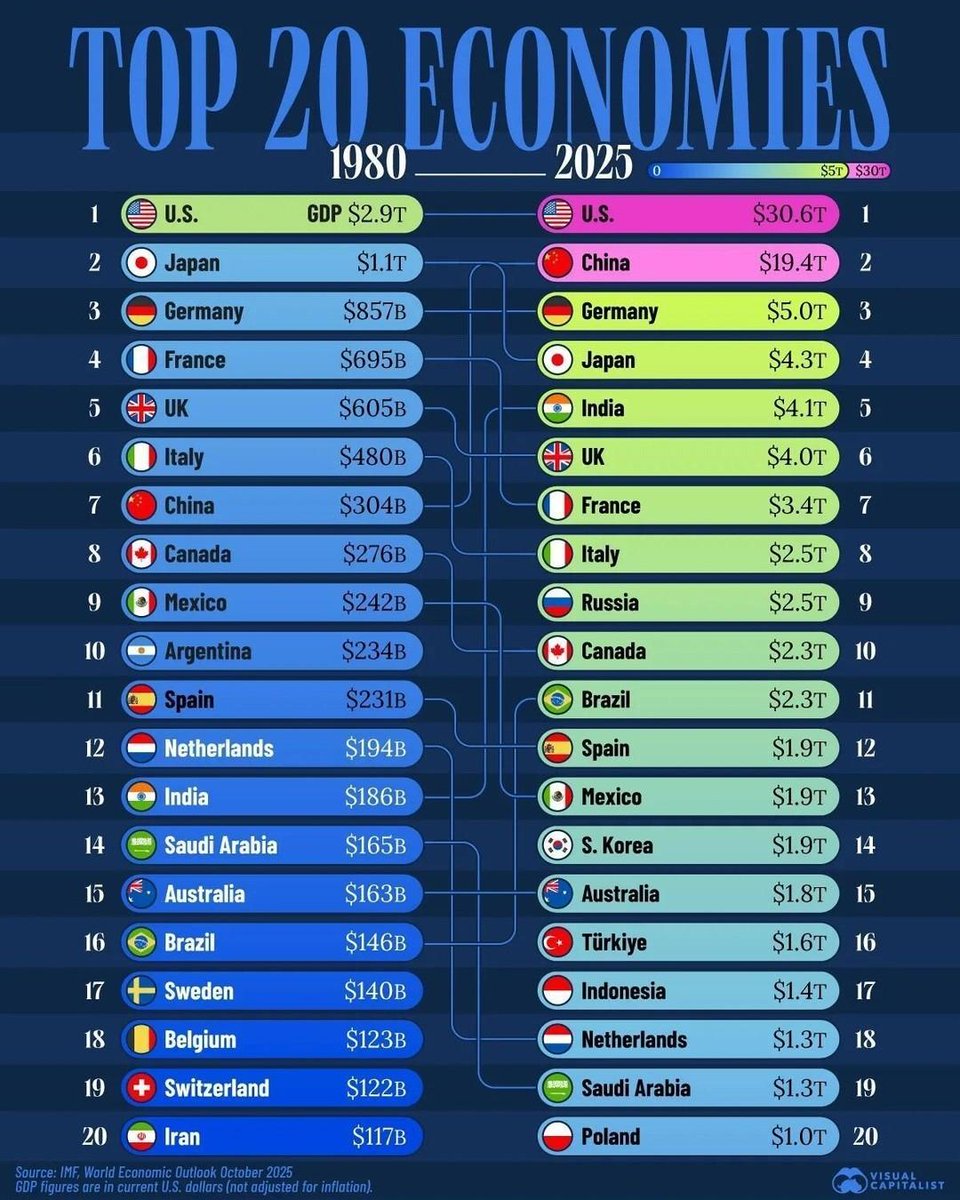
This illustrative comparison depicts how global economic power has shifted since 1980. While traditional giants like the US and Japan remain influential, emerging economies shape the new landscape, emphasizing innovation, sustainability, and digital transformation as drivers of growth.
Note: These insights reflect the global economic trends as of 2025 based on recent data, projections, and strategic developments.
 ChatGPT
 Perplexity
 Gemini AI
 Grok AI