Select Language:
Top 20 Economies by GDP Share in 2025: A Global Snapshot
China Leads the World Economy with Nearly 19% Share
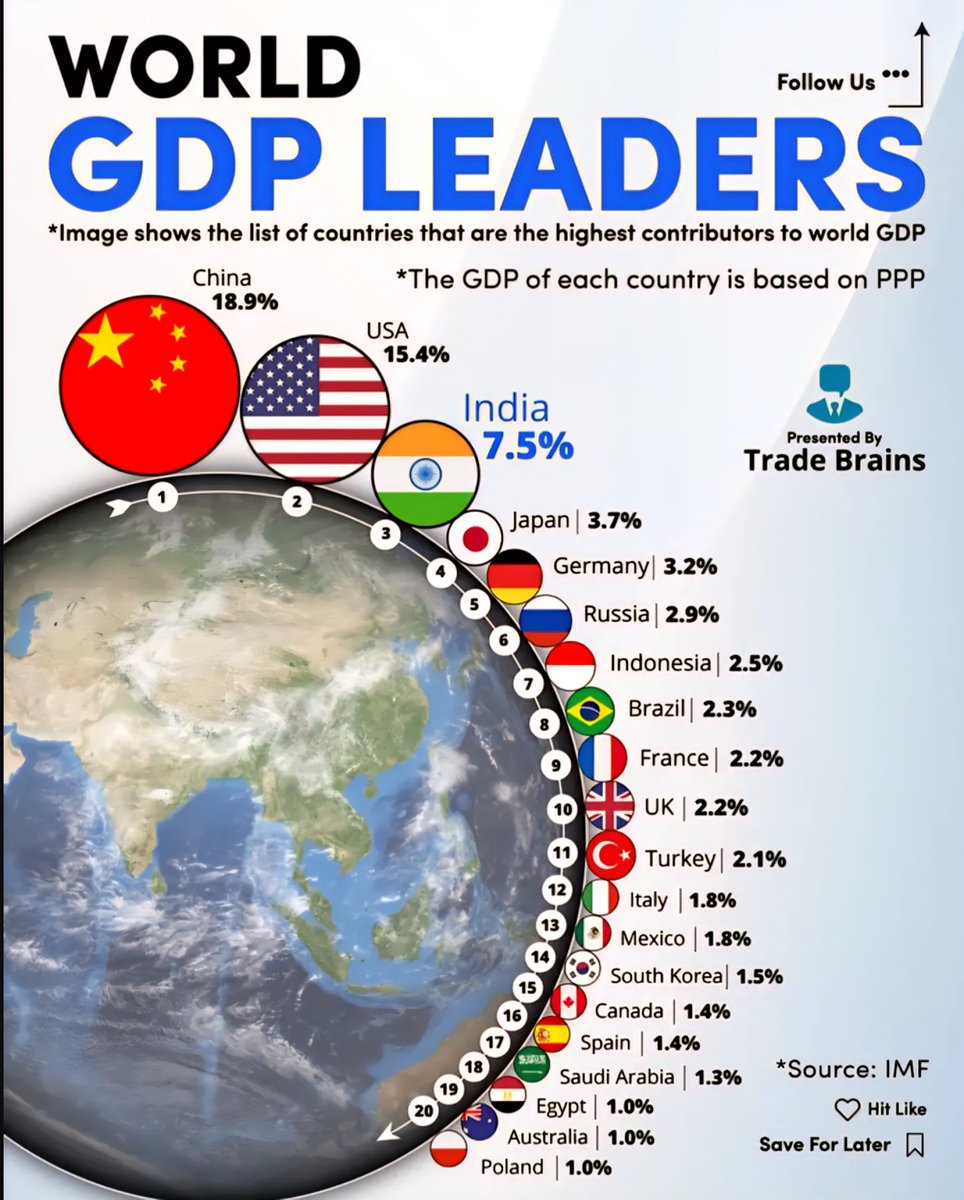
China maintains its position as the world’s largest economy based on purchasing power parity (PPP), commanding approximately 18.9% of the global GDP. This incredible dominance reflects China’s rapid economic growth over the past decade, driven by robust manufacturing, technology sectors, and infrastructure investments. The nation’s economic strength continues to influence global markets, trade policies, and international economic trends.
The United States Holds Its Position as a Economic Powerhouse
The United States secures the second spot with about 15.4% of the world’s GDP share. Despite facing economic uncertainties and shifts towards sustainable energy and technology, the U.S. economy remains resilient due to its advanced industries, innovation hubs, and consumer market size. As global dynamics evolve, the U.S. continues to exert significant influence on international economic policies and financial markets.
India’s Rapid Economic Growth Propels It to the Third Spot
India’s economy now accounts for roughly 7.5% of the global GDP share, reflecting its rapid growth trajectory. A combination of a booming tech industry, expanding middle class, and government reforms have fueled India’s economic ascendancy. The country is positioning itself as a major player on the global stage, especially in digital innovation and manufacturing.
Japan and Germany Maintain Their Long-Standing Economic Roles
Japan’s economy constitutes about 3.7%, while Germany’s stands at approximately 3.2%. Japan remains a leader in robotics, electronics, and automotive manufacturing, whereas Germany continues to be Europe’s economic backbone, known for its engineering prowess and export strength. Both nations exemplify stable, mature economies navigating demographic shifts and technological advancements.
Russia and Indonesia Show Growing Influence
Russia commands around 2.9% of global GDP share, primarily driven by energy exports and natural resources. Meanwhile, Indonesia’s economy accounts for approximately 2.5%, underpinned by its large population, natural resources, and expanding digital economy. These countries are increasingly vital to regional stability and global resource markets.
Latin American and European Economies Keep Steady Presence
Brazil (2.3%), France (2.2%), and the United Kingdom (2.2%) form the core of Latin American and European economic players. Brazil benefits from agriculture and mineral exports, while France and the UK leverage finance, tourism, and high-tech industries. Despite challenges, these nations remain key contributors to global economic diversity.
Turkey and Italy Continue Significant Roles
Turkey’s economy, representing about 2.1%, is notable for its strategic position and diversification efforts in manufacturing, agriculture, and tourism. Italy’s share stands at 1.8%, driven by fashion, automotive, and luxury goods sectors. Both countries face economic hurdles but remain influential in regional geopolitics and trade.
Emerging Economies in North America and Asia Strengthen Their Stance
Mexico (1.8%) and South Korea (1.5%) are pivotal North American and Asian players. Mexico benefits from manufacturing and trade agreements, while South Korea’s technological innovations keep it at the forefront of electronics and shipbuilding industries. Canada and Spain, each holding about 1.4%, continue to benefit from their resource-rich and service-oriented economies, respectively.
The Middle East, Africa, and the Pacific Rim Are Notably Growing
Saudi Arabia (1.3%) exemplifies energy-driven growth, with ongoing diversification efforts. Egypt and Australia, each representing approximately 1%, are focusing on resource extraction, agriculture, and technological advancement. Poland, managing a 1% share, is emerging as a transit and logistics hub in Central Europe.
With these figures, it’s evident that the global economic landscape remains dynamic. Countries are adapting to new technologies, demographic changes, and geopolitical shifts — ensuring that economic influence continues to evolve well into 2025 and beyond.
Source: IMF
 ChatGPT
 Perplexity
 Gemini AI
 Grok AI