Select Language:
Top 20 Countries with the Largest Freshwater Reserves in 2025
Brazil – Housing the Largest Freshwater Reserve at 13.2%
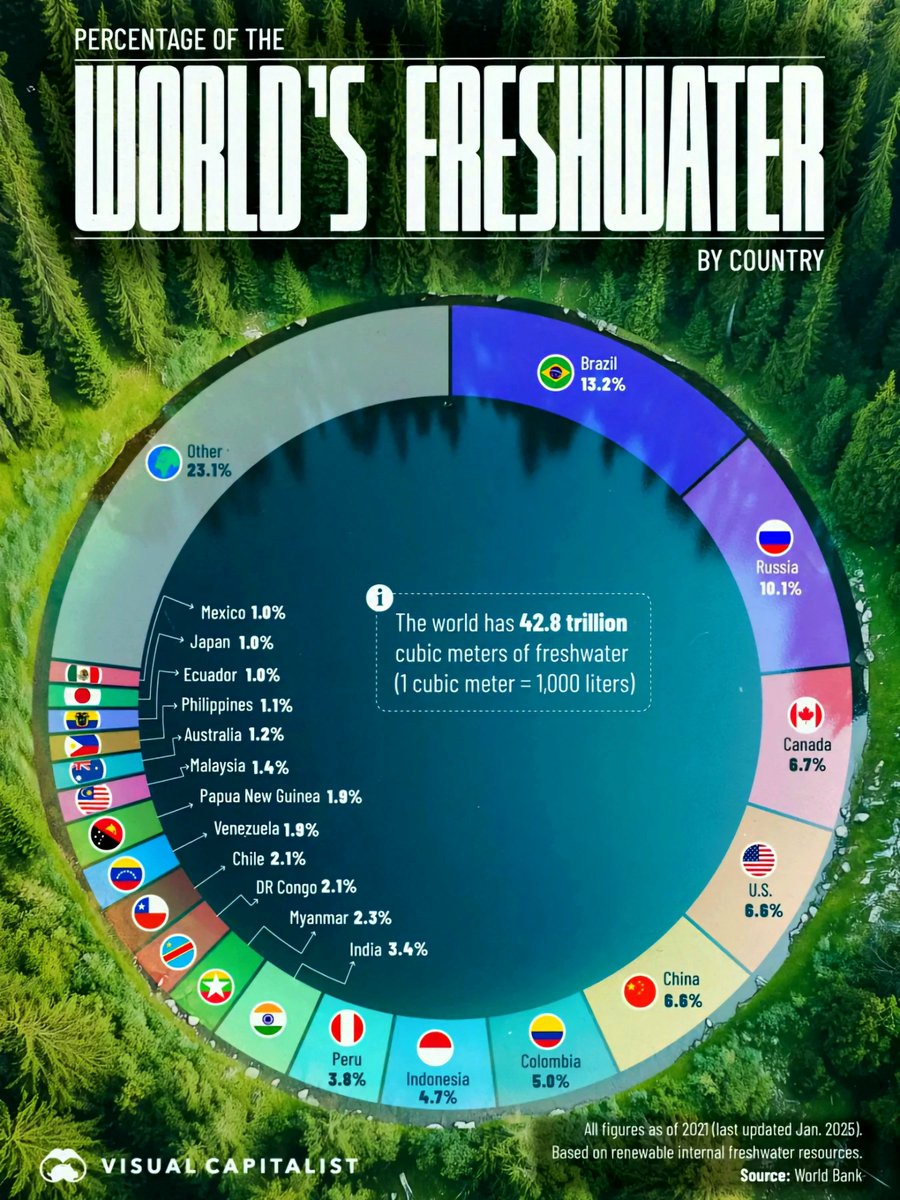
Brazil remains the leader in freshwater reserves, holding approximately 13.2% of the world’s freshwater supplies. Its vast Amazon Basin accounts for much of this abundance, making it a vital resource for both regional ecosystems and global water security.
Russia – Second Largest with 10.1%
Russia boasts the world’s second-largest freshwater reserves, primarily stored in its extensive Siberian lakes and rivers. These reserves are critical for supporting its vast population and industrial activities.
Canada – Holding 6.7%
Canada’s abundance of lakes and rivers make it a major freshwater reservoir, representing around 6.7% of global supplies. The Great Lakes and numerous other freshwater bodies are central to its landscape and economy.
United States – With 6.6%
The U.S. ranks fourth, with significant freshwater reserves distributed across the Great Lakes, Great Plains, and other regions. Freshwater availability remains crucial for agriculture, industry, and daily consumption.
China – Tied with the U.S. at 6.6%
China’s freshwater resources are immense but unevenly distributed, with some regions facing shortages despite overall large reserves. Its data underscores the importance of sustainable management amidst growing demand.
Colombia – 5.0%
Colombia is a freshwater-rich nation, especially in the Amazon and Andean regions, serving as a critical water source for local populations and neighboring countries.
Indonesia – 4.7%
As an archipelagic country, Indonesia’s plentiful lakes, rivers, and underground aquifers contribute to nearly 4.7% of the world’s freshwater reserves.
Peru – 3.8%
Peru’s extensive river systems, including the Amazon basin, provide vital water resources that support agriculture, industry, and ecosystems.
India – 3.4%
Despite rapid population growth and industrialization, India holds a substantial share of freshwater reserves, though regional shortages are becoming more common.
Myanmar – 2.3%
Rich in rivers like the Irrawaddy, Myanmar’s freshwater resources are vital for its agricultural sector and regional stability.
Democratic Republic of the Congo – 2.1%
The DRC’s vast rainforest and river networks make it a notable contributor to the globe’s freshwater stores—notably the Congo River system.
Chile – 2.1%
Chile’s freshwater reserves are concentrated in its southern regions, supporting agriculture and hydroelectricity, especially in the face of arid northern areas.
Venezuela – 1.9%
Venezuela’s abundant lakes and rivers underwrite water needs for citizens and industries, with some reservoirs facing aging infrastructure concerns.
Papua New Guinea – 1.9%
This island nation’s precipitation-heavy climate sustains extensive freshwater lakes and streams, vital for its population.
Malaysia – 1.4%
A tropical climate sustains Malaysia’s freshwater reserves, which are essential for its densely populated urban centers and agriculture.
Australia – 1.2%
Despite its reputation for droughts, Australia maintains significant freshwater resources, mainly stored in its lakes, aquifers, and the Murray-Darling Basin.
Philippines – 1.1%
An archipelago with numerous rivers and lakes, the Philippines’ freshwater is vital for its densely populated islands.
Ecuador – 1.0%
Home to part of the Amazon rainforest, Ecuador’s freshwater resources are crucial for biodiversity and local communities.
Japan – 1.0%
Japan’s mountainous terrain provides abundant rivers and reservoirs, supporting its urbanized population.
Mexico – 1.0%
Mexico’s freshwater reserves come mainly from mountain lakes and underground aquifers, supporting agriculture and urban development.
Global Perspective
Other nations collectively hold roughly 23.1% of the world’s freshwater resources, which total approximately 42.8 trillion cubic meters. This vast stockpile underscores the importance of sustainable water management to meet increasing demand worldwide.
Source: World Bank, 2025
[Note: Although some countries hold smaller proportions, their collective contribution is essential for global water security and ecological balance.]
 ChatGPT
 Perplexity
 Gemini AI
 Grok AI