Select Language:
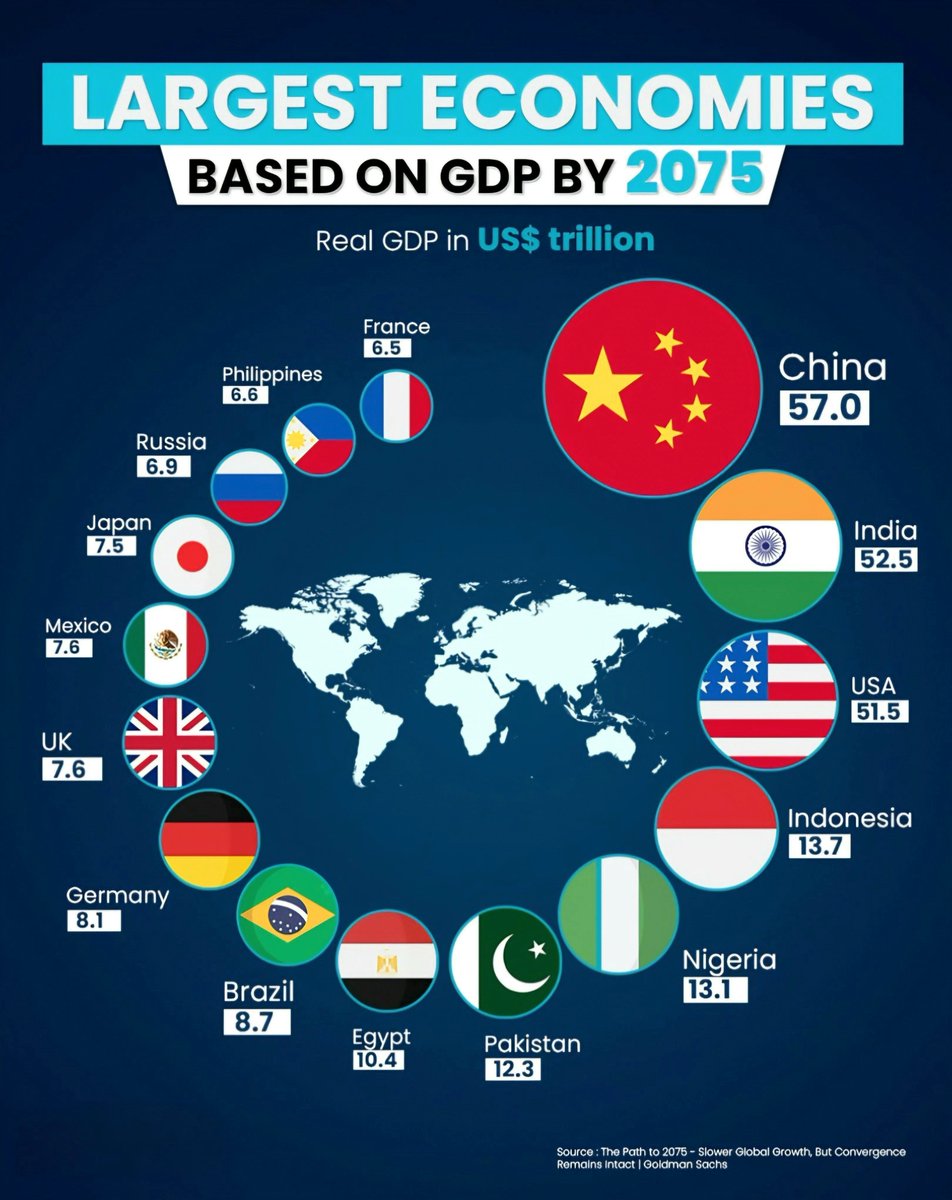
The Future of Global Economics: The Top 15 Largest Countries by 2075
1. China: The Unwavering Leader
China is expected to maintain its economic dominance well into 2075, with projected GDP surpassing $50 trillion. Its rapid technological advancements, investments in renewable energy, and expanding global trade networks solidify its position as the future’s leading economic powerhouse. The nation’s focus on innovation, infrastructure, and a burgeoning middle class continues to drive growth, positioning China at the forefront of the global economy.
2. United States: The Resilient Contender
Despite various geopolitical changes, the United States remains a major economic force, with projections placing its GDP over $35 trillion by 2075. Innovations in AI, space exploration, and biotechnology will fuel American economic expansion. The country’s diverse economy, robust entrepreneurial culture, and large consumer base will continue to sustain its economic influence into the mid-century.
3. India: The Rising Giant
India is forecasted to climb significantly on the global economic ladder, with an estimated GDP of approximately $25 trillion by 2075. Its demographic dividend, technological adoption, and infrastructure development are central to India’s growth story. As urbanization accelerates and sectors like services, manufacturing, and renewable energy thrive, India’s economic influence will expand dramatically.
4. Nigeria: Africa’s Economic Powerhouse
Nigeria is expected to emerge as Africa’s largest economy, with a projected GDP of over $8 trillion. Its natural resources, youthful population, and investments in technology and infrastructure will drive its rise. Nigeria’s economy will diversify beyond oil, focusing on innovation, agriculture, and digital sectors, making it a key player in the continent’s development.
5. Indonesia: Southeast Asia’s Leader
With a projected GDP nearing $7 trillion, Indonesia will be Southeast Asia’s dominant economic force by 2075. Its strategic location, large population, and focus on green energy and digital economy sectors will contribute to its growth. Continued investment in education and infrastructure will bolster its position on the world stage.
6. Brazil: The South American Powerhouse
Brazil is anticipated to grow into a $5.5 trillion economy, leveraging its vast natural resources, agriculture, and evolving technology sectors. Urbanization and environmental innovation will be key drivers. Brazil’s role as a regional leader in Latin America will strengthen, boosting its influence internationally.
7. Pakistan: The Emerging South Asian Nation
Projected to reach approximately $4 trillion in GDP, Pakistan’s strategic location and youthful population will fuel accelerated growth. Investment in technology, energy, and education will position Pakistan as an influential South Asian economy by 2075.
8. Japan: Continued Technological Leadership
Japan will remain a significant player, with GDP predictions around $3.8 trillion. Its advancements in robotics, manufacturing, and green technology will sustain its economic importance, especially in high-tech industries. Japan’s focus on aging population solutions will also shape its economic strategies.
9. Mexico: North America’s Key Contributor
Mexico’s economy is expected to surpass $3.5 trillion. Its close ties with North America, manufacturing sector strengths, and burgeoning internal markets will fuel continued growth. Investments in renewable energy and digital infrastructure will aid Mexico’s ascent.
10. Russia: The Eurasian Economic Force
With a projected GDP of $3 trillion, Russia’s rich natural resources and strategic geopolitical positioning will be central to its economic development. Focused on energy, technology, and innovation, Russia will continue to play an influential role on the global stage.
11. Nigeria: Africa’s Rising Star
Nigeria is predicted to head deeper into its economic potential, perhaps reaching $8.5 trillion, driven by key sectors such as digital innovation, agricultural modernization, and infrastructure. Its expanding middle class will further boost domestic consumption and investment.
12. Egypt: The Crossroads of Africa and Asia
Egypt’s strategic location and growing sectors like tourism, energy, and transportation will lead it to a projected GDP of $1.8 trillion. Its investments in renewable energy and urban development will underpin its economic growth.
13. Indonesia: The Prosperous Archipelago
Positioned as Southeast Asia’s economic linchpin, Indonesia’s economy will exceed $7 trillion, driven by an expanding digital economy, renewable energy projects, and infrastructure investments. Its large and youthful population will remain a critical growth driver.
14. Iran: The Resilient Middle Eastern Power
With a projected GDP of about $2.3 trillion, Iran’s economic future hinges on its technological development, diversification away from oil dependence, and regional collaborations. Reforms and modernization efforts will be crucial to its growth trajectory.
15. Democratic Republic of the Congo: Africa’s Resource-Rich Nation
While still developing, the DRC could reach approximately $1.5 trillion by 2075, propelled by mineral wealth and infrastructure development. Strategic investment in renewable energy and technology sectors will be vital to unlocking its economic potential.
As global dynamics evolve, these projections highlight a future where rapid technological development, strategic investments, demographic shifts, and geopolitical changes will shape the world’s largest economies. The race for economic supremacy will continue, with emerging nations poised to redefine global influence.
 ChatGPT
 Perplexity
 Gemini AI
 Grok AI