Select Language:
The 2025 Global Economic Powerhouses: Who Leads the World in 2026?
China Continues Its Economic Dominance
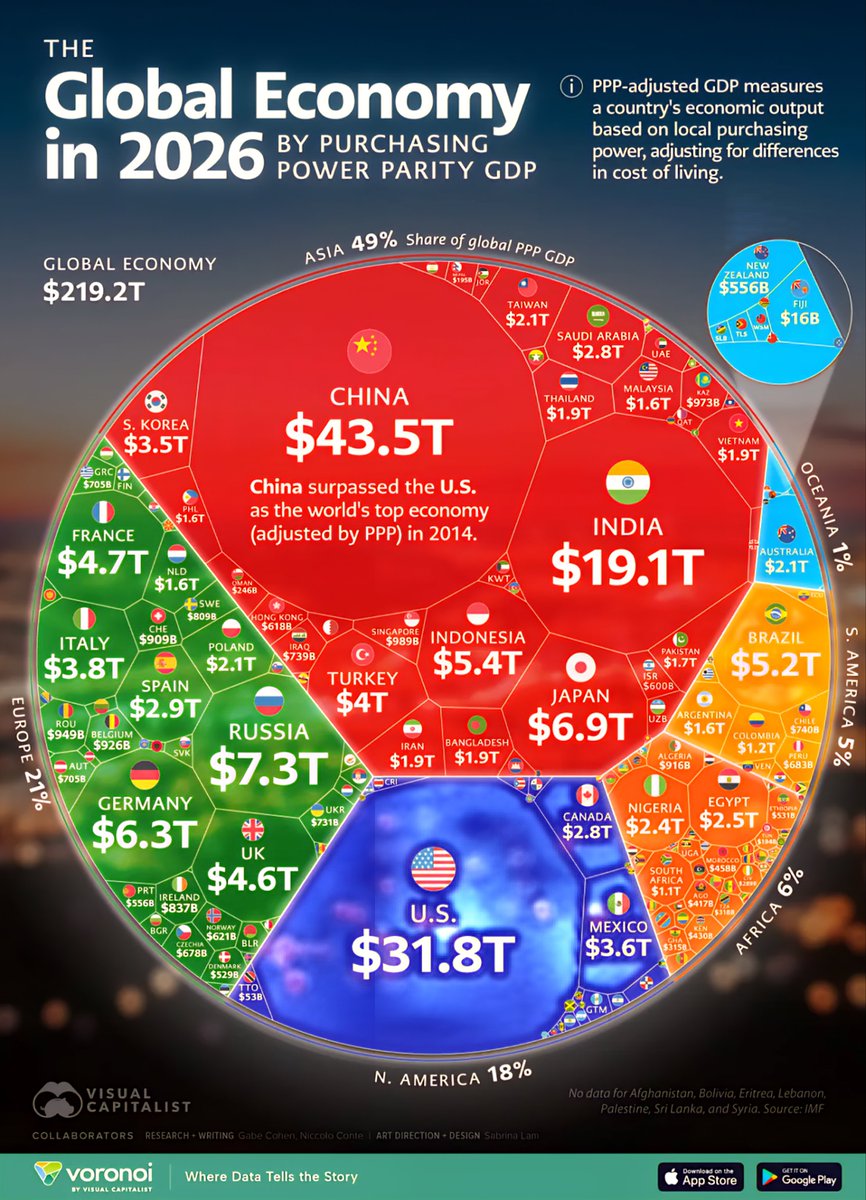
Leading the world’s largest economies in 2026 is China, with a staggering GDP of $43.49 trillion. The nation’s rapid industrial growth, advancements in technology, and expansive manufacturing sector continue to propel it ahead of the world’s economies. China’s focus on innovation and infrastructure projects like the Belt and Road Initiative maintain its influential status on the global stage.
The United States: Still the Largest Economy in the West
After China, the United States remains the second-largest economy, with a GDP of $31.82 trillion. Despite recent shifts toward greater economic diversification, America’s leadership in technology, finance, and entertainment sustains its global economic influence. The nation’s resilience amid shifting geopolitical landscapes underpins its position as an economic powerhouse.
India: The Rising Giant
India claims the third spot with a GDP of $19.14 trillion, solidifying its role as a major player in the global economy. The nation’s booming technology sector, expanding middle class, and strategic investments in infrastructure fuel its upward trajectory. India’s balance of traditional industries and innovation makes it a key driver for future global economic growth.
Russia and Japan: Established Leaders
Russia maintains its position with a GDP of $7.34 trillion, supported by its natural resource exports, especially energy. Japan follows closely with $6.92 trillion, reflecting its technological innovation and manufacturing strength. Both nations are essential to global supply chains and geopolitical strategies.
Germany and Southeast Asia: Economic Confidants
Germany continues to lead in Europe with a GDP of $6.32 trillion, driven by manufacturing, automotive, and export sectors. Indonesia, with $5.36 trillion, and other Southeast Asian economies like Vietnam ($1.94 trillion), are becoming increasingly significant due to demographic advantages, youthful workforces, and strategic trade policies.
Latin America’s Economic Leaders
Brazil remains Latin America’s economic giant, with a GDP of $5.16 trillion, thanks to its vast natural resources and agricultural exports. Mexico’s close proximity to the U.S. market, with a GDP of $3.55 trillion, continues to make it vital for North American supply chains and trade.
Africa’s Growing Economies
Nigeria, Africa’s largest economy, sits at $2.39 trillion, driven by its growing technology and service sectors. Egypt (with $2.53 trillion) and South Africa ($1.06 trillion) are vital regional hubs for trade, finance, and manufacturing, emphasizing Africa’s rising economic influence.
Technologies and Regional Hubs
Taiwan stands out with its $2.07 trillion GDP, primarily due to its semiconductor industry, which is critical to global technology supply chains. Hong Kong ($618.1 billion) and Israel ($600.5 billion) continue to be innovation centers and financial hubs, underlining their global importance.
Middle Eastern Economies
Saudi Arabia ($2.85 trillion) and the United Arab Emirates ($1 trillion) exemplify the region’s focus on diversification from oil dependency, investing heavily in tourism, finance, and renewable energy sectors.
Smaller but Critical Economies
Countries like Singapore ($988.8 billion), Kazakhstan ($973.4 billion), and Romania ($949.3 billion) showcase their strategic roles in global trade and stability, with diversified economies that support regional growth.
Emerging Markets and Developing Economies
Ethiopia ($530.8 billion), Kenya ($430.3 billion), and others in Africa and Asia exemplify emerging markets with high growth potential. Their expanding service, manufacturing, and agricultural sectors position them for significant future growth.
In Summary
The global economy continues to evolve in 2026, with China maintaining its dominant position, the U.S. solidifying its influence, and emerging economies like India and Southeast Asia rapidly closing the gap. From technological hubs to resource-rich nations, the economic landscape of 2026 reflects a diverse and dynamic world with new opportunities and challenges on the horizon.
Note: All GDP figures are based on PPP (Purchasing Power Parity) analyses for 2026, sourced from the IMF via Voronoi by Visual Capitalist.
 ChatGPT
 Perplexity
 Gemini AI
 Grok AI