Select Language:
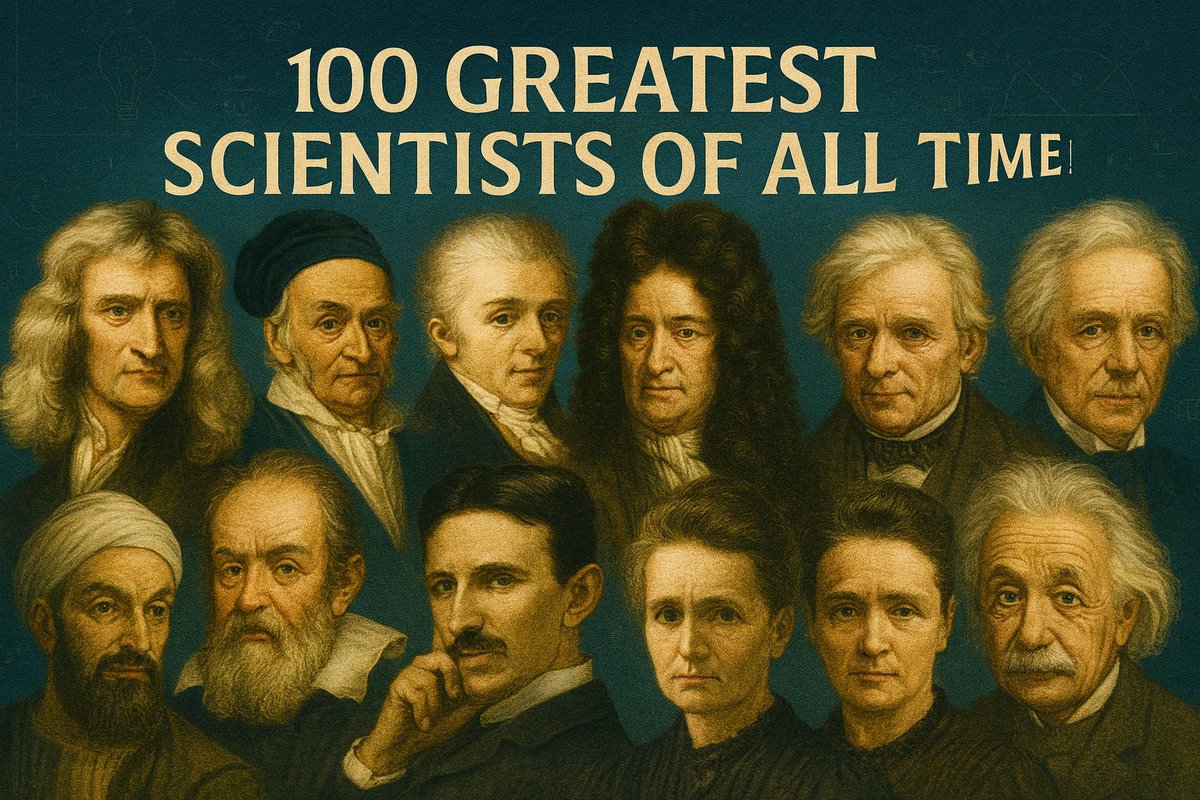
Celebrating 2025’s Top 10 Greatest Scientists of All Time
-
Isaac Newton (United Kingdom)
The man whose laws of motion and gravity laid the groundwork for classical physics remains a towering figure in science. His groundbreaking work in calculus, optics, and astronomy transformed understanding about the universe and inspired generations of scientists. -
Leonhard Euler (Switzerland)
A mathematical prodigy, Euler’s contributions span calculus, graph theory, and algebra. His work continues to influence math, engineering, and computer science, earning him recognition as one of history’s most prolific mathematicians.ADVERTISEMENT -
Gottfried Leibniz (Germany)
Leibniz co-invented calculus independently of Newton, developing a notation still used today. His philosophical insights into logic and metaphysics also shape modern scientific thought. -
Carl Friedrich Gauss (Germany)
Often called the “Prince of Mathematicians,” Gauss’s work in number theory, astronomy, and electromagnetism laid essential foundations that propelled scientific progress across disciplines. -
Michael Faraday (United Kingdom)
Faraday’s discoveries in electromagnetism and electrochemistry revolutionized electrical engineering, leading to the development of motors, transformers, and generators that power today’s world. -
Alhazen Ibn Al-Haytham (Iraq)
Regarded as the pioneer of optics, his experiments with light and vision laid early groundwork for modern scientific method in experimental physics. -
Galileo Galilei (Italy)
The ‘father of modern science,’ Galileo’s astronomical observations and experiments challenged existing doctrines, placing science on a firm empirical foundation. -
Nikola Tesla (Serbia/United States)
Tesla’s pioneering work in AC electricity and wireless communication shaped the modern electrical infrastructure and inspired countless innovations in technology.ADVERTISEMENT -
Marie Skłodowska-Curie (Poland/France)
The first woman to win a Nobel Prize, her research on radioactivity opened new frontiers in physics and medicine, including cancer therapies. -
Albert Einstein (Germany/United States)
Einstein’s theories of relativity revolutionized physics, influencing cosmology and our understanding of space, time, and gravity.
Detailed Insights into the Pioneers of Science
The list of groundbreaking scientists is as diverse as their contributions, spanning centuries and continents. From the early anatomists like Galen to contemporary figures like Katherine Johnson, they collectively shape the foundation of scientific knowledge.
Note: The 2025 rankings recognize scientists who not only advanced their fields but also fostered innovations that continue to impact daily life—such as electricity, medicine, and technology.
Emerging Pioneers and Continuing Legacies
While some names have been celebrated for centuries, modern scientists like William Thomson Kelvin and Katherine Johnson exemplify how the pursuit of knowledge endures. Their work continues to inspire today’s innovation-driven world, encouraging new generations to push the boundaries of understanding.
Contributions That Changed the World
The contributions by these scientist icons range from the microscopic to the cosmic. For instance, Antonie van Leeuwenhoek’s microscopes uncovered microorganisms, reshaping biology, while Wilhelm Röntgen’s discovery of X-rays revolutionized medical diagnostics.
Why These Scientists Matter Today
Recognition of these figures underscores the importance of scientific curiosity, perseverance, and innovation. Their discoveries have paved the way for technological revolutions, enhanced medical treatments, and expanded our cosmic horizons.
Conclusion
As science continues to evolve in 2025, honoring these extraordinary individuals reminds us that progress is a collective effort across generations. Their legacies inspire current and future scientists to explore, innovate, and solve humanity’s most pressing challenges.
 ChatGPT
 Perplexity
 Gemini AI
 Grok AI