Select Language:
The 25 Most Influential Mathematicians of 2025: Pioneers Who Shaped the World of Numbers
-
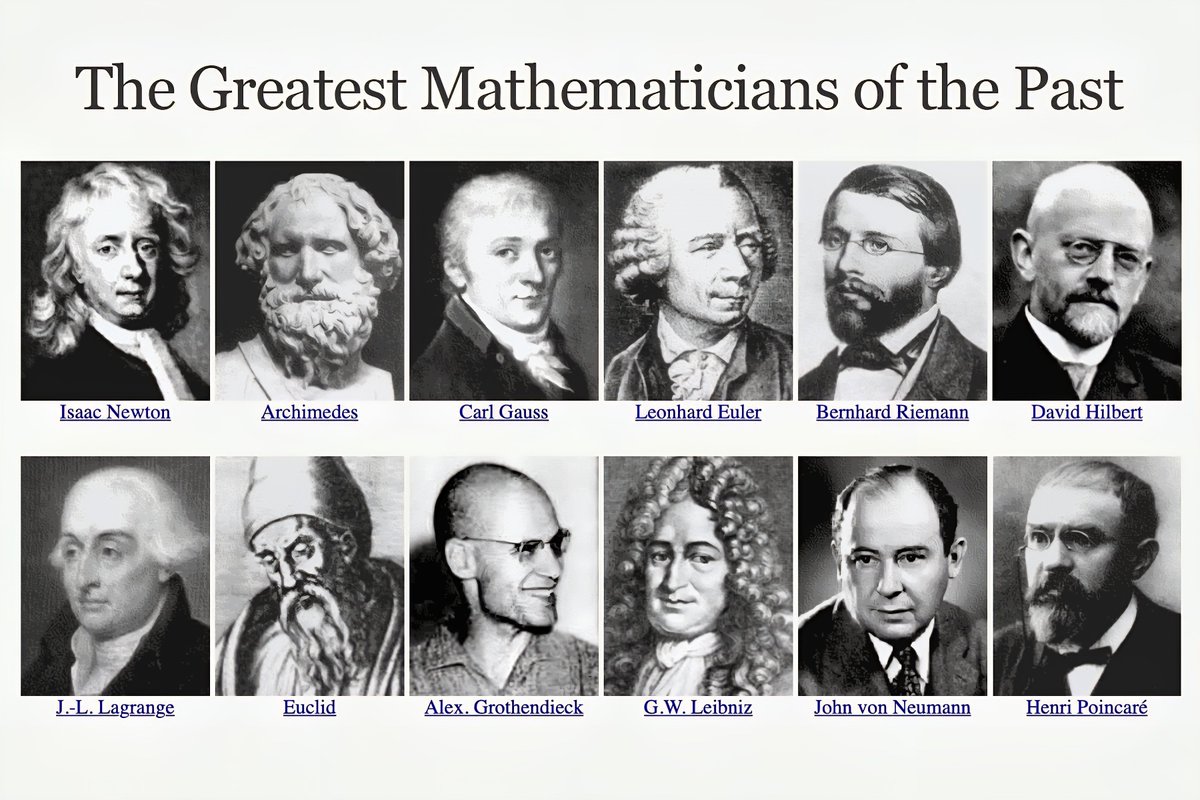
Isaac Newton (England)
The mathematician and physicist credited with the formalization of calculus and groundbreaking laws of motion that still form the foundation of classical mechanics. -
Archimedes (Greece)
A Greek genius renowned for discovering principles of buoyancy and war machines, laying the groundwork for applied mathematics and engineering. -
Carl Friedrich Gauss (Germany)
Often called the “Prince of Mathematicians,” his work spans number theory, algebra, astronomy, and more, influencing countless fields. -
Leonhard Euler (Switzerland)
A prolific mathematician whose contributions range from calculus to graph theory, significantly shaping modern mathematics. -
Bernhard Riemann (Germany)
Famous for Riemannian geometry, which underpins Einstein’s theory of general relativity, and his enigmatic hypothesis about the distribution of prime numbers. -
David Hilbert (Germany)
Known for formulating Hilbert spaces, which are fundamental in quantum mechanics, and for proposing problems that spurred 20th-century mathematical research. -
Joseph-Louis Lagrange (France/Italy)
Pioneer of analysis and mechanics, Lagrange introduced the method of Lagrange multipliers and contributed to celestial mechanics. -
Euclid of Alexandria (Egypt)
The “Father of Geometry,” his Elements remains one of the most influential textbooks in the history of mathematics. -
Alexandre Grothendieck (France)
Transforming algebraic geometry, his abstract theories have deepened the understanding of topology and number theory. -
Gottfried Wilhelm Leibniz (Germany)
Alongside Newton, Leibniz developed calculus independently, impacting virtually all scientific disciplines. -
John von Neumann (Hungary/USA)
Mathematician and computer scientist, key to the development of game theory, quantum mechanics, and the architecture of modern computers. -
Henri Poincaré (France)
A father of chaos theory, Poincaré fundamentally changed the understanding of dynamical systems and topology. -
Évariste Galois (France)
His pioneering work on group theory and polynomial equations laid the basis for modern algebra. -
Srinivasa Ramanujan (India)
A self-taught genius, Ramanujan’s extraordinary formulas and identities continue to influence number theory and mathematical analysis. -
Pierre de Fermat (France)
Famous for Fermat’s Last Theorem, his work in number theory, especially “Fermat primes,” remains foundational. -
Hermann Weyl (Germany)
His research bridged mathematics, physics, and philosophy, especially in gauge theories and symmetry. -
Karl Weierstrass (Germany)
Known as the “Father of Modern Analysis,” his rigorous approach to calculus set the stage for future mathematical proofs. -
Brahmagupta (India)
Ancient Indian mathematician credited with early work on zero, negative numbers, and quadratic equations. -
Niels Abel (Norway)
His work on elliptic functions and Abelian groups revolutionized algebra and complex analysis. -
René Descartes (France)
Father of analytic geometry, he linked algebra with geometry, enabling the development of calculus. -
Georg Cantor (Germany)
Founded set theory, introducing the concept of different infinities, reshaping the understanding of mathematical infinity. -
Emmy Noether (Germany)
A feminist pioneer, her work on symmetry and conservation laws deeply influences modern algebra and physics. -
Peter G. L. Dirichlet (Germany)
Known for contributions to number theory, Fourier series, and the Dirichlet principle. -
Pythagoras of Samos (Greece)
The ancient Greek mathematician renowned for the Pythagorean theorem and early number philosophy. -
Muhammad al-Khwarizmi (Persia)
The father of algebra; his works introduced algorithms and significantly impacted mathematics and computing.
The landscape of mathematics continues to evolve with modern visionaries, but these pioneers laid the paths that continue to guide us today.
Note: The list above recognizes the influence of historical and contemporary mathematicians whose breakthroughs resonate within various scientific fields, driving innovation and understanding in 2025.
 ChatGPT
 Perplexity
 Gemini AI
 Grok AI