Select Language:
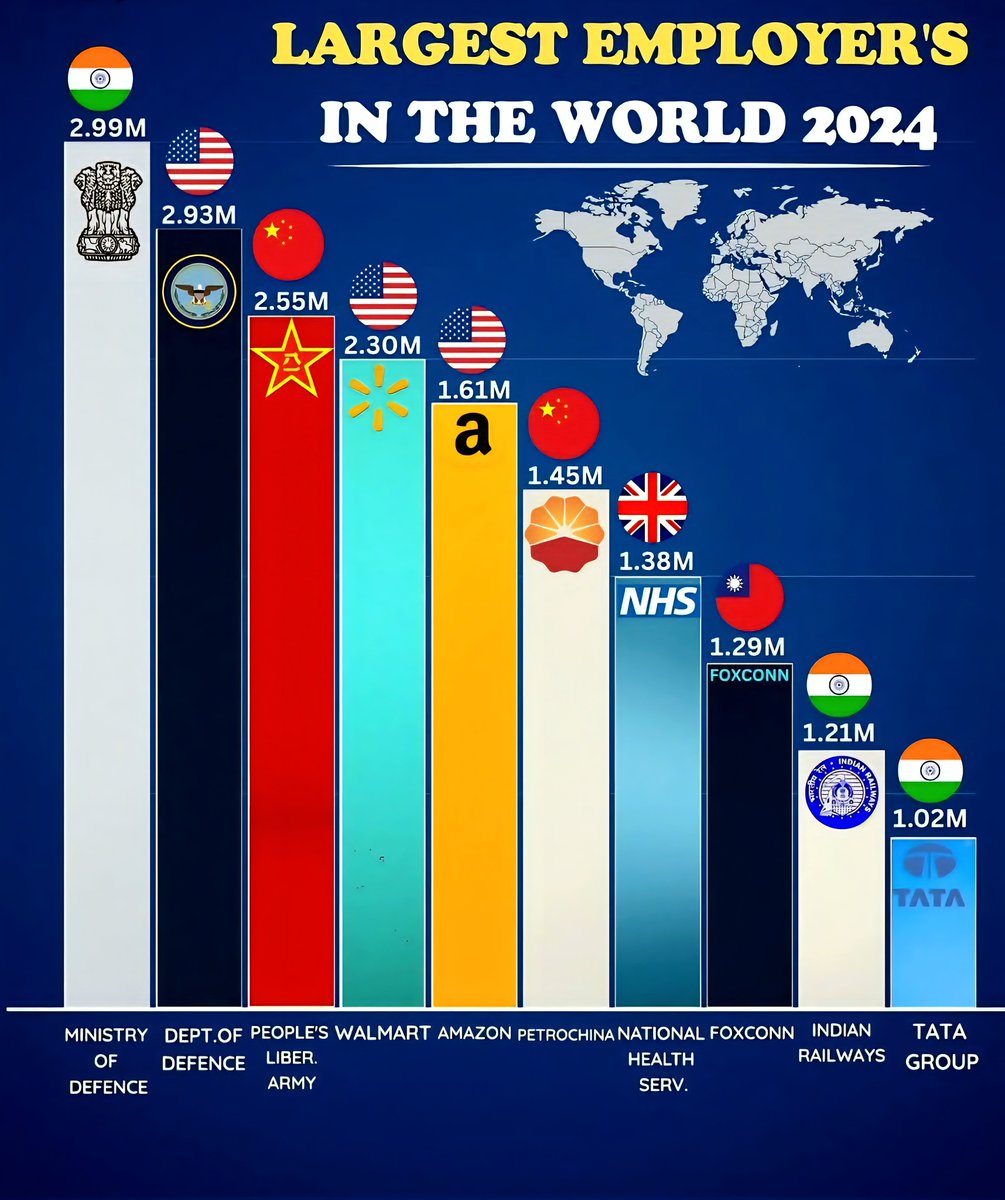
The Largest Employers Around the World in 2025: Top 10 Giant Workforce Companies
1. The Indian Ministry of Defence
Leading the global employer rankings in 2025, the Indian Ministry of Defence proudly employs approximately 3 million individuals. As the backbone of India’s national security infrastructure, it encompasses a vast network of personnel across various branches, including the army, navy, and air force. The ministry’s extensive workforce is vital to maintaining peace and sovereignty in the region.
2. U.S. Department of Defense
Sitting just behind India’s defense sector, the United States’ Department of Defense employs nearly 2.93 million personnel. This massive organization oversees the military operations, procurement, and strategic planning for the U.S. armed forces, underlining its critical role in national security. Its large workforce reflects the country’s commitment to maintaining global military influence.
3. The Chinese People’s Liberation Army
As one of the world’s largest military forces, the Chinese People’s Liberation Army (PLA) employs an estimated 2.55 million personnel. The PLA’s size underscores China’s focus on modernizing its military infrastructure and expanding its influence across Asia and beyond. Its personnel are spread across land, sea, air, and strategic missile forces, showcasing a multi-domain approach to defense.
4. Walmart – The Retail Powerhouse
Walmart remains the largest private employer globally in 2025, with approximately 2.3 million employees. This retail giant has maintained its dominance through nationwide and international outlets, providing jobs ranging from entry-level cashiers to corporate executives. Walmart continues to adapt in the evolving retail landscape, ensuring employment for millions.
5. Amazon – The E-commerce Titan
With a workforce nearing 1.61 million, Amazon continues to revolutionize online shopping and logistics. Its expansive operations include fulfillment centers, delivery networks, and cloud computing services, all driven by a highly diverse and innovative workforce. Amazon’s employment figures reflect its status as a pillar of modern commerce.
6. PetroChina – The Energy Giant
China’s PetroChina employs around 1.45 million workers, making it a key player in the global energy sector. As part of China’s national oil and gas infrastructure, PetroChina focuses on exploration, refining, and distribution. Its vast employment base highlights the importance of energy security in China’s economic growth.
7. National Health Service (NHS) – The Healthcare Backbone of Britain
The National Health Service (NHS) employs about 1.38 million staff members, making it the largest employer in the United Kingdom. The NHS plays a crucial role in delivering health services to millions, encompassing doctors, nurses, administrative personnel, and support staff dedicated to public health.
8. Foxconn – The Electronics Manufacturing Powerhouse
Taiwan’s Foxconn, known for assembling Apple’s iPhones, employs roughly 1.29 million people worldwide. The company’s staggering workforce supports a global supply chain of electronic devices, illustrating the scale of manufacturing employment needed to meet tech demands.
9. Indian Railways – Connecting a Nation
Employing approximately 1.21 million individuals, Indian Railways remains one of the world’s largest employers. Its extensive network connects the subcontinent and supports both passenger and freight services, making it a vital component of India’s economic and social fabric.
10. Tata Group – India’s Conglomerate Giant
Employing more than 1 million workers, Tata Group is a diversified multinational conglomerate with interests spanning automotive, steel, hospitality, and information technology sectors. Its widespread employment reflects Tata’s importance to India’s industrial and economic landscape, with a focus on sustainable growth.
The employment landscape in 2025 demonstrates a diverse array of industries, from defense and healthcare to manufacturing and retail, underscoring the scale at which some organizations operate to shape economies and influence societies worldwide.
Source: World Population Review 2025
 ChatGPT
 Perplexity
 Gemini AI
 Grok AI