Select Language:
1. United States: The Economic Powerhouse
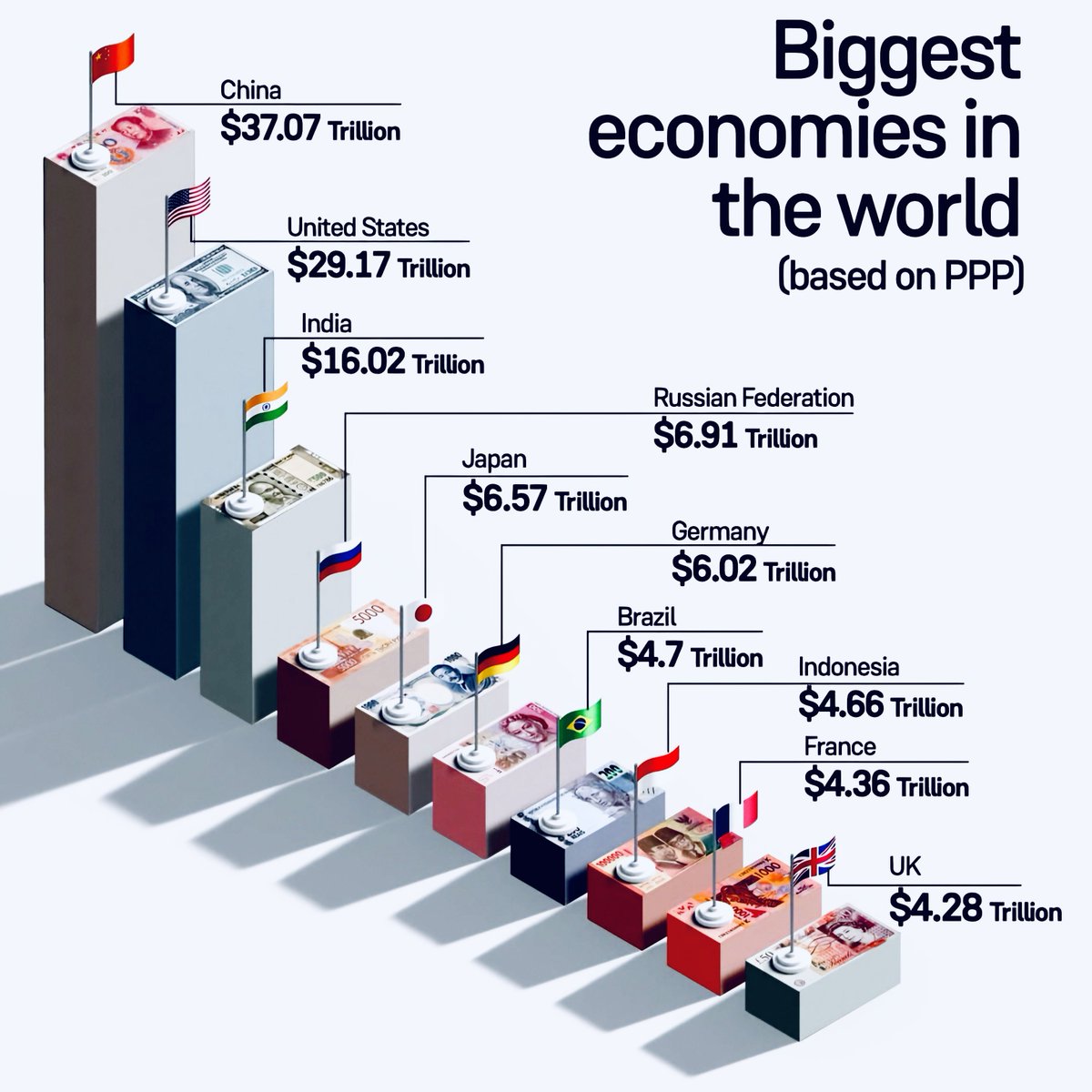
The United States continues to hold its position as the world’s largest economy by Purchasing Power Parity (PPP). Its diverse economy spans technology, finance, healthcare, and consumer goods, making it a dominant global influence. The nation’s innovation sectors, including Silicon Valley, drive growth and set global trends. Despite facing challenges such as income inequality and inflation, the U.S. remains resilient, with a GDP estimated at over $26 trillion in 2025.
2. China: The Rapid Growth Juggernaut
China remains the second-largest economy globally, with remarkable expansion over the past decades. Thanks to its manufacturing base, technological advancements, and rapid urbanization, China’s economy continues to grow at a significant pace. The Belt and Road Initiative and investments in green technologies bolster its future prospects. In 2025, China’s PPP-adjusted GDP is estimated at around $21 trillion, solidifying its position as an economic superpower.
3. India: The Emerging Giant
India’s economy is rapidly ascending, driven by a young population, technological innovation, and a burgeoning service sector. Domestically, digital payments, startups, and manufacturing are expanding. The government’s focus on infrastructure and reforms has attracted foreign investment. With an estimated PPP GDP of approximately $13 trillion in 2025, India is set to challenge traditional economic powers within the next decade.
4. Japan: The Technological Veteran
Having long been a global leader in technology and automotive industries, Japan maintains its position among the top economies. Despite an aging population, Japan leverages innovation, robotics, and high-quality exports to sustain its economic standing. In 2025, Japan’s PPP GDP is approximately $5.8 trillion, reflecting steady growth and technological resilience.
5. Germany: Europe’s Economic Anchor
As Europe’s largest economy, Germany boasts a robust manufacturing sector, especially in automobiles, machinery, and pharmaceuticals. Its strength lies in high-quality exports and a highly skilled workforce. The nation is also pioneering green energy initiatives. With an estimated PPP GDP of about $4.9 trillion in 2025, Germany remains crucial in the global economic arena.
6. Indonesia: Southeast Asia’s Economic Rising Star
Indonesia has experienced rapid economic growth, fueled by commodity exports, a large population, and improving infrastructure. Its expanding middle class and digital economy are expected to propel further development. In 2025, Indonesia’s PPP GDP is roughly $4.4 trillion, making it one of the most significant economies in Southeast Asia.
7. United Kingdom: The Financial Hub
Despite recent economic uncertainties, the UK maintains a formidable presence as a global financial hub, with London being a major center for banking, finance, and international business. The economy is diversified across services, manufacturing, and technology sectors. Its PPP GDP stands at approximately $4 trillion in 2025.
8. France: Cultural and Economic Power
France’s economy benefits from a strong industrial base, tourism, and agriculture, alongside a dynamic tech scene. The government continues to focus on innovation and sustainability. France’s PPP-adjusted GDP reaches around $3.8 trillion in 2025, maintaining its position among top global economies.
9. Brazil: Latin America’s Largest Economy
Brazil boasts extensive natural resources, a large consumer base, and a diversified economy that includes agriculture, mining, and manufacturing. Political and economic reforms in recent years have aimed to stabilize growth. In 2025, Brazil’s PPP GDP is estimated at approximately $3.4 trillion, reinforcing its regional influence.
10. Italy: Europe’s Industrial Powerhouse
Italy remains a key player in fashion, automotive, and manufacturing sectors. Its rich cultural history complements a resilient economy shaped by small and medium enterprises. Italy’s PPP GDP in 2025 is around $3.2 trillion, underlining its importance within the European Union.
This list highlights the shifting landscape of global economic powerhouses in 2025, reflecting growth, innovation, and geopolitical shifts shaping the world’s top economies today.
 ChatGPT
 Perplexity
 Gemini AI
 Grok AI