Select Language:
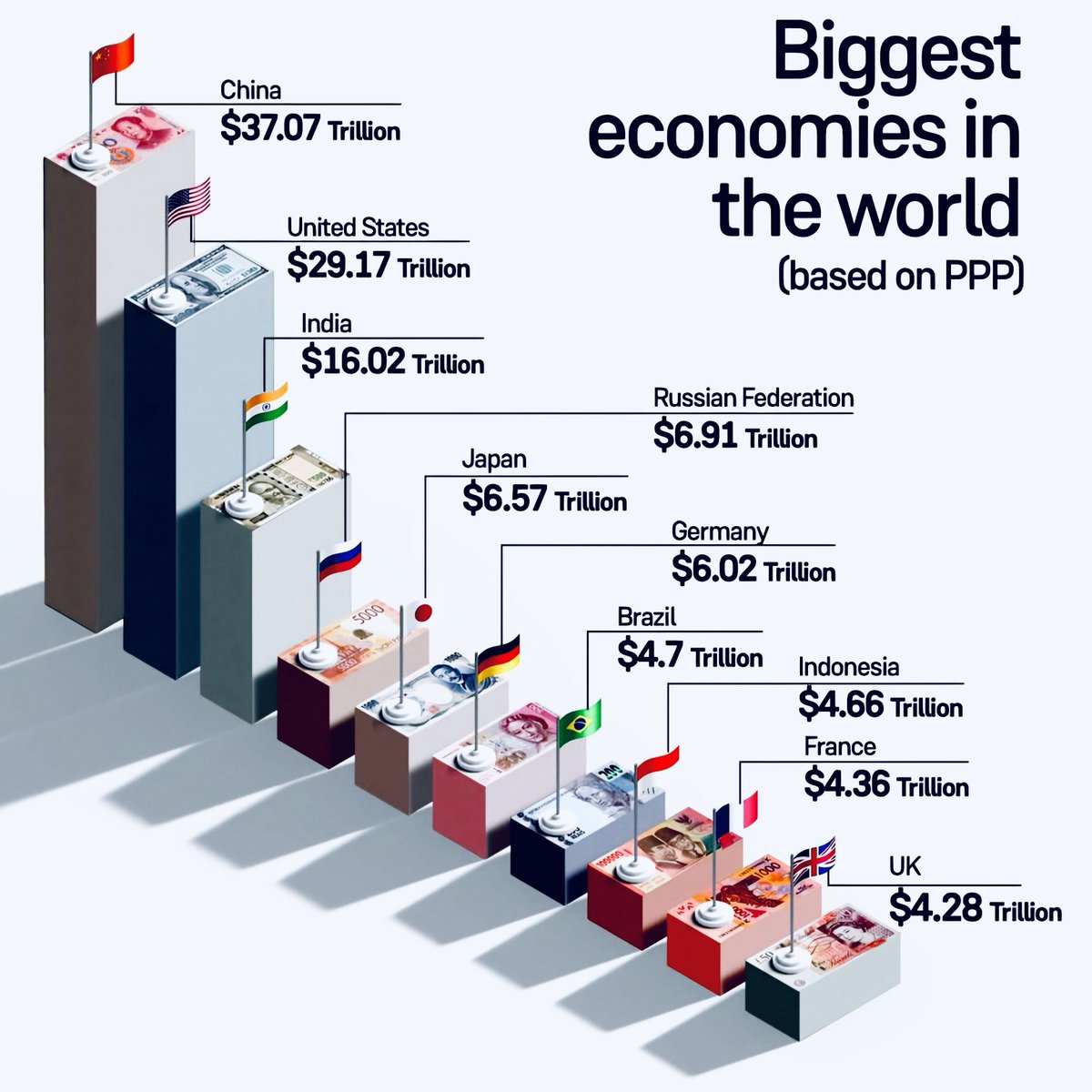
The World’s Largest Economies by PPP in 2025: A Closer Look
China Continues to Dominate Global Economics
With a staggering gross domestic product (GDP) of $37.07 trillion based on Purchasing Power Parity (PPP), China maintains its position as the world’s largest economy. Its rapid development over the past decades has been driven by manufacturing, infrastructure growth, and a burgeoning consumer market. Despite geopolitical tensions and economic challenges, China’s influence on global markets only appears to be strengthening as of 2025. Its robust domestic policies and investments in technology sectors have propelled it to the forefront, shaping the trajectory of global trade and investment.
The United States Holds Strong, But Narrowing Gap
The United States clocks in with a PPP-adjusted GDP of $29.17 trillion, ranking second globally. Despite its smaller lead compared to China, the U.S. remains a powerhouse with dominant technology, finance, and innovation sectors. The country’s diversified economy helps weather international economic fluctuations, maintaining its global influence. However, the recent economic shifts and the push towards sustainable initiatives indicate evolving strategies that could reshape its standing in the coming years.
India Rises to New Heights
India’s economy has surged to an impressive $16.02 trillion in PPP terms, securing its position as the third-largest economy. Rapid urbanization, a booming tech industry, and substantial foreign investments have fueled this growth. By 2025, India’s focus on digital transformation and manufacturing is expected to continue bolstering its status. The nation’s youthful population and expanding middle class are further driving consumption and economic activity, signaling sustained growth ahead.
Russia’s Economic Outlook Amid Global Shifts
Russia’s economy stands at approximately $6.91 trillion in PPP, placing it among the top five. While its economy is heavily reliant on natural resources, especially oil and natural gas, geopolitical tensions and international sanctions have restricted growth. Nonetheless, Russia has been making efforts to diversify its economy, emphasizing agriculture, technology, and defense. Its strategic alliances and resource management will play crucial roles in shaping its economic path moving forward.
Japan’s Steady Economic Presence
With a GDP of around $6.57 trillion in PPP, Japan remains one of the world’s leading economies. Known for its technological innovation, advanced manufacturing, and automotive industry, Japan continues to be a critical player in global markets. Despite aging demographics and slow population growth, Japan’s focus on robotics, automation, and high-tech exports sustains its economic strength.
Germany’s Economic Resilience
Germany, Europe’s largest economy, boasts a PPP GDP of $6.02 trillion. Its strength lies in engineering, automotive technology, and export-oriented manufacturing. Even in the face of global supply chain disruptions and shifting energy policies, Germany has demonstrated resilience and adaptability. The nation’s commitment to sustainable energy and digital transformation signals future growth prospects.
Brazil and Indonesia: Rising Economic Giants
Brazil, with a PPP GDP of $4.70 trillion, remains South America’s largest economy. Its agricultural sector, natural resources, and recent investments in technology are pivotal to its growth. Meanwhile, Indonesia, with $4.66 trillion in PPP terms, is experiencing rapid development fueled by urbanization, infrastructure projects, and a young population. Both countries are increasingly influential in regional geopolitics and global markets.
France’s Persistent Economic Power
France’s economy stands at about $4.36 trillion in PPP, maintaining its position as Western Europe’s key economic player. Its diversified economy, including luxury goods, aerospace, and tourism, continues to be vital. France’s proactive stance on green technologies and innovation initiatives demonstrates its commitment to sustainable growth.
The UK’s Evolving Economic Role
With a PPP GDP of $4.28 trillion, the United Kingdom remains a significant financial and technological hub. Post-Brexit adjustments, alongside investments in artificial intelligence, green energy, and financial services, are shaping a new phase of growth. The UK’s emphasis on innovation and global trade partnerships will influence its economic trajectory in 2025 and beyond.
Summary Table: Top 10 Economies by PPP in 2025
| Rank | Country | PPP GDP (Trillions USD) |
|---|---|---|
| 1 | China | $37.07 |
| 2 | United States | $29.17 |
| 3 | India | $16.02 |
| 4 | Russia | $6.91 |
| 5 | Japan | $6.57 |
| 6 | Germany | $6.02 |
| 7 | Brazil | $4.70 |
| 8 | Indonesia | $4.66 |
| 9 | France | $4.36 |
| 10 | United Kingdom | $4.28 |
As the global economy continues to evolve in 2025, these rankings highlight the changing landscape and emerging powerhouses. While traditional economic leaders maintain their status, rising nations like India and Indonesia are set to redefine economic influence on the world stage, driven by innovation, demographic shifts, and strategic investments.
 ChatGPT
 Perplexity
 Gemini AI
 Grok AI