Select Language:
The Largest Economies of 2075: What the Future Holds
As we look ahead to 2075, the global economic landscape is poised for dramatic transformation. Advanced technology, shifts in geopolitical power, and innovations in industry are expected to redefine the economic hierarchy. Here’s a detailed look at the countries predicted to be the biggest economies of 2075.
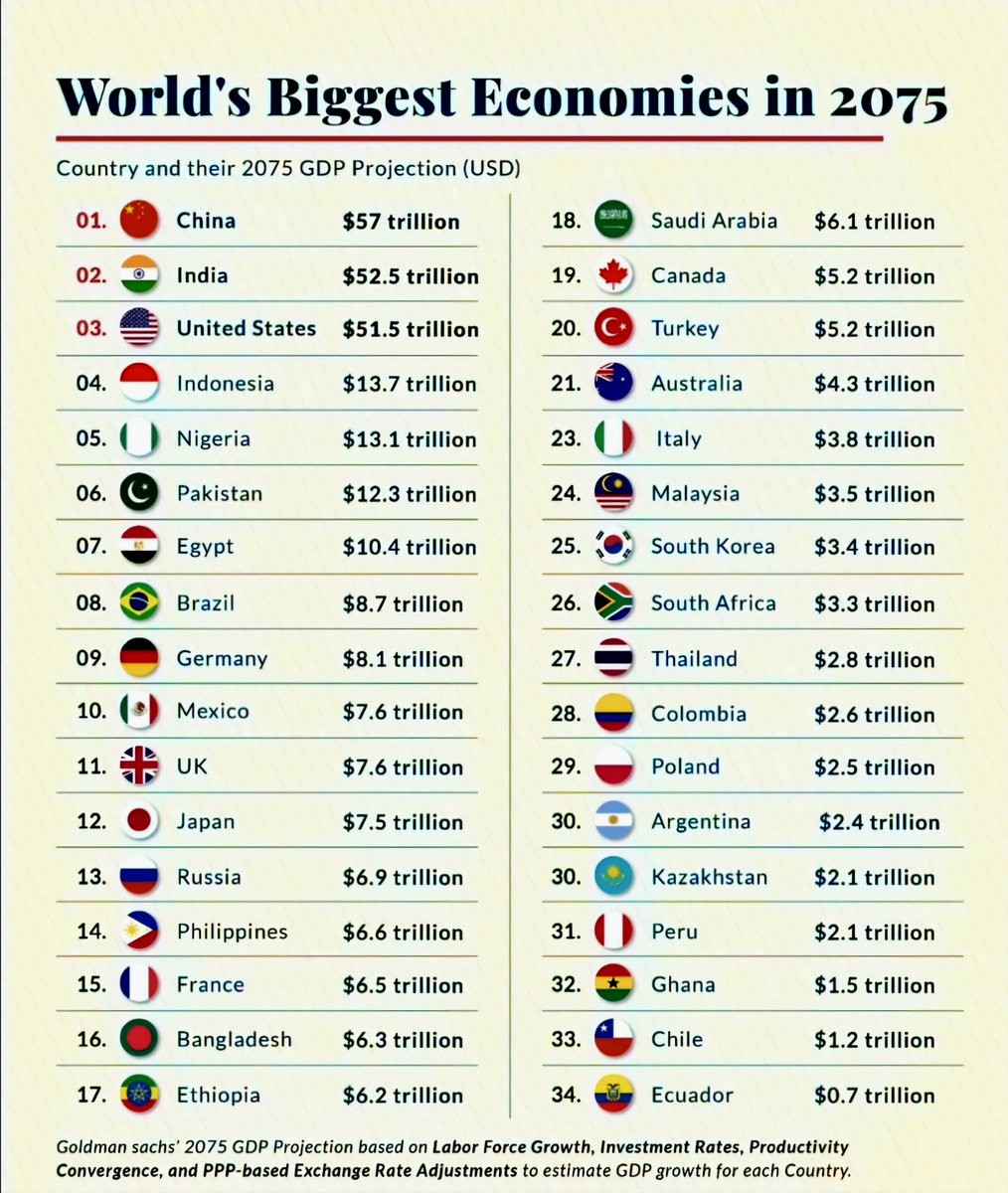
1. The United States: Maintaining Its Economic Supremacy
Expected to remain at the top, the United States will likely sustain its economic leadership through continued innovation in sectors like artificial intelligence, biotechnology, and renewable energy. The country’s robust infrastructure, coupled with a highly developed digital economy, will drive its GDP growth. Furthermore, reimagined manufacturing hubs and a thriving service sector will reinforce America’s position in the global economy. The U.S. is also anticipated to expand its influence in space-based industries, establishing a foothold in extraterrestrial resource extraction.
2. China: Leading the Future in Sustainable Tech
China is projected to leap forward as the second-largest economy by 2075. Building on its current momentum, the nation’s focus on sustainable development and clean energy will accelerate its economic rise. Innovations in quantum computing and green technologies are expected to give China an edge in global markets. Its large population and strategic investments in education, infrastructure, and high-tech industries will ensure its economic influence continues to expand. The Belt and Road Initiative could evolve into a multidimensional network of economic alliances, further boosting China’s global standing.
3. India: The New Economic Powerhouse
India’s rapid technological advancements and demographic dividend will position it as a key economic player. By 2075, India is expected to have transformed into a hub for advanced manufacturing, biotech, and space exploration. Its government’s focus on education and infrastructure, combined with digital innovation, will drive economic growth. As labor costs remain comparatively low and its startup ecosystem matures, India will become a magnet for multinational corporations seeking to tap into its expanding consumer market and skilled workforce.
4. European Union: A Unified Economic Force
The European Union will likely evolve into a unified economic superpower, encompassing nearly all member states. With a focus on green energy, digital sovereignty, and advanced manufacturing, the EU will maintain a significant role in the global economy. Strong regulations, emphasis on sustainability, and technological innovation will allow the EU to thrive in sectors like clean energy, pharmaceuticals, and AI-driven services. Its commitment to social sustainability and economic integration will help it weather potential geopolitical and economic fluctuations.
5. Nigeria: Africa’s Rising Economic Giant
Nigeria is projected to emerge as Africa’s primary economic force by 2075. Driven by youthful demographics, technological adoption, and resource-rich industries, Nigeria’s economy could grow exponentially. Investments in infrastructure, education, and technology will be critical to this growth. The nation’s burgeoning fintech sector, expanding industrial base, and strategic location will help it forge strong regional and global connections, establishing Nigeria as a major player on the world stage.
6. Brazil: South America’s Leading Economy
Brazil’s rich natural resources, combined with its expanding tech sector, will ensure its prominence among global economies. By 2075, Brazil might harness innovations in agriculture, bioenergy, and sustainable forestry to bolster its economy. Efforts to modernize infrastructure and diversify beyond traditional commodities will help stabilize and grow its GDP. Political stability and strategic global partnerships will be essential as Brazil continues to leverage its geographic advantage and resource wealth.
7. Indonesia: The Rising Southeast Asian Power
Indonesia’s strategic location and abundant natural resources are expected to position it as a major Asian economic hub. With a large, youthful population, Indonesia will likely lead efforts in digital economy expansion and clean energy initiatives. Investments in education, infrastructure, and technology will help it develop a diversified economy focused not only on manufacturing and resources but also on innovation and regional trade alliances.
8. Russia: Reimagined and Resilient
Despite current geopolitical challenges, Russia might reinvent itself as a technological and energy powerhouse by 2075. Investments in artificial intelligence, space exploration, and renewable energy will help diversify its economy. Russia’s vast natural resources, particularly in rare earth elements critical to advanced tech, will continue to be vital. Its strategic position as a bridge between East and West could enable it to forge new global alliances, boosting its economic stature.
9. Japan: Innovation and Sustainability at the Forefront
Japan’s reputation as a technology pioneer and sustainable innovator is expected to persist. By 2075, Japan will likely lead developments in robotics, AI, and clean energy solutions. Its focus on aging population management, smart cities, and eco-friendly industries will keep its economy resilient. Japan’s long-standing expertise in manufacturing and high-tech sectors will be vital in maintaining its influence globally.
10. Mexico: Central America’s Economic Powerhouse
Mexico’s strategic proximity to the United States and its growing manufacturing base will position it as Latin America’s top economy by 2075. Emphasizing technological innovation, renewable energy, and infrastructure development, Mexico will benefit from increased foreign investment. Its diverse economy, rich cultural landscape, and youthful population will continue fueling sustained growth.
By 2075, the world’s economic power centers will be shaped by technological innovation, demographic shifts, and sustainable development. These countries will lead global markets, spearheading advancements that could redefine wealth and influence for generations to come.
 ChatGPT
 Perplexity
 Gemini AI
 Grok AI