Select Language:
The World’s Largest Economies in 2025: A Closer Look at the Top 10
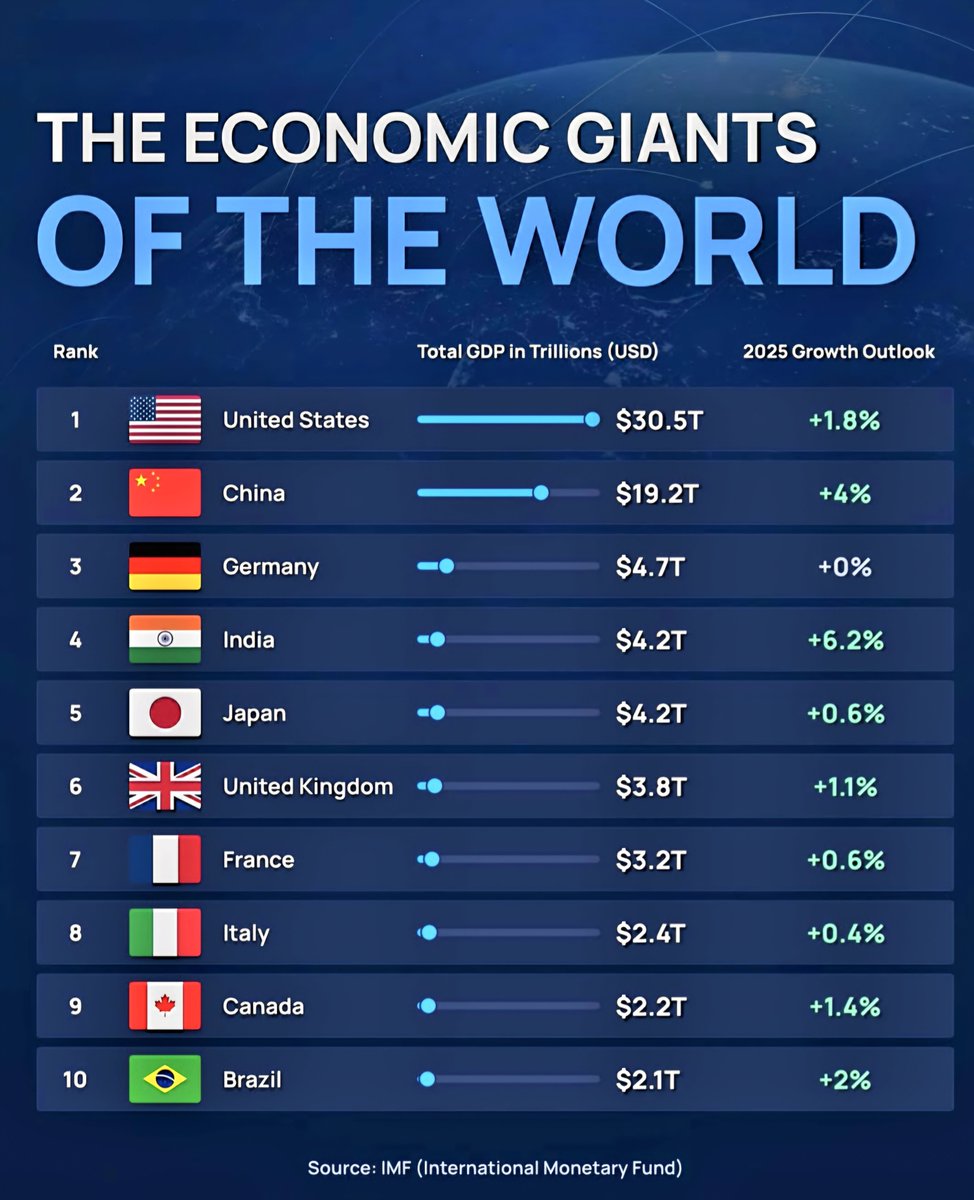
As the global economy continues to evolve, 2025 has marked an interesting year with shifts in rankings and growth rates among the world’s leading nations. Here’s a detailed list of the top 10 largest economies in the world today, highlighting their current GDP figures, annual growth rates, and what these numbers might mean for the international market.
1. United States Dominates at Over $30 Trillion
The United States maintains its position as the world’s largest economy, with a gross domestic product (GDP) of approximately $30.5 trillion. Despite facing economic headwinds in previous years, the US economy grew modestly by about 1.8% in 2025. Its diverse industries, technological innovation, and consumer spending continue to underpin its economic strength. As the backbone of global finance and innovation, the US’s economic stability remains crucial to worldwide markets.
2. China Continues Rapid Expansion with $19.2 Trillion
China remains in second place with a GDP of $19.2 trillion, driven by a remarkable 4% growth rate this year. The country’s focus on high-tech manufacturing, expanding consumer markets, and infrastructural investments have sustained its impressive growth trajectory. As the global manufacturing hub, China’s economic activities have far-reaching impacts on international supply chains and commodity markets.
3. Germany Steady at $4.7 Trillion
Holding onto its position as Europe’s economic powerhouse, Germany’s GDP sits at around $4.7 trillion. Its economy has remained relatively stable this year with 0% growth, indicating a period of steady, mature development. Germany’s strength in automotive, engineering, and industrial sectors continues to support its robust economic standing within the European Union and globally.
4. India Surges Forward with a $4.2 Trillion Economy
India’s economy is on a remarkable upward trajectory, reaching approximately $4.2 trillion. This year, the country saw a notable growth rate of 6.2%, reflecting its expanding technological sector, increased foreign investment, and ambitious infrastructure projects. India’s demographic dividend and economic reforms are poised to keep it among the fastest-growing major economies for years to come.
5. Japan’s Economy Shows Resilience at $4.2 Trillion
Japan retains its position with a GDP of $4.2 trillion, experiencing a modest growth of 0.6%. Despite demographic challenges and an aging population, Japan’s innovative technology and manufacturing sectors continue to support a resilient economy. Its steady performance underscores its role as an economic leader in Asia.
6. United Kingdom Approaching $3.8 Trillion
The UK’s economy values at about $3.8 trillion, with a growth rate of 1.1%. Post-Brexit adjustments, global trade ties, and the country’s financial services remain vital drivers. While facing economic hurdles, the UK’s adaptability keeps it among the top economies worldwide.
7. France Maintains Strong Foundations at $3.2 Trillion
France’s GDP totals $3.2 trillion, with a growth rate of 0.6%. Its diverse economy—spanning luxury goods, aerospace, and tourism—continues to support steady growth. France’s strategic investments in renewable energy and technology are expected to bolster its economic profile further.
8. Italy’s Economy Anchored at $2.4 Trillion
Italy’s economic output is around $2.4 trillion, with a modest growth of 0.4%. Challenges such as high public debt and political uncertainties persist, yet Italy’s vibrant manufacturing and fashion industries provide some stability to its economy.
9. Canada’s Economy at $2.2 Trillion
Canada boasts a GDP of $2.2 trillion, up by 1.4% this year. Its abundant natural resources, especially in energy and minerals, along with a strong technological sector, contribute to its steady economic growth. Canada remains a significant player in North American trade.
10. Brazil Rounds Out the Top 10 at $2.1 Trillion
Brazil’s economy reaches $2.1 trillion, with an impressive growth rate of 2%. Its agricultural sector, natural resources, and increasing investments in infrastructure underpin this expansion. Brazil’s emerging markets continue to attract international interest and investment.
The Year 2025 paints a dynamic picture of global economic powerhouses, highlighting shifting growth patterns and resilience among varied economies. Countries that adapt to technological advancements, demographic changes, and global trade dynamics are poised to lead in the upcoming years.
Figures are rounded for clarity.
Source: IMF, 2025
 ChatGPT
 Perplexity
 Gemini AI
 Grok AI