Select Language:
The Leading Countries in Military Airpower in 2025: A Detailed Look
1. The United States Continues to Dominate with Over 13,000 Military Aircraft
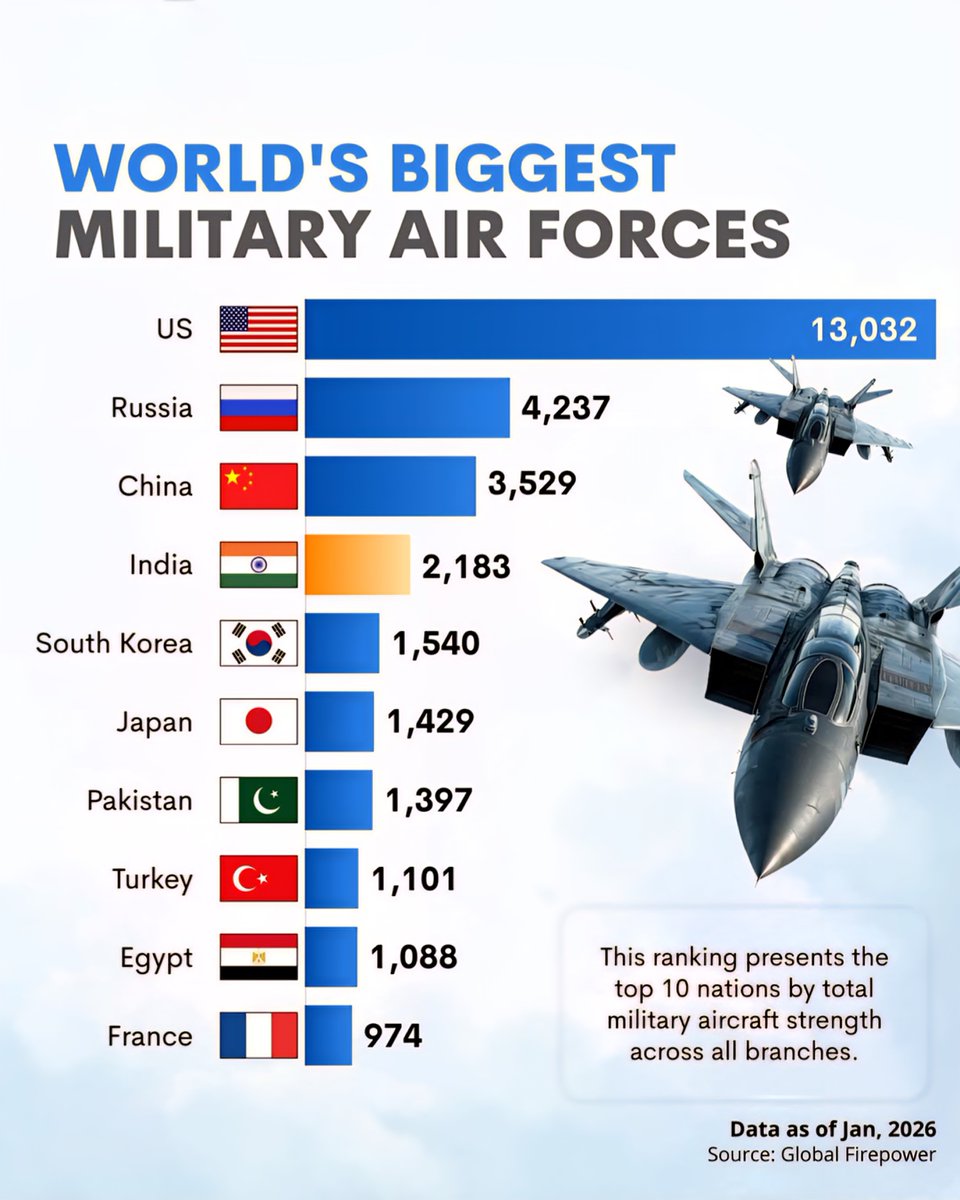
The United States remains the unmatched leader in military aviation, boasting a fleet of approximately 13,032 aircraft. This robust inventory encompasses fighter jets, bombers, cargo planes, early-warning aircraft, and unmanned aerial systems. America’s significant investment in advanced technology and frequent modernization efforts ensure its air dominance across multiple theaters worldwide. The substantial number reflects decades of strategic planning and technological innovation, maintaining its edge in aerial warfare.
2. Russia Maintains a Strong Presence with Over 4,200 Aircraft
Russia stands firm as the second-largest military aviation force, with around 4,237 aircraft. Its fleet includes various multi-role fighters, strategic bombers, and helicopters. Russian aerospace capabilities have been bolstered by ongoing modernization programs and sustained production efforts, emphasizing versatility and durability. The nation’s focus on maintaining a formidable air force underscores its strategic priorities in regional influence and defense preparedness.
3. China Expands Its Aerospace Power with More Than 3,500 Aircraft
China holds the third spot on the list with approximately 3,529 military aircraft. Rapid advancements in aircraft technology, domestically produced fighters, and increased procurement have propelled China into the forefront of aviation strength. The People’s Liberation Army Air Force (PLAAF) continues to modernize its fleet, integrating stealth fighters like the J-20, and expanding its capabilities in missile defense and strategic deterrence.
4. India’s Growing Air Force Approaches 2,200 Aircraft
India commands a fleet of around 2,183 aircraft, reflecting substantial growth over the past few years. With a diverse mix of fighters, transport aircraft, and helicopters, India is actively expanding its air power through domestic manufacturing and international procurement. Strengthening its strategic airbase network and enhancing operational readiness have been key objectives amidst regional tensions and global alliances.
5. South Korea’s Air Force Surges Forward with Over 1,500 Aircraft
South Korea maintains approximately 1,540 military aircraft, emphasizing modern fighter jets and support planes. This robust fleet underscores South Korea’s focus on regional security, particularly given tensions with neighboring North Korea. Continued investment in advanced fighters like the F-35 and upgraded early-warning aircraft highlight South Korea’s commitment to maintaining a technological edge.
6. Japan’s Airpower Rises with About 1,430 Aircraft
Japan’s approximately 1,429 aircraft serve as a vital component of its self-defense strategy in the Pacific region. The Japan Self-Defense Forces (JSDF) prioritize cutting-edge fighters, surveillance, and reconnaissance aircraft, bolstered by recent acquisitions of F-35 stealth fighters. Given regional security challenges, Japan’s focus remains on maintaining a technologically advanced air fleet.
7. Pakistan Reinforces Its Air Capabilities with Nearly 1,400 Aircraft
Pakistan operates around 1,397 aircraft, including fighters, trainers, and transport planes. Its fleet supports both conventional defense and strategic deterrence, with ongoing efforts to modernize and expand its capabilities. Close neighborly relations and regional security concerns drive Pakistan’s investment in maintaining a versatile aerial force.
8. Turkey’s Air Force Surpasses 1,100 Aircraft
With approximately 1,101 military aircraft, Turkey’s air force plays a pivotal role in regional geopolitics and NATO operations. Turkey has increased procurement of modern fighters and surveillance aircraft, focusing on self-reliance with domestic defense initiatives. Its strategic geographic position emphasizes the importance of a strong and versatile air fleet.
9. Egypt’s Air Power Comprises Over 1,080 Aircraft
Egypt maintains a significant fleet (around 1,088 aircraft), prioritizing fighter jets, transport, and reconnaissance planes. As a key regional player, Egypt continuously upgrades its fleet to address internal and external threats. Strategic modernization efforts aim to enhance operational capacity and foster regional influence.
10. France Rounds Out the Top 10 with Nearly 1,000 Aircraft
France’s approximately 974 aircraft underpin its national defense and NATO commitments. Equipped with advanced fighters, surveillance, and transport planes, France remains a key military contributor to European and global security initiatives. Ongoing modernization ensures its aircraft fleet stays competitive on the international stage.
This ranking underscores the shifting dynamics of global military aviation in 2025. While the United States continues to lead with a vast and highly sophisticated fleet, multiple nations are rapidly modernizing and expanding their air capabilities to meet evolving security challenges. The global aerial landscape remains dynamic, with technological advancements and strategic priorities shaping future developments.
Source: Global Firepower, as of January 2026
Note: The figures represent total military aircraft across all branches, including air force, navy, and army aviation units.
 ChatGPT
 Perplexity
 Gemini AI
 Grok AI