Select Language:
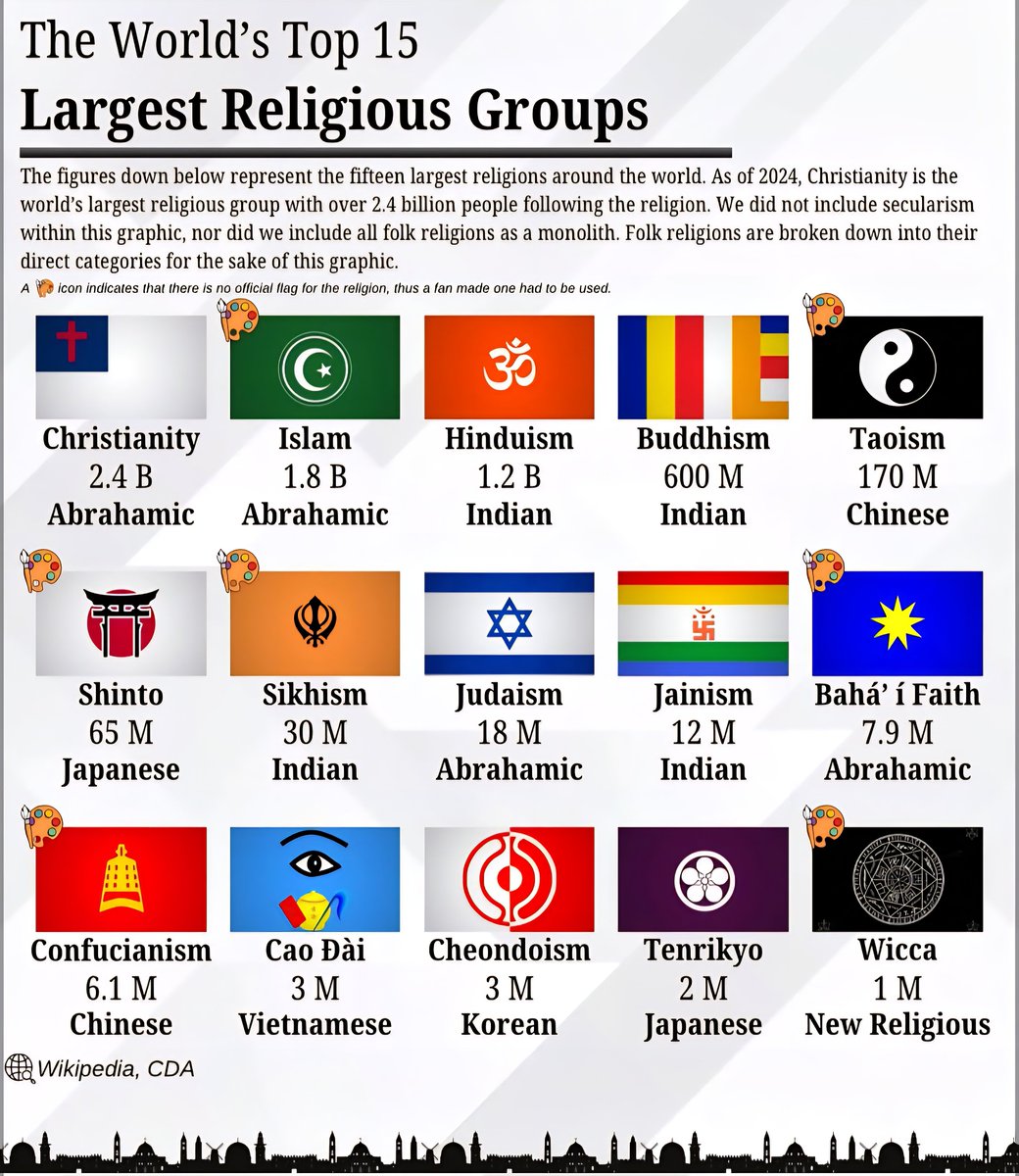
1. Christianity Tops the List with Over 2.4 Billion Followers
Christianity remains the world’s most widespread religion, boasting approximately 2.4 billion adherents globally in 2025. This faith, based on the teachings of Jesus Christ, dominates various regions, especially North America, Latin America, and parts of Africa and Europe. The diverse denominations under Christianity, including Catholicism, Protestantism, and Orthodox Christianity, contribute to its vast following. This religion plays a significant role not only in spiritual life but also influences cultural, social, and political landscapes worldwide.
2. Islam: A Fast-Growing Faith with 1.8 Billion Followers
With around 1.8 billion believers, Islam holds the second spot among the world’s largest religions. Predominantly practiced across the Middle East, North Africa, South Asia, and parts of Southeast Asia, Islam continues its rapid growth due to high birth rates and conversions. The two main branches, Sunni and Shia, shape religious practices and cultural norms within Muslim communities. Islam’s influence extends into global geopolitics, economics, and cross-cultural exchanges on a large scale.
3. Hinduism: Encompassing 1.2 Billion Devotees
Hinduism, primarily practiced in India and Nepal, remains the third-largest religion with approximately 1.2 billion followers. Known for its rich mythology, rituals, and philosophical systems, Hinduism influences daily life, festivals, and societal structures in its major regions. Its diverse practices, ranging from devotional worship (bhakti) to yoga and meditation, have garnered global interest, making Hindu traditions a significant aspect of world spirituality.
4. Buddhism: With Nearly 600 Million Followers
Buddhism proudly counts about 600 million adherents, mainly concentrated in East Asia, Southeast Asia, and parts of South Asia. Founded by Siddhartha Gautama, or Buddha, around the 5th century BCE, it emphasizes mindfulness, compassion, and the pursuit of enlightenment. Western countries have also seen growing interest in Buddhist meditation techniques and philosophies, making Buddhism a major spiritual influence across continents.
5. Taoism: Simplicity and Harmony with 170 Million Followers
Taoism, rooted deeply in Chinese culture and philosophy, claims roughly 170 million followers. Emphasizing harmony with nature and simple living, Taoism influences traditional Chinese medicine, martial arts, and philosophical thought. Though often integrated with other Chinese religions, Taoism’s core principles continue to shape lifestyles and spiritual practices in East Asia.
6. Shinto: Japan’s Indigenous Faith with 65 Million Practitioners
Shinto is Japan’s native spirituality, with an estimated 65 million followers. Focused on reverence for kami (spirits or deities), Shinto rituals are widely practiced alongside Buddhism, blending traditions seamlessly in Japanese life. Festivals, shrines, and rituals rooted in Shinto are integral to Japanese cultural identity.
7. Sikhism: A Growing Faith with 30 Million Followers
Founded in the Indian subcontinent, Sikhism numbers about 30 million adherents worldwide. Its teachings aim to foster equality, justice, and spiritual devotion through the remembrance of one God and community service. Sikh communities are well-established in India, the UK, Canada, and the United States, where they actively promote social harmony.
8. Judaism: An Enduring Religion with 18 Million Followers
Judaism has maintained its presence for over three millennia, with approximately 18 million believers around the world. Mainly centered in Israel and the United States, Judaism emphasizes ancestral traditions, ethics, and a covenant with God. The religion continues to influence Western culture and thought profoundly.
9. Jainism: A Minority with 12 Million Followers
Jainism, primarily practiced in India, has about 12 million followers committed to non-violence and ascetic principles. Known for its strict ethical codes, Jainism emphasizes compassion and environmental consciousness, which continue to inspire global discussions on sustainability.
10. Bahá’í Faith: A Global Religion with 7.9 Million Followers
The Bahá’í Faith, with about 7.9 million adherents globally, promotes unity among all races and religions. Founded in the 19th century in Persia, it advocates for peace, gender equality, and universal education, influencing social development in numerous countries.
11. Confucianism: Ethical Foundations with 6.1 Million Followers
Though often regarded as a philosophical system, Confucianism has around 6.1 million followers. Its teachings focus on morality, social harmony, and respect for elders, shaping cultural and ethical norms across East Asia for centuries.
12. Cao Đài: A Syncretic Faith with 3 Million Believers
Centered in Vietnam, Cao Đài combines elements from Buddhism, Christianity, Taoism, and Confucianism. Its roughly 3 million followers practice a unique spiritual tradition that aims to unify various religious philosophies.
13. Cheondoism: Korea’s Indigenous Religion with 3 Million Followers
Rooted in Korean history, Cheondoism emphasizes the divine nature of all beings and the importance of moral living. With around 3 million followers, it remains an influential spiritual tradition within South Korea.
14. Tenrikyo: A Japan-Based Religion with 2 Million Followers
Tenrikyo, founded in Japan in the 19th century, revolves around gratitude and charity. It counts about 2 million followers who seek joy and spiritual fulfillment through community service and religious practices.
15. Wicca: Modern Spirituality with 1 Million Practitioners
Wicca, often categorized as a Neopagan religion, boasts approximately 1 million practitioners worldwide. Focused on nature worship, ritual magic, and seasonal celebrations, Wicca has gained popularity especially in Western countries as a form of spiritual expression outside traditional religions.
In 2025, these figures reflect a dynamic landscape of faiths and spiritual practices shaping societies across the globe. From ancient traditions to modern movements, the world’s religions continue to influence daily life, cultural identities, and global interactions.
Sources: Wikipedia, CIA World Factbook, 2025 data.
 ChatGPT
 Perplexity
 Gemini AI
 Grok AI