Select Language:
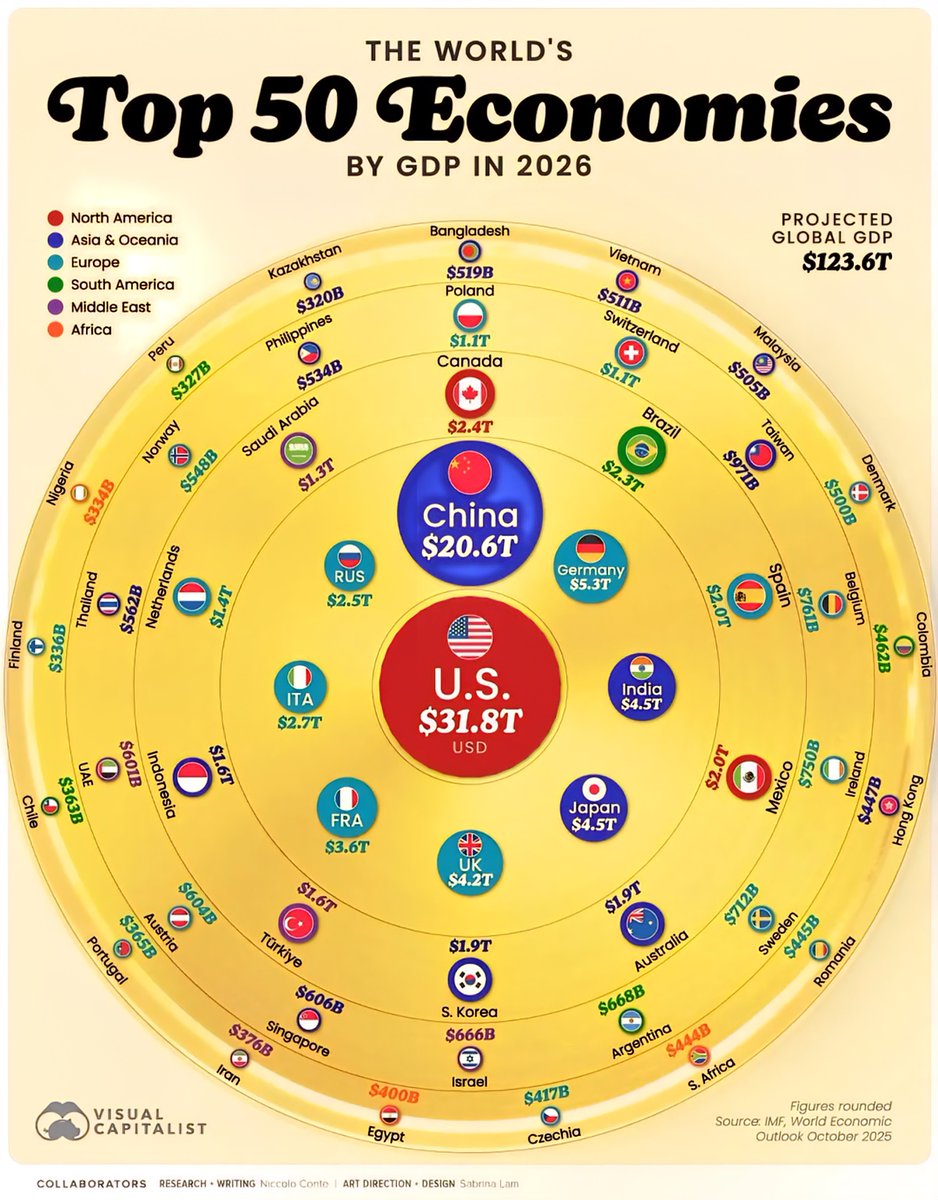
Top 50 Economies of 2026: A Global Economic Breakdown
The Dominance of the United States
Leading the world with an eye-watering GDP of $31.82 trillion, the United States retains its position as the top economy globally. Its diversified economic sectors—ranging from technology and finance to healthcare—continue to fuel its leadership. Despite global shifts, the U.S. maintains a significant edge over other nations, reinforcing its influence on international markets.
China’s Continued Rise
China remains in the second spot with a GDP of $20.65 trillion. Its rapid economic development over the past decade has bolstered its position as a global manufacturing and export powerhouse. The country’s investment in infrastructure and technology sectors underpins its growing economic stature.
European Powerhouses Keep Strong
Germany, with its robust industrial base, holds the third spot at $5.33 trillion. Its automotive, engineering, and technological sectors IPs are vital to the European Union economy. France and the UK follow closely, with GDPs of $3.56 trillion and $4.23 trillion respectively, illustrating their enduring economic strength despite geopolitical changes.
Emerging Markets Gaining Ground
India’s economy, valued at $4.51 trillion, demonstrates rapid growth driven by technology, manufacturing, and consumer sectors. Japan continues to hold its position with $4.46 trillion, maintaining its reputation as a leader in electronics and automotive manufacturing.
North America and Beyond
Canada’s economy hits $2.42 trillion, bolstered by natural resources and a resilient financial sector. Brazil’s GDP of $2.29 trillion reflects its ongoing development in agriculture, mining, and energy. Mexico stands out at $2.03 trillion, benefiting from its proximity to the U.S. market and manufacturing sector expansion.
Middle East and Asia’s Growing Economies
Saudi Arabia, with a GDP of $1.32 trillion, benefits from its oil sector, while Turkey’s economy hits $1.58 trillion, driven by a diverse industrial base. Indonesia’s economy, valued at $1.55 trillion, is among Southeast Asia’s largest economies, with increased investment in technology and manufacturing.
European and Asian Niche Leaders
Switzerland and the Netherlands, known for financial services and innovation, hold GDPs of $1.07 trillion and $1.41 trillion, respectively. Taiwan’s economy reaches nearly $971 billion, driven by semiconductor manufacturing.
Smaller but Significant Economies
Ireland, Sweden, and Argentina demonstrate diverse economic landscapes, with GDPs of $750 billion, $711 billion, and $668 billion respectively. Middle Eastern and Southeast Asian nations like the UAE ($601 billion), Thailand ($561 billion), and Vietnam ($511 billion) showcase diverse growth trajectories fueled by tourism, manufacturing, and oil exports.
Africa, Eastern Europe, and Others
South Africa maintains a GDP of around $444 billion, serving as Africa’s financial hub. Eastern European countries like Poland and Romania with $1.11 trillion and $445 billion are expanding their industrial capacities. Nigeria and Pakistan, as emerging economies in Africa and South Asia, hold GDPs of approximately $334 billion and $410 billion, respectively.
Key Trends to Watch
- The continuous rise of Asian economies, especially India, Indonesia, and Vietnam, indicates a shift towards decentralized global economic power.
- Technological innovation remains a defining factor for top economies, with semiconductor markets and fintech leading growth sectors.
- Middle Eastern nations are diversifying away from oil reliance, investing heavily in tourism, tech, and renewable energy.
Conclusion
The global economic landscape in 2026 is marked by dynamic shifts, with traditional powers maintaining dominance while emerging markets accelerate growth. Countries investing in technology, infrastructure, and diversification are positioned to lead in the next decade. Keep an eye on regional alliances and technological innovations, as they will shape the economic narrative moving forward.
 ChatGPT
 Perplexity
 Gemini AI
 Grok AI