Select Language:
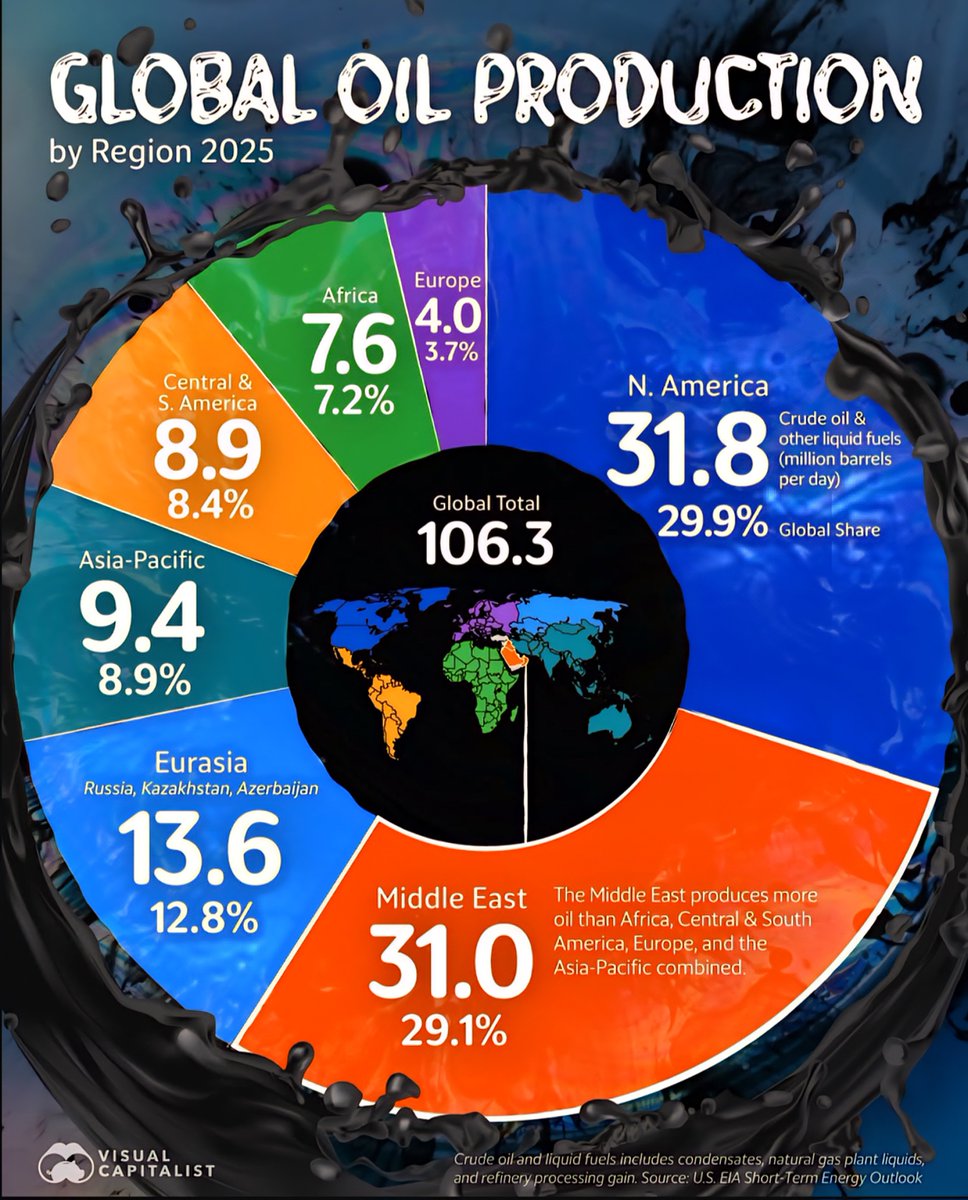
North America Leads in Oil Production, Accounting for Nearly 30% of Global Output
North America topped the global oil production chart in 2025, churning out an impressive 31.8 million barrels per day. This region’s contribution accounts for approximately 29.9% of the world’s total oil output. The United States remains the dominant producer within North America, driven by technological advancements in shale extraction and sustained investments in oil infrastructure. Canada’s oil sands and Mexico’s deepwater offshore fields also contribute significantly to the region’s robust production numbers. The North American dominance has been reinforced by ongoing exploration efforts and policy frameworks that favor energy production, making it a key player in meeting the world’s energy demands.
Middle East Continues Its Role as a Global Oil Powerhouse with Slightly Lower Production Levels
The Middle East produced about 31.0 million barrels daily in 2025, representing roughly 29.1% of global output. As the region’s first quarter of oil production remains relatively stable, major producers like Saudi Arabia, Iraq, and the United Arab Emirates continue to wield considerable influence over global oil markets. This stability is aided by longstanding alliances within OPEC and strategic investments in oil infrastructure. The Middle East’s output levels have seen modest fluctuations owing to geopolitical factors and shifting global demand, but its position as an energy epicenter remains firmly secured.
Eurasian Countries Maintain Moderate but Significant Production Volumes
Eurasia, encompassing Russia and surrounding nations, produced about 13.6 million barrels per day in 2025. This constitutes roughly 12.8% of global production, positioning Eurasia as a crucial contributor. Russia continues to be one of the largest exporters of oil worldwide, employing extensive drilling activities and leveraging vast reserves. Despite recent sanctions and geopolitical tensions, the region’s long-term investment in oil infrastructure ensures its status as a reliable energy supplier. Eurasia’s consistent output plays a vital role in stabilizing global markets, especially during times of supply disruptions elsewhere.
Asia-Pacific’s Steady Growth Maintains Its Position in the Oil Landscape
The Asia-Pacific region produced approximately 9.4 million barrels daily in 2025, accounting for about 8.9% of global production. Countries like China, Australia, and India are the primary contributors. China’s rise as a significant oil importer and strategic global trade hub has impacted regional production patterns. Meanwhile, Australia continues to develop its offshore fields, and India is increasing refining capacity. This region’s production levels are expected to further grow as nations strive for energy independence and diversify their energy sources.
Central and South America: A Consistent Contributor to Global Supply
With a total of 8.9 million barrels per day produced, Central and South America represent around 8.4% of the world’s oil output. Brazil remains the dominant producer, with vast offshore reserves boosting its export capacity. Venezuela continues to struggle with production challenges, but countries like Colombia and Argentina are gradually increasing their output through new exploration initiatives. The ongoing development of deepwater projects and technology upgrades fuels the region’s steady contribution to global supply.
Africa Maintains Its Role in the Global Oil Market
Africa produced about 7.6 million barrels daily in 2025, making up roughly 7.2% of global production. Nigeria and Angola are among the top producers, with new investments in offshore drilling and field development. Although African producers face infrastructural and political hurdles, ongoing foreign investments and regional collaborations are expected to bolster output in the coming years. Africa’s strategic reserves remain vital for global oil security and market balancing.
Europe’s Oil Production Remains Stable but Small in Comparison
European countries produced approximately 4.0 million barrels per day in 2025, accounting for about 3.7% of total global output. The region primarily produces oil from the North Sea, with Norway and the UK leading. Environmental regulations, declining reserves, and shifts toward renewable energy sources have constrained growth. Nonetheless, Europe’s continued focus on offshore oil maintenance and recovery projects ensures a baseline level of production. The region’s smaller share reflects a transition toward sustainable energy solutions.
Global Oil Production Reaches a Record 106.3 Million Barrels Daily
All regions combined, the world produced a staggering 106.3 million barrels of oil per day in 2025. This historic high underscores the ongoing demand for fossil fuels despite the global push toward renewable energy. The output’s stability highlights the resilience of traditional oil-producing regions amidst geopolitical tensions, technological evolution, and climate policies. As nations navigate their energy futures, the global oil landscape remains a critical component of the worldwide economy.
Source: U.S. EIA Short-Term Energy Outlook via Visual Capitalist, 2025
 ChatGPT
 Perplexity
 Gemini AI
 Grok AI