Select Language:
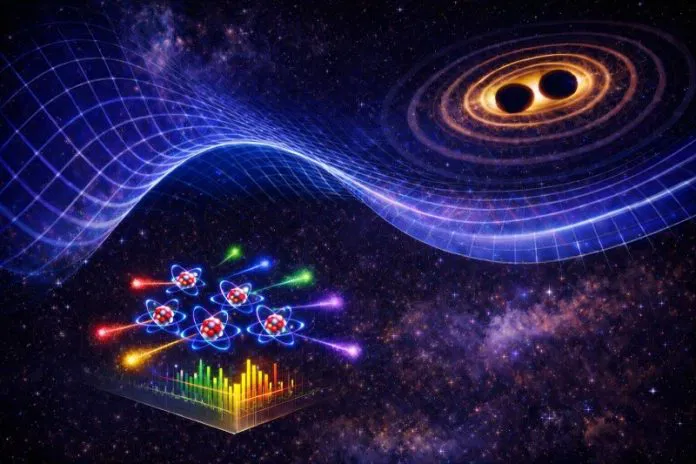
Gravitational waves are minute disturbances in spacetime caused by some of the universe’s most explosive events, like the collision of two black holes. Since their first detection in 2015, scientists have used massive instruments capable of measuring incredibly tiny changes in distance—smaller than a proton’s width—to identify these ripples.
However, a new theoretical study suggests an entirely different, potentially more subtle method of detection: examining how atoms emit light. Researchers from Stockholm University, Nordita, and the University of Tübingen propose that gravitational waves could subtly influence the light emitted by atoms.
This study, published in Physical Review Letters, doesn’t yet include experimental verification, but it introduces an exciting new avenue for detecting gravitational waves in the future.
Understanding this idea starts with how atoms normally behave. When atoms absorb energy, they enter an excited state. They don’t stay excited for long; instead, they quickly release that energy as light at a specific frequency—a process called spontaneous emission, fundamental to quantum physics.
The scientists suggest that gravitational waves can slightly disrupt the quantum fields surrounding atoms. When this occurs, the light emitted by the atoms isn’t perfectly uniform in every direction. Instead, the frequency of the emitted light may vary depending on its direction of travel.
Imagine a music player that always plays the same steady note. A gravitational wave wouldn’t change the volume of the note, but it might subtly alter its tone depending on where you’re listening from. This minor variation could encode information about the gravitational wave’s properties and direction.
One reason this effect hasn’t been observed before is because the total amount of light emitted remains unchanged; only the tiny details—such as the light’s frequency in different directions—are affected. Detecting these slight variations would require highly sensitive instruments.
The researchers believe that existing atomic clock technologies could help test this concept. These systems depend on extremely stable light signals, making them capable of detecting tiny shifts. Particularly, cold atoms—atoms cooled to near absolute zero—could be used to observe these effects over longer durations.
If viable, this approach could pave the way for a new class of gravitational wave detectors that are much more compact than current giant observatories. Instead of sprawling facilities spanning kilometers, future detectors might be small enough to fit on a tabletop or even within millimeter-sized devices.
While more research is necessary to address practical challenges like background noise, the initial findings are promising. This work suggests that even the tiniest particles—atoms—could someday help us “listen” to the faint ripples of spacetime in an entirely new way.
 ChatGPT
 Perplexity
 Gemini AI
 Grok AI