
Select Language:
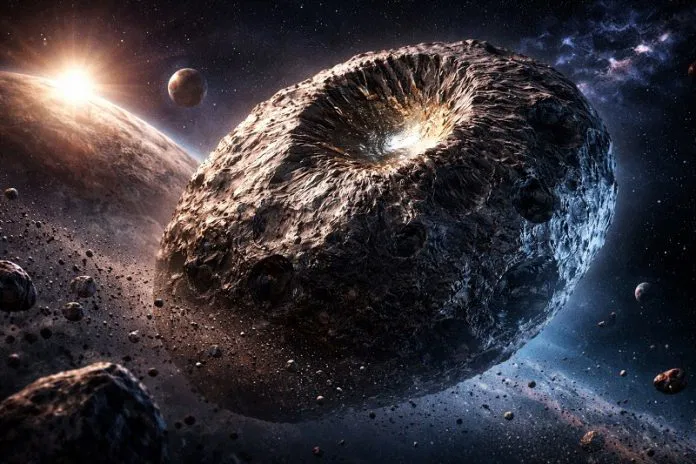
Asteroid 16 Psyche has intrigued scientists for over two centuries. Recent studies suggest that its large impact craters might provide clues about its origins and offer insights into how planets formed during the early days of our solar system.
Located in the asteroid belt between Mars and Jupiter, Psyche is approximately 140 miles (226 kilometers) across and stands out as the largest known metal-rich asteroid. Scientists theorize it could be the exposed core of an ancient planet that was shattered long ago, although other possibilities exist as well.
Some believe Psyche might be a conglomerate of rock and metal formed through numerous collisions, or that it perhaps started out with a high metal content from the beginning. To investigate these ideas, researchers at the University of Arizona used computer simulations to explore how a massive crater near Psyche’s north pole could have come into being.
Their aim was to anticipate what NASA’s Psyche spacecraft, set to arrive in 2029, might discover. Craters serve as natural windows into an asteroid’s interior. When an impact occurs, it can carve deep below the surface, exposing material normally hidden from view. By examining the size, shape, and internal structure of these craters, scientists can better understand what lies beneath.
In their models, the team recreated a crater roughly 30 miles wide and three miles deep, testing various scenarios. One scenario assumed Psyche has a layered structure with a metallic core enveloped by a thin rocky crust, while another proposed a completely mixed composition of metal and rock.
Interestingly, both models could produce a crater similar to what has been observed on Psyche. A key factor, however, is porosity—the amount of empty space inside the asteroid. Many asteroids aren’t solid but contain cracks and gaps from previous impacts. This porosity influences how the asteroid responds during a collision; porous bodies tend to absorb more impact energy, resulting in deeper, steeper craters with less debris ejected outward.
Incorporating porosity into their simulations resulted in more accurate predictions of Psyche’s surface features. These insights will help interpret data from the spacecraft, including crater characteristics, surface composition, and internal density variations.
This research underscores how Psyche acts like a “fossil” from the early solar system. Similar to how archaeologists study ancient ruins, scientists examine Psyche to understand planetary formation billions of years ago.
Once the spacecraft arrives, it will analyze Psyche’s surface, gravity, magnetic field, and composition. Comparing these findings with simulation results could confirm whether Psyche is truly an exposed planetary core or something entirely different.
Regardless of the outcome, Psyche provides a rare glimpse into the core-building blocks of planets and offers valuable clues about the dynamic forces that shaped our solar system.
 ChatGPT
 Perplexity
 Gemini AI
 Grok AI