Select Language:
Warhammer 40,000: Dawn of War – Definitive Edition is a remastered version of the original Dawn of War game along with all its expansions. It features improved graphics and includes every expansion, making it a great entry point for newcomers interested in Dawn of War, real-time strategy games, or Warhammer 40,000 lore. If you’re new to Dawn of War and missed its initial release, don’t worry. This game is highly accessible, though it can be challenging for beginners to learn how to command their armies effectively. Follow these tips to quickly improve and compete against AI or human opponents.
Aggression Is Key to Victory
Unlike many RTS games, Dawn of War encourages aggressive play. Your resource income depends on capturing Control Points scattered on the map. Sending units to take and defend these points allows you to earn Requisition, the main resource for building and reinforcing units. Control over the map leads to more resources, while the opponent’s control provides a resource advantage. You can’t simply turtle in your base; gaining map control early snowballs into victory. The game progresses from capturing and spreading control early on, contesting key locations like Relics in mid-game, and then using large armies and Relic units to dominate late-game enemies.
Start with Dark Crusade’s Campaign
The Dawn of War Definitive Edition includes the base game and three expansions: Winter Assault, Dark Crusade, and Soulstorm. Each features its own single-player campaign. For beginners, starting with Dark Crusade is recommended. Unlike a linear campaign, it functions more like a 4X game, where you conquer a planet through a turn-based system. The campaign offers good tutorials and engaging storyline missions, making it easier for new players to learn the game mechanics, especially on Normal or Easy difficulty.
Maintain Morale
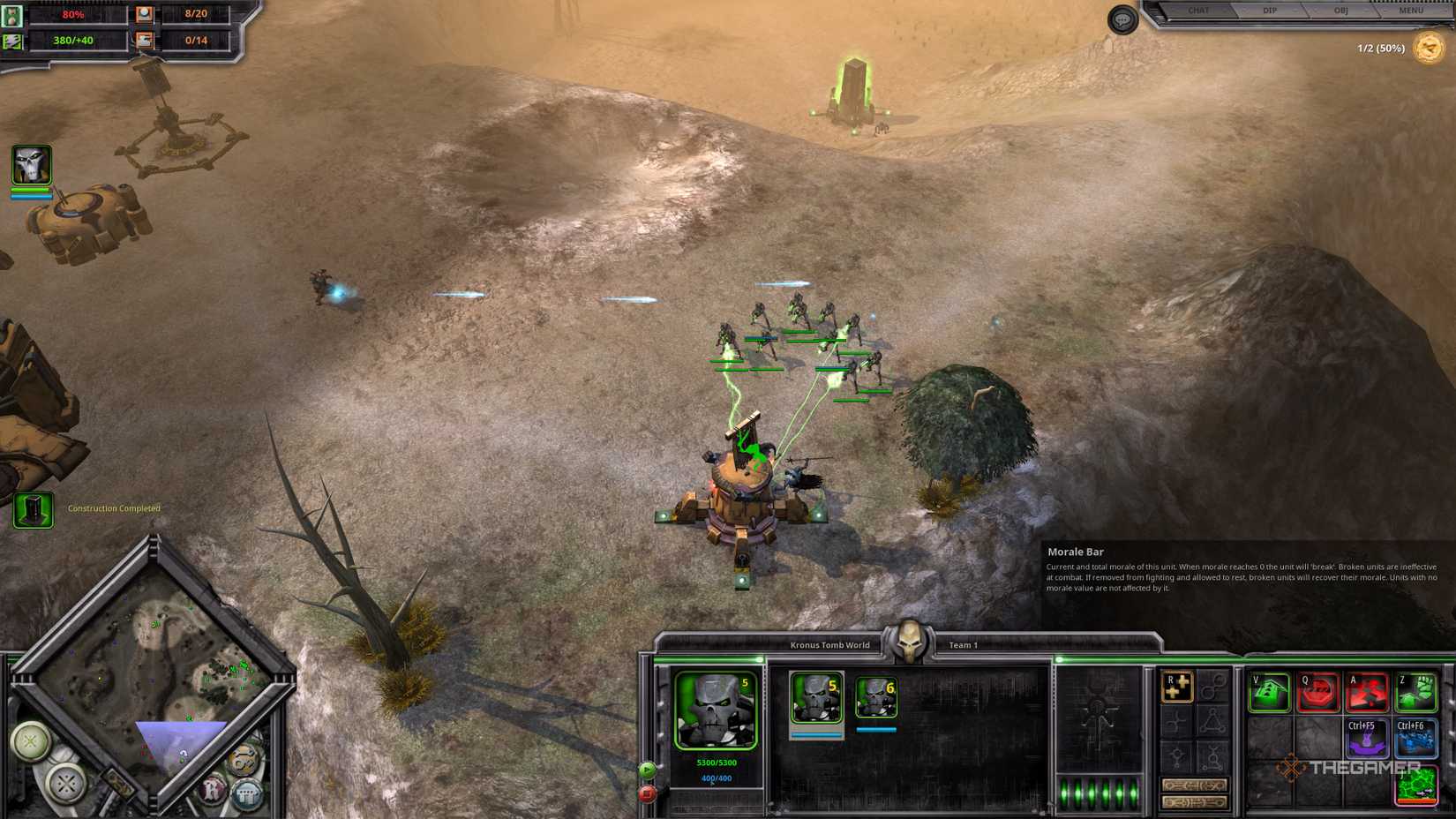
Dawn of War introduces a morale system where infantry units have two health meters: hit points and morale. Morale influences combat effectiveness; full morale means maximum accuracy and performance. Taking damage or casualties reduces morale. If a squad’s morale hits zero, accuracy drops by 80%, but they gain a small boost to movement speed to help them withdraw and recover. Morale isn’t permanent; units regenerating morale over time, provided they aren’t actively under fire. Monitoring morale helps keep your units fighting effectively, especially in difficult battles.
Utilize Environmental Cover
Although the original Dawn of War lacks a cover system seen in later titles, terrain features like craters and structures provide defensive bonuses. Units in cover boost their damage resistance, indicated by blue pips below their banners. One pip grants +25% ranged damage resistance; two pips double that to +50%. Vehicles get a 25% damage resistance with cover. Stacking this with other mitigation methods, like smoke grenades or special gear, greatly increases durability. Units in cover also recover morale faster, which is especially useful during intense combat.
Use Hotkeys
Most RTS games rely on mouse commands, but hotkeys streamline gameplay, especially on higher difficulties or multiplayer. On easier modes, mouse control may suffice, but hotkeys save time and improve efficiency. Key functions include cycling through dormant units with the period (.) key, switching between unit groups with Ctrl + number, changing combat stances with F1-F5, and queuing commands with Shift + Right-Click. Customizing keybinds is possible in options, and mastering hotkeys will make your play much smoother.
Try Every Faction
Dawn of War offers nine playable factions, each with unique playstyles and strengths. While mastering them all can be ambitious, experimenting helps you understand how different units and tactics work. Learning the strengths and weaknesses of each faction allows you to develop your preferred style and respond effectively to opponents. For example, Space Marines are versatile, Chaos emphasizes damage and late-game relics, Orks rely on melee swarms, and Tau excel at long-range firepower.
| Faction | Playstyle | Signature Feature |
|---|---|---|
| Space Marines | Versatile across all categories | Drop Pods for deployment anywhere on the map |
| Chaos | Similar to Space Marines but focuses on damage | Demon units and powerful relics |
| Orks | Melee-focused with high numbers | Waaagh! banners increase army capacity |
| Eldar | Hit-and-run tactics with high mobility | Fleet of Foot for fast movement |
| Imperial Guard (Dark Crusade only) | Ranged swarm, support vehicles | Cheap units, fast reinforcement |
| Tau (Dark Crusade) | Long-range attack, infiltration | Extreme attack range |
| Necrons | Tough, resilient, late-game unstoppable | Resurrection ability to revive units |
| Sisters of Battle (Soulstorm) | Weaker Space Marines with Faith mechanics | Faith points for special abilities |
| Dark Eldar (Soulstorm) | Fragile glass cannons, souls harvesting | Soul Essence for empowering units |
Learning these factions and their individual strategies will deepen your understanding of the game and improve your skills. Each faction’s unique abilities and units shape how you approach battles, positioning, and resource management.
 ChatGPT
 Perplexity
 Gemini AI
 Grok AI