Select Language:
Disney Lorcana has quickly become a leading trading card game, thanks in part to its unique approach to gameplay compared to Magic: The Gathering and Pokémon. Its foundation is built on a beloved Disney IP, allowing for a lot of creative freedom that has resulted in some highly collectible cards.
The game is designed to be accessible for players of all ages and experience levels, making it easy for friends and family to join in, which is one of the reasons it’s so popular with us.
Updated March 6, 2026, by Niall Walsh:
It’s been a while since we last updated this guide, so we’ve refreshed it to include changes since Lorcana was released nearly three years ago.
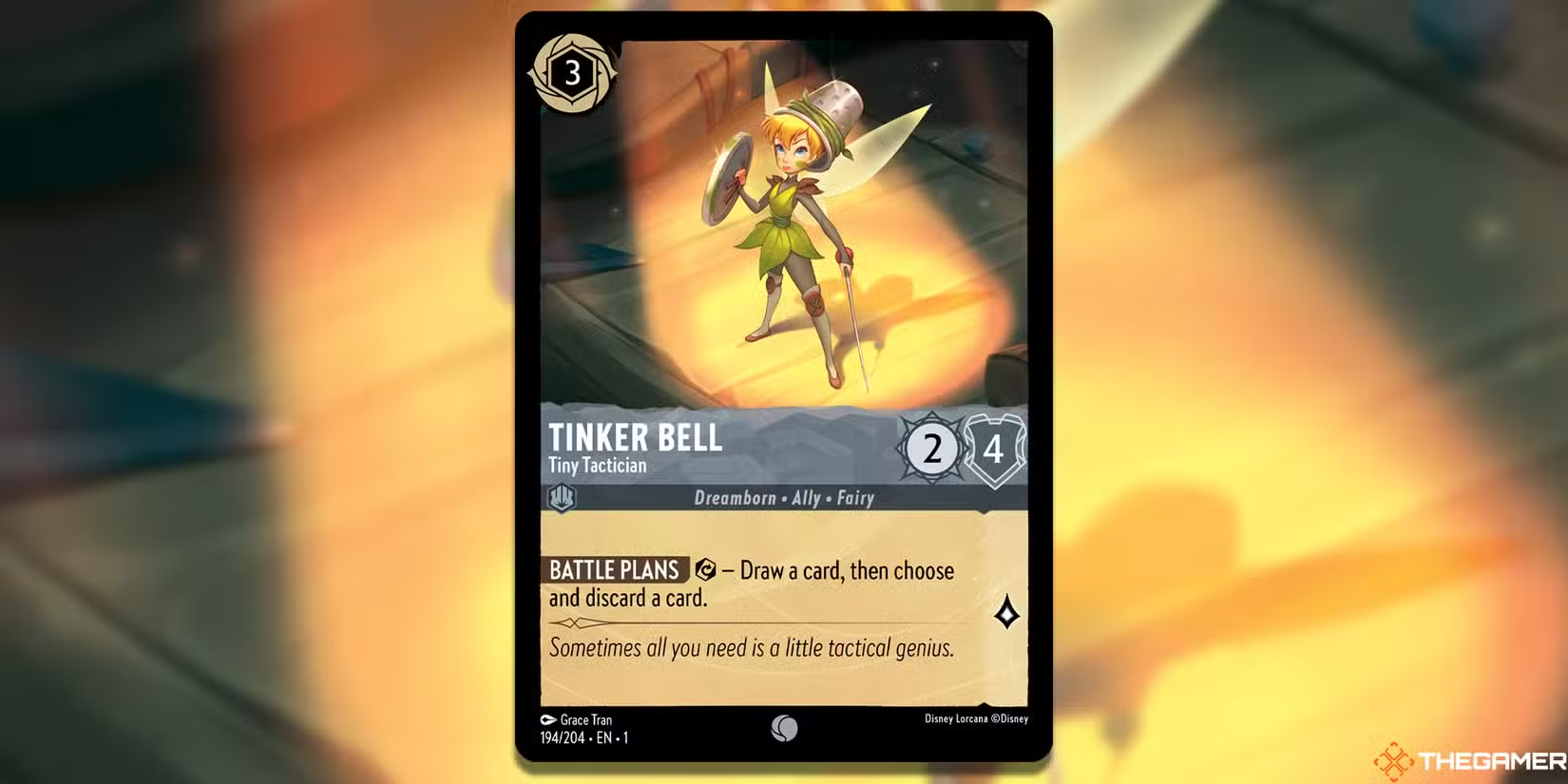
Reading a Lorcana Card
Lorcana cards feature various stats and abilities crucial to understanding gameplay. Knowing how to read them is essential.
| Detail | Description |
|---|---|
| Cost | Shows how much ink you need to play the card. Cards with a circle (Inkwell icon) can be placed into your Inkwell to be used as ink. |
| Name | The card’s name; only four copies of the same exact name can be included in a deck. |
| Strength | Indicates how much damage the character deals during a challenge. |
| Willpower | How much damage the character can take before being banished. |
| Classifications | Types that specify the card’s category, e.g., character classes, songs, or actions. |
| Ink | Represents the card’s ‘color’; each deck is limited to two inks. |
| Abilities | Main actions the card can do, triggered by other game actions or activated on your turn. Some are keyworded, like Evasive or Ward, working the same every time. |
| Lore Value | The amount of lore generated when a character quests. |
| Set Information | Details about the card’s set, such as artist, card number, and language. |
| Rarity | Rarity level: grey (Common), white (Uncommon), bronze (Rare), silver (Super Rare), gold (Legendary). |
Building Your Deck
Your Lorcana deck needs at least 60 cards. You can only include up to four copies of any specific card by its exact name, including subtitles. For example, you can have four Mickey Mouse, Wayward Sorcerer cards and four Mickey Mouse, Brave Little Tailor cards in one deck.
Your deck is made up of three types of cards:
- Characters: Your main force for challenging opponents and questing for lore.
- Items: Can’t challenge but have effects and abilities.
- Actions: Single-use cards, played for effects and then discarded. Songs are a subtype of Action and can sometimes be played for free by exerting a character with a matching cost.
Your deck can only contain cards with two different inks. Each card belongs to one of six inks, each with its own strategic flavor:
- Amber (Yellow): Buffs and protects.
- Amethyst (Purple): Uses abilities and actions to control the table.
- Emerald (Green): Adaptive, effective at moving cards between zones.
- Ruby (Red): Fast, aggressive, deals direct damage efficiently.
- Sapphire (Blue): Focuses on playing and using items.
- Steel (Grey): High defense, challenging to overcome with brute force.
Each ink has unique strengths suited for different strategies.
How to Win
The game offers two main ways to win:
- Accumulate 20 Lore before your opponent does. This usually involves questing your characters each turn with a solid board presence.
- Opponent runs out of cards in their deck. If you try to draw a card but have none left, you lose immediately.
Starting the Game and Adjusting Your Hand
After both players—ideally two, but more are supported—prepare by shuffling your deck and drawing seven cards for your opening hand. If it’s your first game, you must keep this hand. Otherwise, you may choose to put any number of cards on the bottom of your deck and redraw an equal amount. You can only do this once per game.
Decide randomly who goes first. Once the game begins, proceeding with gameplay is straightforward.
Turn Structure
Your turn is divided into two main phases: Starting and Main.
The Beginning Phase involves three steps:
- Ready: Turn any exerted cards upright.
- Set: Resolve any start-of-turn abilities.
- Draw: Draw the top card unless it’s your very first turn.
The Main Phase is where most actions occur:
- Play cards by paying ink.
- Reveal cards from your hand into your Inkwell (face-down).
- Activate abilities of characters and items (must have been in play since the start of the turn).
- Quest characters for lore.
- Challenge opponent’s characters.
There’s no formal end step; your turn ends once you’ve exhausted your options. End-of-turn effects conclude, and the turn passes to the next player.
Timing and Priority
All actions are restricted to your turn—the game does not permit using instant-speed effects during opponents’ turns. The only exception is if a character’s ability triggers due to an opponent’s action, like a reaction to a challenge.
Making Ink and Playing Cards
To play any card, pay the ink cost shown in the top-left corner. Instead of gathering resources, Lorcana allows you to convert cards from your hand into ink:
- Cards with an ornate circle (Inkwell icon) can be revealed and placed face-down in your Inkwell once per turn.
- Each ink card can be exerted to produce one ink, which pays for other cards or activates certain abilities.
- Exerted ink cannot be challenged, but it replenishes at the start of your next Beginning phase.
Playing cards involves sacrificing ink, but with proper management, you can generate enough to perform powerful plays.
Singing Songs
Songs are a type of action with potent effects. They can be played without paying ink if you exert a character whose cost matches the song’s required exertion level, potentially for free. Maintaining diverse ink costs on your board ensures you can always play the songs you want for maximum advantage.
Questing
Questing is mainly how you generate lore. Each exerted character produces lore equal to its Lore Value, moving closer to victory. Characters can only be exerted for one purpose—either questing, challenging, or using a special ability that requires exerting—per turn.
Some characters have unique abilities related to questing, such as reducing the cost of items or reordering cards in your deck, adding strategic depth.
Challenging
Instead of attacking directly, challenges in Lorcana are used to keep exerted characters in check:
- You can challenge only exerted characters.
- Your challenge must be initiated during your main phase.
- To challenge, exert one of your characters; both involved characters deal damage equal to their Strength.
- If a character’s damage exceeds its Willpower, it is banished (discarded) and removed from the game.
- Damage remains across turns—meaning you can chip away over time, but beware that your heavy hitters may accumulate damage and be banished.
Characters can only challenge once per turn, but multiple characters can challenge the same exerted character if needed.
 ChatGPT
 Perplexity
 Gemini AI
 Grok AI