Select Language:
In Where Winds Meet, you’ll find a lot of items, some of which can be surprisingly valuable, even if they don’t seem important at first. The armor you’re wearing might be an ancient artifact waiting to share its story.
Antiques are pieces you often come across in different areas. You can see them listed in the Journal for each region, but unfortunately, it doesn’t specify exactly where each one is located. The best way to find them is by checking your inventory, where they can be filtered as “Traceable.”
Most Antiques are just left lying around—like letters, armor, fans, handkerchiefs, or similar items. When you pick them up, many of these can also be equipped as gear. However, not every collectible is labeled as an Antique right away. You need to discover their true value before they’re officially marked as Antiques. If an item gives detailed descriptions or entries in your compendium, avoid recycling it. And if needed, you can retrieve recycled Antiques at the Incense Burner.
Most areas in the game hide Antiques, but since they aren’t marked on the map, you’ll have to pick up everything you find. Look for clues in the environment—items with a background story are often linked to specific events or places. For example, in the Peace Bell Tower, you might find a Handkerchief near a battle site, or after defeating Ye Wanshan at Bodhi Sea, his armor becomes a recognizable Antique. If you find an item that you think might be an Antique, try to investigate it as soon as possible, even if it isn’t marked yet.
To activate an Antique and unlock its deeper story, you need to fully explore its background. Many of these items come with lengthy descriptions that hint at how to reveal their traces from the past. For example, Ye Wanshan’s armor mentions it was meant for a monk. Finding that monk can unlock the full story behind the armor, turning it into an Antique. You can check which Antiques still have clues by filtering your inventory for “Traceable” ones; clicking on each will give you more details and hint at what’s needed to fully activate them.
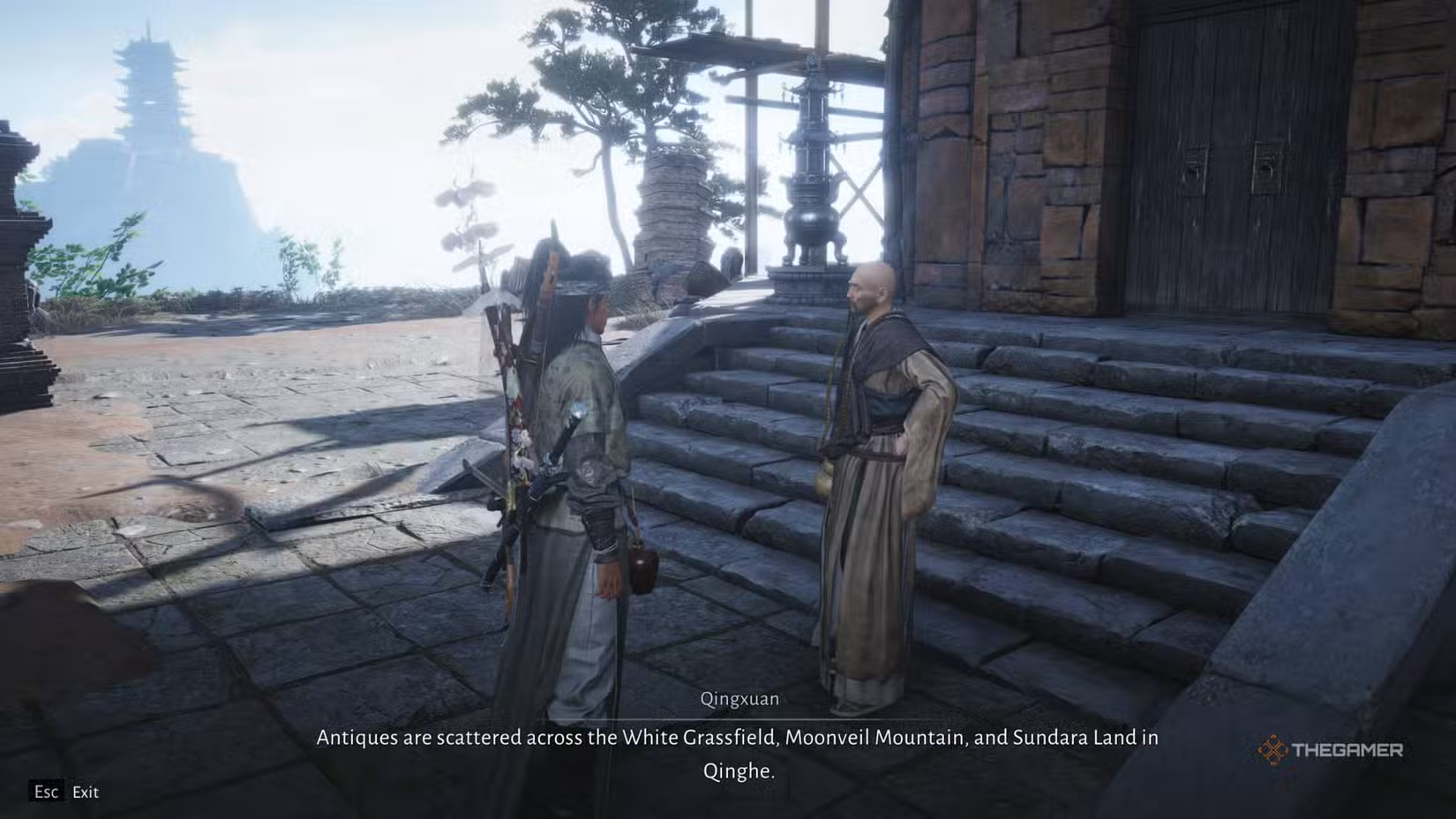
At Halo Peak, you’ll meet Qingxuan, who discusses Antiques, their histories, and special hidden features called Concealed Edges. Unlocking these can give items extra powers, but you’ll first need the Qinghe Memories. Qingxuan asks for Karma to activate the Incense Burner, but what he really needs is the Qinghe Memories, a reward for reaching Qinghe Exploration level six, which requires exploring a lot of the Qinghe region. Gaining experience from various activities, especially finding Antiques and their traces, helps increase your exploration level. Once you obtain the Qinghe Memories, give them to Qingxuan, and he’ll unlock the Incense Burner for you.
The Incense Burner at Halo Peak is a handy, free tool. It provides clues about each Antique in Qinghe, telling you approximately where to find them and what they are. For instance, one clue might mention a Tang Palace Hairpin buried in a lone grave deep in the Gleaming Abyss. While it won’t give you the exact location of the traces, it helps you remember which Antiques you’ve already discovered and makes hunting more manageable.
The ultimate goal with these Antiques is to turn some into powerful accessories, known as Concealed Edges. Currently, only certain weapons like swords and spears can be turned into accessories, and the options are limited. Unlocking a Concealed Edge isn’t straightforward; it involves finding all Antiques in a region—such as the Verdant Wilds, Moonveil Mountain, or Sundara Land in Qinghe. Doing so, then returning to Qingxuan, grants you a Concealed Edge for each fully explored area. Once activated, interacting with the Concealed Edge will highlight the weapons it can be used on, transforming them into permanent accessories.
 ChatGPT
 Perplexity
 Gemini AI
 Grok AI