Select Language:
During the initial hours of a new campaign in Terra Invicta, your focus will be on Earth, expanding your influence globally while researching technologies that enable space exploration.
Once you reach space, launching probes is straightforward. However, moving between planets and managing materials more efficiently requires ships. Building ships is notably more complicated than other game systems.
Do You Have to Design Ships?
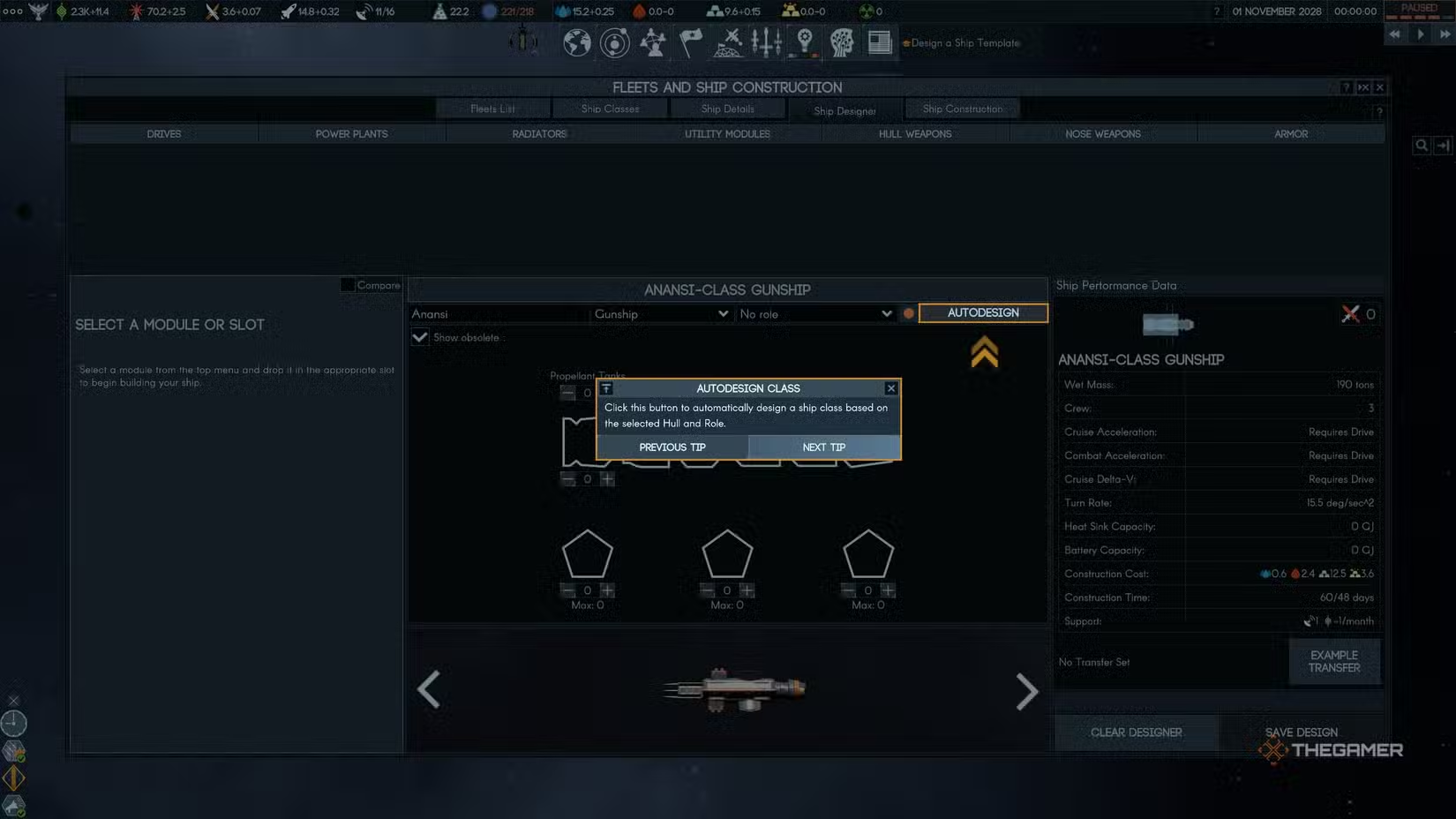
Here’s the exciting part. If you enjoy the detailed aspects of strategy games, you’ll love designing ships. There are no pre-made ships or preset functions. You must design every ship yourself. The game offers an auto-design option based on the hull and role you select, which works fine, but it’s best to build your own ship to understand the mechanics and optimize its performance.
You can save your design as a template to produce identical ships or make slight modifications. Creating entirely new ship types means starting from scratch. Building ships is crucial as you progress into space and is one of the most detailed parts of the game — you may spend hours tweaking ship stats.
How to Build and Design Ships
To build ships, you’ll need two main components: a location to construct them and the modules to assemble. Construction is done at a Space Dock module, which can be built on any space station or habitable station. Once built, you can start designing a ship there, but your options are limited by the modules you’ve researched.
Researching necessary modules early is smart, as many modules are required for ship construction. The process can be resource-intensive, so establishing mines on Mars and in the asteroid belt will help gather the needed materials.
After designing a ship, you do a Test Transfer to see how far it can travel within the solar system and how long it takes to reach different destinations. Once satisfied, you can save the design and begin construction.
Choosing a Hull and Role
Ship design begins with selecting a hull. You start with a decent variety, but more options unlock through research. The hull type determines how many modules can be fitted and the shape of those modules. For example, some hulls may not support certain weapons but will accommodate essential components like drives and power plants.
Next, you choose a role for the ship. While the role doesn’t strictly define the ship’s capabilities in control mode, it influences how the ship behaves and is necessary for building it. You can also set ships to operate automatically, letting AI handle their tasks.
Every Ship Module and What It Does
Designing a ship involves eight main categories, plus additional parts:
-
Drives: These propel your ship, affecting its thrust, acceleration, and Delta-V (travel range). Choose drives that are lightweight and efficient. Adjust thrusters and propellant to optimize speed and fuel use.
-
Power Plants: Power sources must be compatible with your drives, providing energy for all ship systems. Consider your ship’s purpose when selecting.
-
Radiators: These dissipate heat generated by onboard systems. It’s vital to size radiators to avoid overheating, which can cause fires. During combat, retracting radiators and installing heat sinks can help manage heat.
-
Utility Modules: These define your ship’s role — from construction modules for building on other planets to mobile labs or defense crews. The options depend on the hull type, so select accordingly.
-
Hull Weapons: Fixed on the ship’s hull, these weapons usually have broader firing arcs but are less powerful than nose guns.
-
Nose Weapons: Positioned at the ship’s front, nose weapons are stronger but require precise aiming due to their narrow firing cone.
-
Armor: Armor can be added to the tail, hull, and nose, each adding mass and protection. More armor means better durability but heavier ships.
Understanding Ship Performance Data
As you assemble your ship, its performance metrics update in real-time. Key stats include:
-
Wet Mass: Total weight. Heavier ships have lower acceleration and turn rates.
-
Crew: Number of crew members required to man the ship.
-
Cruise Acceleration: How quickly the ship can change speed in space.
-
Combat Acceleration: How agile the ship is during fights, important for evasion and chasing.
-
Cruise Delta-V: The maximum delta-V determines which destinations the ship can reach. For example, at least 8,000 meters per second (m/s) for Earth-Moon travel, and 20,000 m/s for interplanetary trips without relying on launch windows.
-
Turn Rate: How fast the ship can rotate; smaller ships turn faster.
-
Heat Sink Capacity: How much heat it can store temporarily during combat, preventing overheating.
-
Battery Capacity: Stores power for the ship when not drawing directly from the power plant.
-
Construction Cost/Time: Resources and time needed to build the ship; larger ships or advanced modules increase costs and duration.
-
Support: Monthly upkeep cost.
It’s important to remember: no single ship will excel at everything. As long as it performs its intended role well, you can improve and refine your designs over time.
 ChatGPT
 Perplexity
 Gemini AI
 Grok AI