
Select Language:
A Chinese startup focused on developing general-purpose embodied intelligence models has secured nearly CNY 1 billion (approximately USD 140 million) in a Series A+ funding round and has launched its proprietary open-source foundational model for embodied AI.
The recent fundraising was led by the cloud division of a major tech company based in China. Alongside this, institutional investors such as Guoke Investment and the China Development Bank Financial, along with industry players including a popular meal delivery service and a leading PC manufacturer, participated in the round.
Earlier this year, the company raised hundreds of millions of yuan in a Series A round led by the meal delivery giant. This latest investment marks the first time leading internet companies have jointly invested in a humanoid robotics firm, as well as the first investment by a major cloud provider in this particular sector.
The company’s founder and CEO revealed that they have accelerated their model iteration cycle, now releasing a new version every two to three months. Beyond funding, industry stakeholders have contributed real-world scenarios for testing, although the company’s products remain in the proof-of-concept stage.
Their open-source foundation model, called Wall-OSS, includes full model parameters, training and inference code, optimization methods, and supporting toolchains. The CEO expressed hope that this open-source model will serve as an accessible “brain” for developers, encouraging rapid ecosystem growth. He emphasized that widespread adoption of such models is crucial for industry maturity and the realization of versatile embodied intelligence.
Since establishing its R&D team, the company has utilized extensive real-world data for training its models and built a large-scale data collection facility to enhance data quality and volume. Proprietary, high-quality data has been instrumental in refining and updating their embodied intelligence technology.
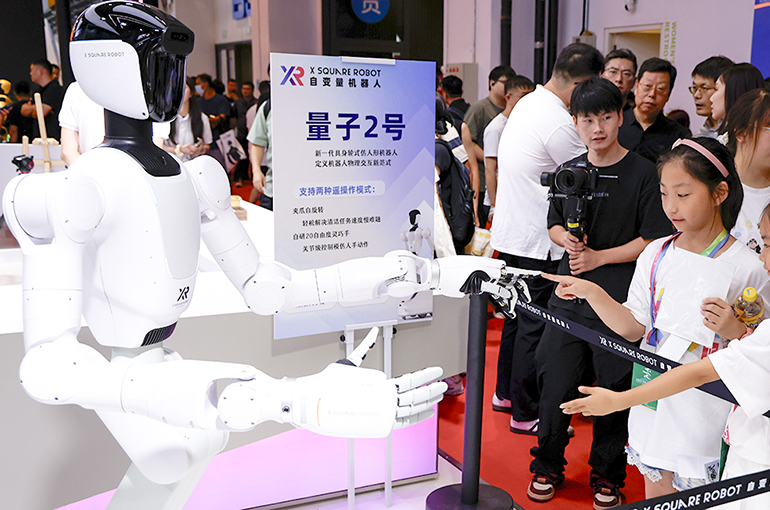
Regarding their hardware initiatives, the CEO stated that the company aims to design hardware from the perspective of model training, fostering a tighter integration between software and physical components. Currently, they have rolled out the Quanta X2 humanoid robot and a custom-developed dexterous robotic hand with 20 degrees of freedom, targeting small-scale production before the year’s end.
The cloud division’s participation was motivated by confidence in the company’s rapid development pace, technical strategy, and the potential to convert iterative innovations into industry-wide influence. Industry precedents indicate collaborations between robot manufacturers and cloud service providers—example companies include Amazon Web Services and Microsoft Azure.
 ChatGPT
 Perplexity
 Gemini AI
 Grok AI