
Select Language:
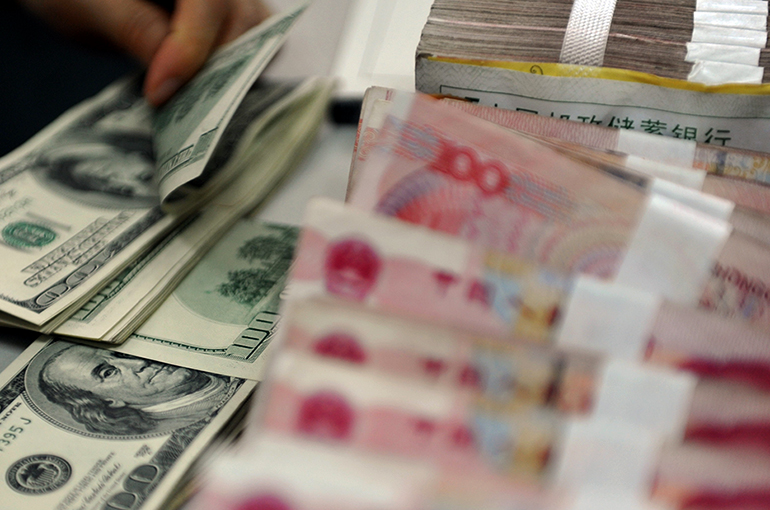
The Chinese yuan has continued its strong performance against the US dollar since the beginning of the year, breaking the 7 mark twice after more than two and a half years. Yesterday, the central parity rate for the yuan was set at 6.9755, an increase of 103 basis points from the previous trading day, according to the China Foreign Exchange Trading System under the authority of the nation’s central bank. Meanwhile, the onshore yuan closed trading at 6.9453 against the dollar, up 123 basis points from the day before.
On January 23, the central parity rate was raised by 90 basis points to 6.9929, marking the largest single-day appreciation since August 25 and the first time it surpassed 7 in 32 months. The yuan’s recent appreciation has not been driven by a single factor but rather by the combined effects of global market conditions and domestic supply and demand factors.
Externally, a trend of a weakening US dollar has provided significant support for the yuan’s gains. Since late November, the US Dollar Index has dropped from 100.22 to 97.51, a decline of nearly 2.7 percent, with many non-US currencies appreciating during this period, according to a research report by China Galaxy Securities.
Domestically, a surge in seasonal foreign exchange settlement demand has played a crucial role in strengthening the yuan. Following the yuan’s ongoing appreciation against the dollar, the previously accumulated demand for foreign exchange settlement—driven by high export growth—may accelerate further, stated Wang Qing, chief macroeconomic analyst at Golden Credit Rating International. The positive market sentiment is also contributing to the yuan’s upward momentum, with some experts noting it has helped the currency breach the 7 mark.
Since April last year, banks have experienced a turnaround, with the surplus of foreign exchange settlement and sales becoming positive, observed Wang Jian, chief banking analyst at Guosen Securities. Since May, monthly surpluses have exceeded tens of billions of US dollars, even reaching hundreds of billions, indicating that residents are increasingly converting their foreign exchange holdings into yuan, Wang added.
Looking ahead, Zou Lan, deputy governor of the People’s Bank of China, indicated that the yuan’s exchange rate is expected to continue fluctuating within a two-way range with maintained flexibility. The PBOC aims to allow the market to play a decisive role in setting rates, while managing expectations, preventing excessive swings, and keeping the yuan’s value stable at a reasonable level.
Analysts at Galaxy Securities forecast that the yuan’s recent appreciation will be gradual rather than rapid. Technically, key levels may be around 6.85, and the currency is expected to oscillate between gains and declines throughout the year rather than steadily appreciating in one direction.
The strengthening yuan is viewed positively for Chinese equities, as a steady appreciation can ease international investor concerns, lower stock risk premiums, and attract foreign capital into the stock market, according to Galaxy Securities.
The currency is expected to stay relatively strong after crossing the 7 threshold, supported by continued robust export growth in the first quarter, ongoing domestic demand for foreign exchange settlement before the Lunar New Year, positive market sentiment, and a lack of a significant rebound in the US Dollar Index in the near term, Wang Qing explained.
However, it is unlikely that the yuan’s recent strength will persist for the entire year, with some experts predicting potential depreciation against the dollar toward the end of 2026.
 ChatGPT
 Perplexity
 Gemini AI
 Grok AI