Select Language:
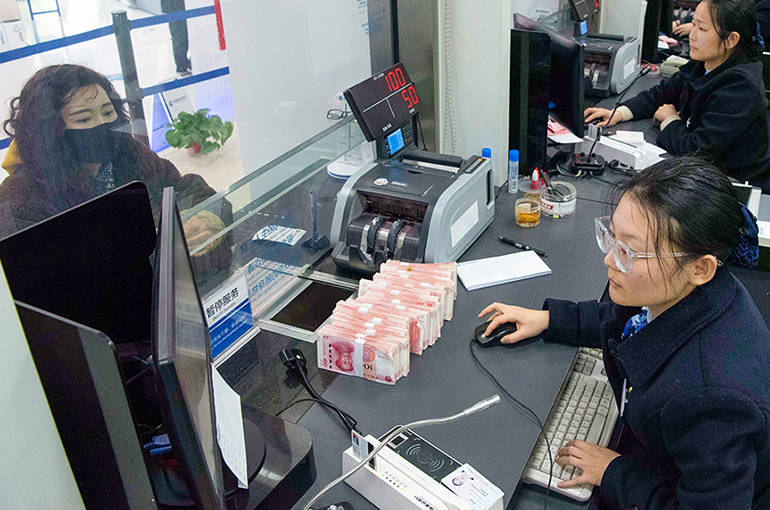
As the Spring Festival approaches, Chinese banks are intensifying their efforts to attract depositors. Small and medium-sized banks are increasing interest rates on specific deposit products, while larger banks are focusing on offering incentives rather than raising rates directly, according to recent findings.
This rivalry stems from concerns that a substantial number of high-interest fixed deposits maturing in 2026 might shift elsewhere. However, most industry experts believe these funds will largely stay within the banking system or move into low-risk assets such as wealth management products, money market funds, or insurance, rather than the stock market.
Over ten small and medium-sized banks have adjusted their deposit interest rates upward in stages this year. These increases mostly apply to products with higher minimum deposit requirements and maturities between one and three years. Many of these banks are rural commercial or village banks, some offering rates close to 2 percent.
Hunan Xinhuang Rural Commercial Bank, for example, increased the interest rate for three-year fixed deposits of CNY30,000 (approximately USD4,330) and above to 1.75 percent. Additionally, the bank raised the rates on one-year and three-year certificates of deposit to 1.4 percent and 1.8 percent, respectively.
Larger banks are focusing on incentives
Unlike smaller institutions, large banks are not generally raising deposit rates directly. Instead, they are enhancing promotional efforts by offering rewards such as points and cashback incentives to attract and retain customers.
A client manager at a major state-owned bank in Shenzhen explained that customers can earn cashback rewards via WeChat once their average daily financial assets for the month reach certain levels. For example, a deposit increase of CNY50,000 to CNY100,000 (about USD7,223 to USD14,433) unlocks a CNY40 (roughly USD6) reward, which can increase up to CNY5,000 for deposits exceeding CNY6 million (approximately USD865,976).
Similarly, a client manager at another state-owned bank branch in Jiangxi said that customers who open fixed deposits of one year or longer can earn points that are redeemable for gifts. There is also a cashback option where a specific amount can be deducted directly from the deposit payment. For instance, depositing more than CNY100,000 with a CNY40 cashback effectively reduces the net payment to CNY99,960.
Despite recent gains in the stock market, most industry insiders and financial institutions believe that the high-interest fixed deposits set to mature will mostly remain within the banking system or flow into low-risk, deposit-like assets such as wealth management products and money market funds.
According to Zhong Linnan, a macroeconomic analyst at GF Securities, residents’ income expectations remain modest. Preservation and growth of savings continue to be the top priorities for most depositors. As a result, even with relatively low interest rates, a stable number of residents are expected to rollover fixed deposits, invest in insurance, or repay loans early when deposits mature.
Likewise, Song Xuetao, chief economist at Sinolink Securities, noted that the main destinations for deposit migration are low-risk assets, primarily wealth management products and money market funds, due to their liquidity. While insurance products are also receiving steady investment inflows, they offer less flexibility and have been less closely linked to deposit trends historically. Data indicates that medium- and low-risk wealth management products continue to dominate and are steadily increasing their market share.
 ChatGPT
 Perplexity
 Gemini AI
 Grok AI