Select Language:
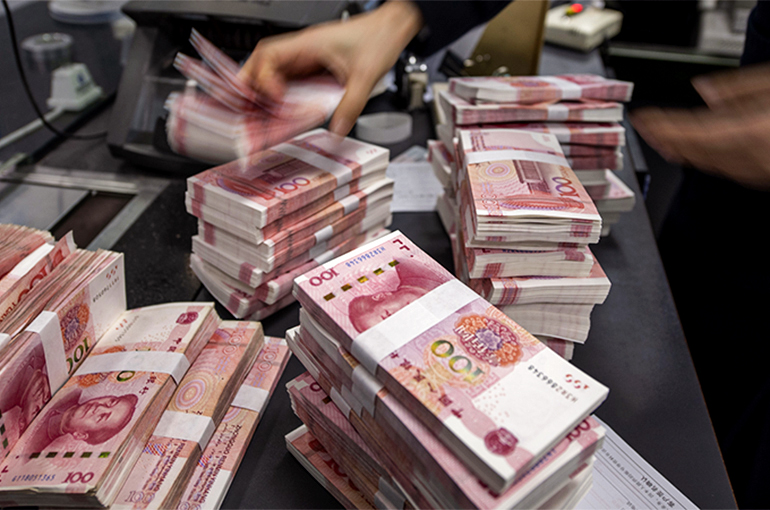
The central bank injected 700 billion yuan (approximately $100.5 billion) of net liquidity into the market today through its medium-term lending facility, a significantly larger amount than last month, to ensure sufficient liquidity during the upcoming Chinese New Year holiday period next month.
A total of 900 billion yuan in one-year MLF operations are scheduled today, according to the central bank. With 200 billion yuan in MLF loans maturing this month, the net infusion amounts to 700 billion yuan. This marks the 11th consecutive month of increasing MLF rollovers, and the current figure exceeds December’s by a notable margin of 100 billion yuan.
Earlier, on January 15, the central bank completed a six-month outright reverse repo operation totaling 900 billion yuan (about $129.2 billion) to offset 600 billion yuan in maturing loans, resulting in a net addition of 300 billion yuan. Combining today’s MLF action with previous interventions, the medium-term liquidity injections this month have reached a total of 1 trillion yuan (roughly $143.6 billion).
By substantially boosting medium-term liquidity, the central bank aims to prevent potential cash shortages before the holiday, maintaining ample funds within the banking system, according to Wang Qing, chief macroeconomic analyst at a prominent rating agency. This strategy supports key projects and sustains the momentum of the nation’s economic recovery.
During the Lunar New Year holiday, lasting from February 15 to February 23 this year, demand for cash typically rises sharply, Wang explained. Moreover, early allocation of new debt quotas to local governments this year indicates that there will be significant government bond issuance, further increasing the need for funds.
Given the sizable liquidity injections via reverse repos and MLF loans, the probability of the central bank reducing the reserve requirement ratio in the near future remains low, said Ming Ming, chief economist at a major securities firm. However, with a flexible and adaptive policy approach, there remains room for potential interest rate cuts and RRR reductions over the longer term.
 ChatGPT
 Perplexity
 Gemini AI
 Grok AI